Nested Named Entity Recognition for Chinese Biomedical Text

Overview

CBio-NAMER

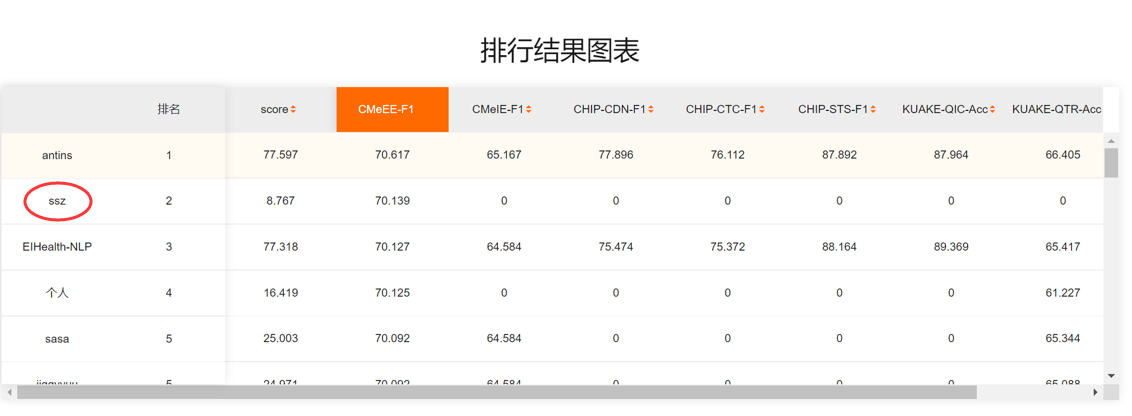
CBioNAMER (Nested nAMed Entity Recognition for Chinese Biomedical Text) is our method used in CBLUE (Chinese Biomedical Language Understanding Evaluation), a benchmark of Nested Named Entity Recognition. We got the 2nd price of the benchmark by 2021/12/07. Single model CBioNAMER also achieves top20 in CBLUE. The score of CBioNAMER has surpassed human(67.0 in F1-score​).

Result

Results of our method:

ensemble

Results of our single model CBioNAMER:
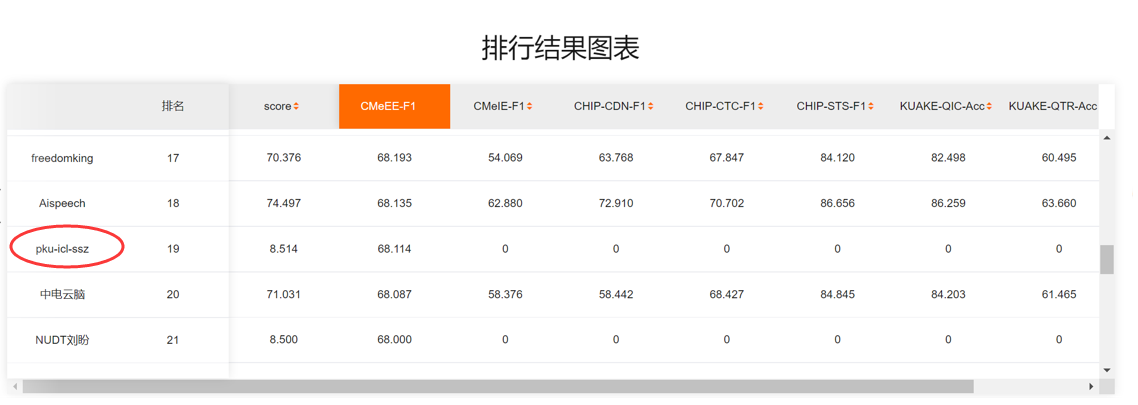
single

Approach

CBioNAMER is a sub-model in our result, which is based on GlobalPointer (a powerful open-source model, thanks for author, we rewrite it with Pytorch) and MacBert.

Usage

First, install PyTorch>=1.7.0. There's no restriction on GPU or CUDA.

Then, install this repo as a Python package:

$ pip install CBioNAMER

Python package transformers==4.6.1 would be automatically installed as well.

API

The CBioNAMER package provides the following methods:

CBioNAMER.load_NER(model_save_path='./checkpoint/macbert-large_dict.pth', maxlen=512, c_size=9, id2c=_id2c, c2c=_c2c)

Returns the pretrained model. It will download the model as necessary. The model would use the first CUDA device if there's any, otherwise using CPU instead.

The model_save_path argument specifies the path of the pretrained model weight.

The maxlen argument specifies the max length of input sentences. The sentences longer than maxlen would be cut off.

The c_size argument specifies the number of entity class. Here is 9 for CBLUE.

The id2c argument specifies the mapping between id and entity class. By default, the id2c argument for CBLUE is:

_id2c = {0: 'dis', 1: 'sym', 2: 'pro', 3: 'equ', 4: 'dru', 5: 'ite', 6: 'bod', 7: 'dep', 8: 'mic'}

The c2c argument specifies the mapping between entity class and its Chinese meaning. By default, the c2c argument for CBLUE is:

_c2c = {'dis': "疾病", 'sym': "临床表现", 'pro': "医疗程序", 'equ': "医疗设备", 'dru': "药物", 'ite': "医学检验项目", 'bod': "身体", 'dep': "科室", 'mic': "微生物类"}


The model returned by CBioNAMER.load_NER() supports the following methods:

model.recognize(text: str, threshold=0)

Given a sentence, returns a list of dictionaries with recognized entity, the format of the dictionary is {'start_idx': entity's starting index, 'end_idx': entity's ending index, 'type': entity class, 'Chinese_type': Chinese meaning of entity class, 'entity': recognized entity}. The threshold argument specifies that the returned list only contains the recognized entity with confidence score higher than threshold.

model.predict_to_file(in_file: str, out_file: str)

Given input and output .json file path, the model would do inference according in_file, and the recognized entity would be saved in out_file. The output file can be submitted to CBLUE. The format of input file is like:

[
  {
    "text": "该技术的应用使某些遗传病的诊治水平得到显著提高。"
  },
    ...
  {
    "text": "There is a sentence."
  }
]

Examples

import CBioNAMER

NER = CBioNAMER.load_NER()
in_file = './CMeEE_test.json'
out_file = './CMeEE_test_answer.json'
NER.predict_to_file(in_file, out_file)
import CBioNAMER

NER = CBioNAMER.load_NER()
text = "该技术的应用使某些遗传病的诊治水平得到显著提高。"
recognized_entity = NER.recognize(text)
print(recognized_entity)
# output:[{'start_idx': 9, 'end_idx': 11, 'type': 'dis', 'Chinese_type': '疾病', 'entity': '遗传病'}]
You might also like...
Bidirectional LSTM-CRF and ELMo for Named-Entity Recognition, Part-of-Speech Tagging and so on.

anaGo anaGo is a Python library for sequence labeling(NER, PoS Tagging,...), implemented in Keras. anaGo can solve sequence labeling tasks such as nam

Named-entity recognition using neural networks. Easy-to-use and state-of-the-art results.

NeuroNER NeuroNER is a program that performs named-entity recognition (NER). Website: neuroner.com. This page gives step-by-step instructions to insta

Pytorch-Named-Entity-Recognition-with-BERT

BERT NER Use google BERT to do CoNLL-2003 NER ! Train model using Python and Inference using C++ ALBERT-TF2.0 BERT-NER-TENSORFLOW-2.0 BERT-SQuAD Requi

Tool to add main subject to items on Wikidata using a WMFs CirrusSearch for named entity recognition or a manually supplied list of QIDs

ItemSubjector Tool made to add main subject statements to items based on the title using a home-brewed CirrusSearch-based Named Entity Recognition alg

Implemented shortest-circuit disambiguation, maximum probability disambiguation, HMM-based lexical annotation and BiLSTM+CRF-based named entity recognition

Implemented shortest-circuit disambiguation, maximum probability disambiguation, HMM-based lexical annotation and BiLSTM+CRF-based named entity recognition

Use Google's BERT for named entity recognition (CoNLL-2003 as the dataset).

For better performance, you can try NLPGNN, see NLPGNN for more details. BERT-NER Version 2 Use Google's BERT for named entity recognition (CoNLL-2003

Named Entity Recognition API used by TEI Publisher

TEI Publisher Named Entity Recognition API This repository contains the API used by TEI Publisher's web-annotation editor to detect entities in the in

RoNER is a Named Entity Recognition model based on a pre-trained BERT transformer model trained on RONECv2

RoNER RoNER is a Named Entity Recognition model based on a pre-trained BERT transformer model trained on RONECv2. It is meant to be an easy to use, hi

Spacy-ginza-ner-webapi - Named Entity Recognition API with spaCy and GiNZA

Named Entity Recognition API with spaCy and GiNZA I wrote a blog post about this

Releases(v0.0.1)
This repository contains the code for running the character-level Sandwich Transformers from our ACL 2020 paper on Improving Transformer Models by Reordering their Sublayers.

Improving Transformer Models by Reordering their Sublayers This repository contains the code for running the character-level Sandwich Transformers fro

Ofir Press 53 Sep 26, 2022
GAP-text2SQL: Learning Contextual Representations for Semantic Parsing with Generation-Augmented Pre-Training

GAP-text2SQL: Learning Contextual Representations for Semantic Parsing with Generation-Augmented Pre-Training Code and model from our AAAI 2021 paper

Amazon Web Services - Labs 83 Jan 09, 2023
Nmt - TensorFlow Neural Machine Translation Tutorial

Neural Machine Translation (seq2seq) Tutorial Authors: Thang Luong, Eugene Brevdo, Rui Zhao (Google Research Blogpost, Github) This version of the tut

6.1k Dec 29, 2022
Performance-Efficiency Trade-offs in Unsupervised Pre-training for Speech Recognition

SEW (Squeezed and Efficient Wav2vec) The repo contains the code of the paper "Performance-Efficiency Trade-offs in Unsupervised Pre-training for Speec

ASAPP Research 67 Dec 01, 2022
Augmenty is an augmentation library based on spaCy for augmenting texts.

Augmenty: The cherry on top of your NLP pipeline Augmenty is an augmentation library based on spaCy for augmenting texts. Besides a wide array of high

Kenneth Enevoldsen 124 Dec 29, 2022
A calibre plugin that generates Word Wise and X-Ray files then sends them to Kindle. Supports KFX, AZW3 and MOBI eBooks. X-Ray supports 18 languages.

WordDumb A calibre plugin that generates Word Wise and X-Ray files then sends them to Kindle. Supports KFX, AZW3 and MOBI eBooks. Languages X-Ray supp

172 Dec 29, 2022
BERN2: an advanced neural biomedical namedentity recognition and normalization tool

BERN2 We present BERN2 (Advanced Biomedical Entity Recognition and Normalization), a tool that improves the previous neural network-based NER tool by

DMIS Laboratory - Korea University 99 Jan 06, 2023
BPEmb is a collection of pre-trained subword embeddings in 275 languages, based on Byte-Pair Encoding (BPE) and trained on Wikipedia.

BPEmb is a collection of pre-trained subword embeddings in 275 languages, based on Byte-Pair Encoding (BPE) and trained on Wikipedia. Its intended use is as input for neural models in natural languag

Benjamin Heinzerling 1.1k Jan 03, 2023
Pre-training with Extracted Gap-sentences for Abstractive SUmmarization Sequence-to-sequence models

PEGASUS library Pre-training with Extracted Gap-sentences for Abstractive SUmmarization Sequence-to-sequence models, or PEGASUS, uses self-supervised

Google Research 1.4k Dec 22, 2022
Korean Simple Contrastive Learning of Sentence Embeddings using SKT KoBERT and kakaobrain KorNLU dataset

KoSimCSE Korean Simple Contrastive Learning of Sentence Embeddings implementation using pytorch SimCSE Installation git clone https://github.com/BM-K/

34 Nov 24, 2022
A BERT-based reverse-dictionary of Korean proverbs

Wisdomify A BERT-based reverse-dictionary of Korean proverbs. 김유빈 : 모델링 / 데이터 수집 / 프로젝트 설계 / back-end 김종윤 : 데이터 수집 / 프로젝트 설계 / front-end Quick Start C

Eu-Bin KIM 94 Dec 08, 2022
Transformer Based Korean Sentence Spacing Corrector

TKOrrector Transformer Based Korean Sentence Spacing Corrector License Summary This solution is made available under Apache 2 license. See the LICENSE

Paul Hyung Yuel Kim 3 Apr 18, 2022
PyTorch implementation of the NIPS-17 paper "Poincaré Embeddings for Learning Hierarchical Representations"

Poincaré Embeddings for Learning Hierarchical Representations PyTorch implementation of Poincaré Embeddings for Learning Hierarchical Representations

Facebook Research 1.6k Dec 29, 2022
Translation to python of Chris Sims' optimization function

pycsminwel This is a locol minimization algorithm. Uses a quasi-Newton method with BFGS update of the estimated inverse hessian. It is robust against

Gustavo Amarante 1 Mar 21, 2022
Ongoing research training transformer language models at scale, including: BERT & GPT-2

Megatron (1 and 2) is a large, powerful transformer developed by the Applied Deep Learning Research team at NVIDIA.

NVIDIA Corporation 3.5k Dec 30, 2022
PyTorch Implementation of VAENAR-TTS: Variational Auto-Encoder based Non-AutoRegressive Text-to-Speech Synthesis.

VAENAR-TTS - PyTorch Implementation PyTorch Implementation of VAENAR-TTS: Variational Auto-Encoder based Non-AutoRegressive Text-to-Speech Synthesis.

Keon Lee 67 Nov 14, 2022
Tracking Progress in Natural Language Processing

Repository to track the progress in Natural Language Processing (NLP), including the datasets and the current state-of-the-art for the most common NLP tasks.

Sebastian Ruder 21.2k Dec 30, 2022
Th2En & Th2Zh: The large-scale datasets for Thai text cross-lingual summarization

Th2En & Th2Zh: The large-scale datasets for Thai text cross-lingual summarization 📥 Download Datasets 📥 Download Trained Models INTRODUCTION TH2ZH (

Nakhun Chumpolsathien 5 Jan 03, 2022
A spaCy wrapper of OpenTapioca for named entity linking on Wikidata

spaCyOpenTapioca A spaCy wrapper of OpenTapioca for named entity linking on Wikidata. Table of contents Installation How to use Local OpenTapioca Vizu

Universitätsbibliothek Mannheim 80 Jan 03, 2023
Facebook AI Research Sequence-to-Sequence Toolkit written in Python.

Fairseq(-py) is a sequence modeling toolkit that allows researchers and developers to train custom models for translation, summarization, language mod

20.5k Jan 08, 2023