guess the correlation
data inspection
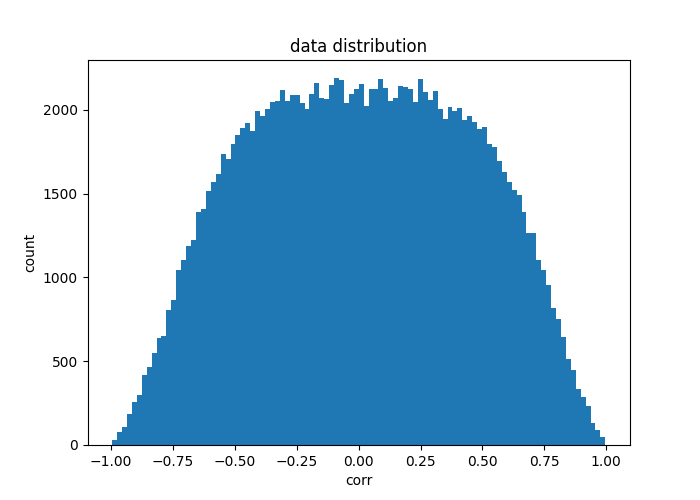
a pretty normal distribution
train/val/test split
splitting amount
.dataset:                150000 instances
├─80%─├─80%─training      96000 instances
│     └─20%─validation    24000 instances
├─20%─testing             30000 instances
after a rough glance at the dataset distribution, considered the dataset is pretty normal distributed and has enough instances to keep the variance low after 80/20 splitting.
splitting method
def _split_dataset(self, split, training=True):
    if split == 0.0:
        return None, None

    # self.correlations_frame = pd.read_csv('path/to/csv_file')
    n_samples = len(self.correlations_frame)

    idx_full = np.arange(n_samples)

    # fix seed for referenceable testing set
    np.random.seed(0)
    np.random.shuffle(idx_full)

    if isinstance(split, int):
        assert split > 0
        assert split < n_samples, "testing set size is configured to be larger than entire dataset."
        len_test = split
    else:
        len_test = int(n_samples * split)

    test_idx = idx_full[0:len_test]
    train_idx = np.delete(idx_full, np.arange(0, len_test))

    if training:
        dataset = self.correlations_frame.ix[train_idx]
    else:
        dataset = self.correlations_frame.ix[test_idx]

    return dataset
training/validation splitting uses the same logic
model inspection
CorrelationModel(
  (features): Sequential(
    (0): Conv2d(1, 16, kernel_size=(3, 3), stride=(2, 2), padding=(2, 2))
    #(0): params: (3*3*1+1) * 16 = 160
    (1): BatchNorm2d(16, eps=1e-05, momentum=0.1, affine=True, track_running_stats=True)
    #(1): params: 16 * 2 = 32
    (2): ReLU(inplace=True)
    (3): MaxPool2d(kernel_size=3, stride=2, padding=0, dilation=1, ceil_mode=False)
    (4): Conv2d(16, 32, kernel_size=(3, 3), stride=(1, 1), padding=(2, 2))
    #(4): params: (3*3*16+1) * 32 = 4640
    (5): BatchNorm2d(32, eps=1e-05, momentum=0.1, affine=True, track_running_stats=True)
    #(5): params: 32 * 2 = 64
    (6): ReLU(inplace=True)
    (7): MaxPool2d(kernel_size=3, stride=2, padding=0, dilation=1, ceil_mode=False)
    (8): Conv2d(32, 64, kernel_size=(3, 3), stride=(1, 1), padding=(1, 1))
    #(8): params: (3*3*32+1) * 64 = 18496
    (9): BatchNorm2d(64, eps=1e-05, momentum=0.1, affine=True, track_running_stats=True)
    #(9): params: 64 * 2 = 128
    (10): ReLU(inplace=True)
    (11): MaxPool2d(kernel_size=3, stride=2, padding=0, dilation=1, ceil_mode=False)
    (12): Conv2d(64, 32, kernel_size=(3, 3), stride=(1, 1), padding=(1, 1))
    #(12): params: (3*3*64+1) * 32 = 18464
    (13): ReLU(inplace=True)
    (14): MaxPool2d(kernel_size=3, stride=2, padding=0, dilation=1, ceil_mode=False)
    (15): Conv2d(32, 16, kernel_size=(3, 3), stride=(1, 1), padding=(1, 1))
    (#15): params: (3*3*32+1) * 16 = 4624
    (16): ReLU(inplace=True)
    (17): MaxPool2d(kernel_size=3, stride=2, padding=1, dilation=1, ceil_mode=False)
    (18): Conv2d(16, 8, kernel_size=(3, 3), stride=(1, 1), padding=(1, 1))
    (#18): params: (3*3*16+1) * 8 = 1160
    (19): ReLU(inplace=True)
  )
  (avgpool): AdaptiveAvgPool2d(output_size=(1, 1))
  (linear): Sequential(
    (0): Conv2d(8, 1, kernel_size=(1, 1), stride=(1, 1))
    #(0): params: (8+1) * 1 = 9
    (1): Tanh()
  )
)
Trainable parameters: 47777
loss function
the loss function of choice is smooth_l1, which has the advantages of both l1 and l2 loss
def SmoothL1(yhat, y):                                                  <--- final choice
    return torch.nn.functional.smooth_l1_loss(yhat, y)

def MSELoss(yhat, y):
    return torch.nn.functional.mse_loss(yhat, y)

def RMSELoss(yhat, y):
    return torch.sqrt(MSELoss(yhat, y))

def MSLELoss(yhat, y):
    return MSELoss(torch.log(yhat + 1), torch.log(y + 1))

def RMSLELoss(yhat, y):
    return torch.sqrt(MSELoss(torch.log(yhat + 1), torch.log(y + 1)))
evaluation metric
def mse(output, target):
    # mean square error
    with torch.no_grad():
        assert output.shape[0] == len(target)
        mae = torch.sum(MSELoss(output, target)).item()
    return mae / len(target)

def mae(output, target):
    # mean absolute error
    with torch.no_grad():
        assert output.shape[0] == len(target)
        mae = torch.sum(abs(target-output)).item()
    return mae / len(target)

def mape(output, target):
    # mean absolute percentage error
    with torch.no_grad():
        assert output.shape[0] == len(target)
        mape = torch.sum(abs((target-output)/target)).item()
    return mape / len(target)

def rmse(output, target):
    # root mean square error
    with torch.no_grad():
        assert output.shape[0] == len(target)
        rmse = torch.sum(torch.sqrt(MSELoss(output, target))).item()
    return rmse / len(target)

def msle(output, target):
    # mean square log error
    with torch.no_grad():
        assert output.shape[0] == len(target)
        msle = torch.sum(MSELoss(torch.log(output + 1), torch.log(target + 1))).item()
    return msle / len(target)

def rmsle(output, target):
    # root mean square log error
    with torch.no_grad():
        assert output.shape[0] == len(target)
        rmsle = torch.sum(torch.sqrt(MSELoss(torch.log(output + 1), torch.log(target + 1)))).item()
    return rmsle / len(target)
training result
trainer - INFO -     epoch          : 1
trainer - INFO -     smooth_l1loss  : 0.0029358651146370296
trainer - INFO -     mse            : 9.174910654958997e-05
trainer - INFO -     mae            : 0.04508562459920844
trainer - INFO -     mape           : 0.6447089369893074
trainer - INFO -     rmse           : 0.0008826211761528006
trainer - INFO -     msle           : 0.0002885178522810747
trainer - INFO -     rmsle          : 0.0016459243478796756
trainer - INFO -     val_loss       : 0.000569225614812846
trainer - INFO -     val_mse        : 1.7788300462901436e-05
trainer - INFO -     val_mae        : 0.026543946107228596
trainer - INFO -     val_mape       : 0.48582320946455004
trainer - INFO -     val_rmse       : 0.0005245986936303476
trainer - INFO -     val_msle       : 9.091730712680146e-05
trainer - INFO -     val_rmsle      : 0.0009993902465794235
                    .
                    .
                    .
                    .
                    .
                    .
trainer - INFO -     epoch          : 7                           <--- final model
trainer - INFO -     smooth_l1loss  : 0.00017805844737449661
trainer - INFO -     mse            : 5.564326480453019e-06
trainer - INFO -     mae            : 0.01469234253714482
trainer - INFO -     mape           : 0.2645472921580076
trainer - INFO -     rmse           : 0.0002925463738307978
trainer - INFO -     msle           : 3.3151906652316634e-05
trainer - INFO -     rmsle          : 0.0005688522928685416
trainer - INFO -     val_loss       : 0.00017794455110561102
trainer - INFO -     val_mse        : 5.560767222050344e-06
trainer - INFO -     val_mae        : 0.014510956528286139
trainer - INFO -     val_mape       : 0.25059283276398975
trainer - INFO -     val_rmse       : 0.0002930224982944007
trainer - INFO -     val_msle       : 3.403802761204133e-05
trainer - INFO -     val_rmsle      : 0.0005525556141122554
trainer - INFO - Saving checkpoint: saved/models/correlation/1031_043742/checkpoint-epoch7.pth ...
trainer - INFO - Saving current best: model_best.pth ...
                    .
                    .
                    .
                    .
                    .
                    .
trainer - INFO -     epoch          : 10                           <--- early stop
trainer - INFO -     smooth_l1loss  : 0.00014610137016279624
trainer - INFO -     mse            : 4.565667817587382e-06
trainer - INFO -     mae            : 0.013266990386570494
trainer - INFO -     mape           : 0.24146838792661826
trainer - INFO -     rmse           : 0.00026499629460158757
trainer - INFO -     msle           : 2.77259079665176e-05
trainer - INFO -     rmsle          : 0.0005148174095957074
trainer - INFO -     val_loss       : 0.00018394086218904705
trainer - INFO -     val_mse        : 5.74815194340772e-06
trainer - INFO -     val_mae        : 0.01494487459709247
trainer - INFO -     val_mape       : 0.27262411576509477
trainer - INFO -     val_rmse       : 0.0002979971170425415
trainer - INFO -     val_msle       : 3.1850282267744966e-05
trainer - INFO -     val_rmsle      : 0.0005451643197642019
trainer - INFO - Validation performance didn't improve for 2 epochs. Training stops.
loss graph 
testing result
Loading checkpoint: saved/models/correlation/model_best.pth ...
Done
Testing set samples: 30000
100%|█████████████████████████████████████████████████████████████████████████████████████████████████████████████████████████████████████████████████████████████████████████████████████████████████████████████████████████| 59/59 [00:19<00:00,  3.04it/s]
Testing result:
{'loss': 0.0001722179292468354, 'mse': 6.77461177110672e-07, 'mae': 0.014289384969075522, 'mape': 0.2813985677083333, 'rmse': 3.6473782857259115e-05, 'msle': 3.554690380891164e-06, 'rmsle': 7.881066799163819e-05}

 64 Dec 17, 2022
 2 Jan 12, 2022
 5 Mar 26, 2022
 5.9k Dec 30, 2022
 8 Feb 27, 2022
 4 May 14, 2022
 44 Nov 15, 2022
 1.2k Dec 30, 2022
 10 Dec 29, 2022
 5 Nov 21, 2022
 74 Mar 07, 2022
 619 Dec 21, 2022
 4 Mar 30, 2022
 8 Dec 06, 2022
 0 Jul 11, 2022
 4 Dec 09, 2021
 36 Dec 27, 2022
 13 Dec 16, 2022
 1.8k Jan 02, 2023
 1 Jan 09, 2022