Physics-informed convolutional-recurrent neural networks for solving spatiotemporal PDEs

Overview

PhyCRNet

Physics-informed convolutional-recurrent neural networks for solving spatiotemporal PDEs

Paper link: [ArXiv]

By: Pu Ren, Chengping Rao, Yang Liu, Jian-Xun Wang and Hao Sun

Highlights

  • Present a Physics-informed discrete learning framework for solving spatiotemporal PDEs without any labeled data
  • Proposed an encoder-decoder convolutional-recurrent scheme for low-dimensional feature extraction
  • Employ hard-encoding of initial and boundary conditions
  • Incorporate autoregressive and residual connections to explicitly simulate the time marching

Training and Extrapolation

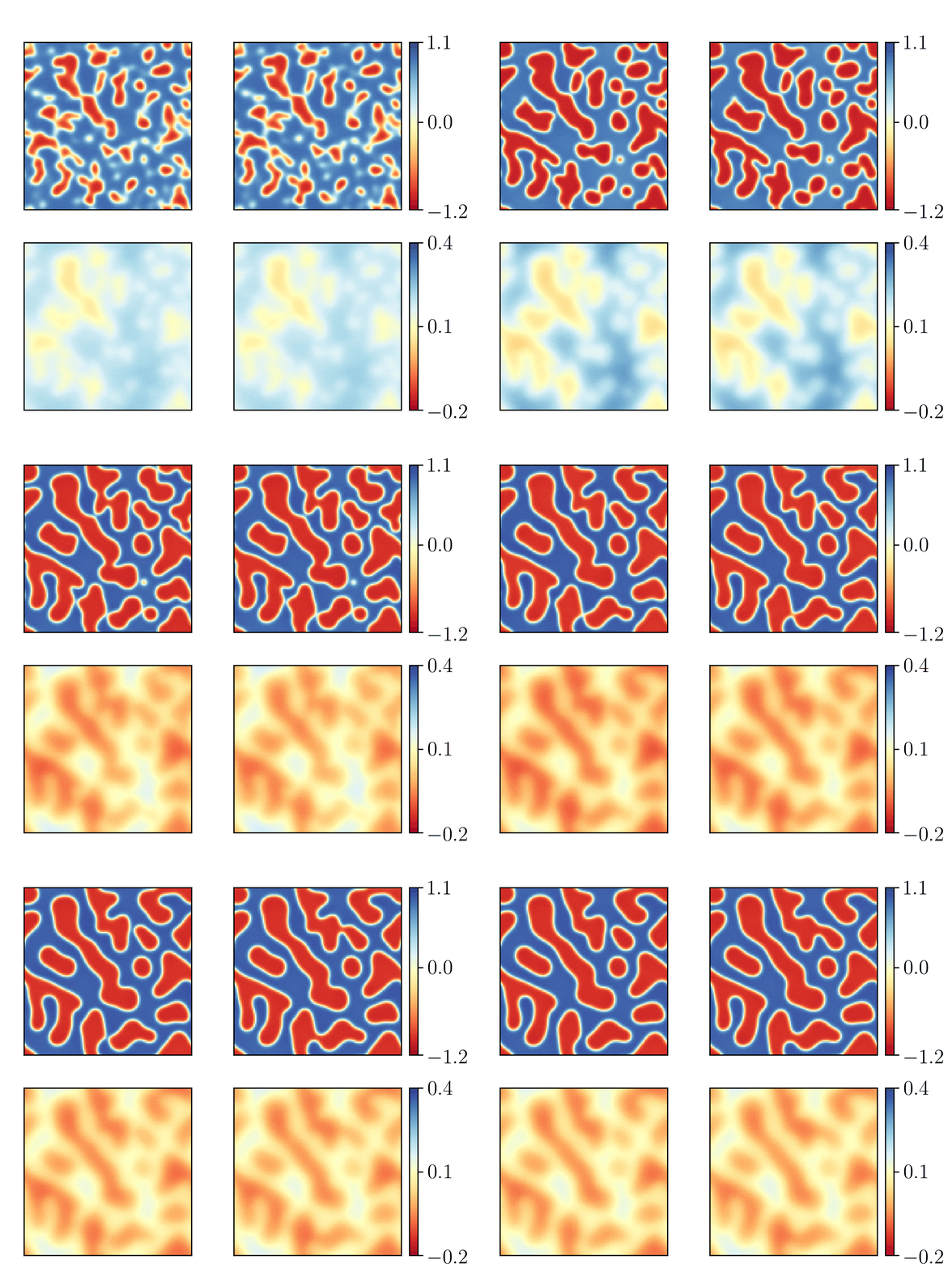
We show the comparison between PhyCRNet and PINN on 2D Burgers' equations below. The left, middle and right figures are the ground truth, the result from our PhyCRNet and the result from PINNs respectively.
Generalization

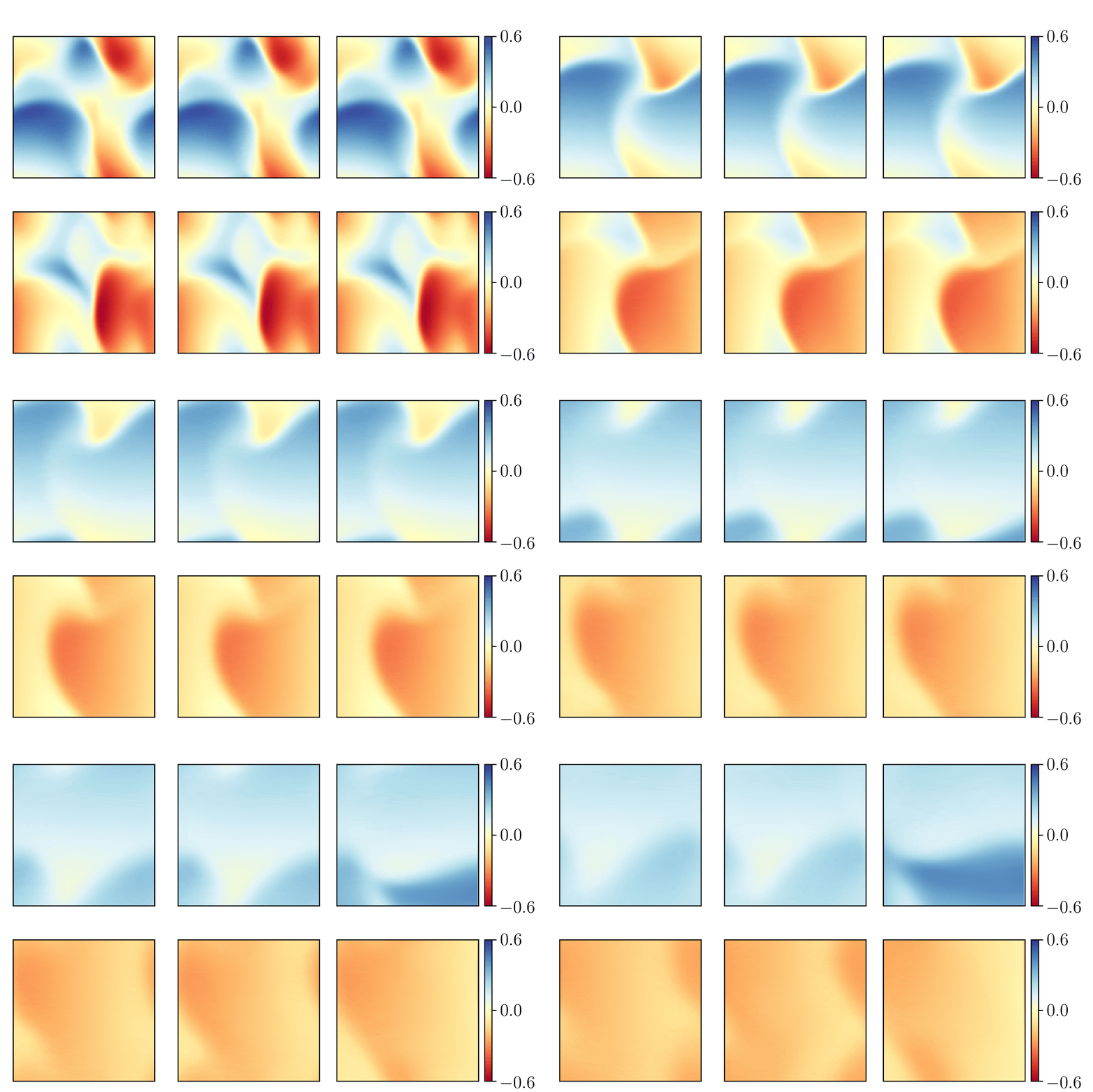
We show the generalization test on FitzHugh-Nagumo reaction-diffusion equations with four different initial conditions. The left and right parts are the ground truth generated with the high-order finite difference method and the results from our PhyCRNet, respectively.

Requirements

  • Python 3.6.13
  • Pytorch 1.6.0
  • Other packages such as Matplotlib, Numpy and Scipy are also used

Datasets

We provide the codes for data generation used in this paper, including 2D Burgers' equations and 2D FitzHugh-Nagumo reaction-diffusion equations. They are coded in the high-order finite difference method. Besides, the code for random field is modified from [Link]. You may find the data solver for λ-ω reaction-diffusion equations in [Link].

The initial conditions tested in this paper are also provided in the folder Datasets.

Codes

The general code of PhyCRNet is provided in the folder Codes, where we use 2D Burgers' equations as a testing example. For other PDE systems, the network setting is similar. You may try modifying the grid sizes and time steps to your own cases.

Citation

If you find our research helpful, please consider citing us with:

@article{ren2021phycrnet,
  title={PhyCRNet: Physics-informed Convolutional-Recurrent Network for Solving Spatiotemporal PDEs},
  author={Ren, Pu and Rao, Chengping and Liu, Yang and Wang, Jianxun and Sun, Hao},
  journal={arXiv preprint arXiv:2106.14103},
  year={2021}
}
Owner
Pu Ren
Pu Ren
pcnaDeep integrates cutting-edge detection techniques with tracking and cell cycle resolving models.

pcnaDeep: a deep-learning based single-cell cycle profiler with PCNA signal Welcome! pcnaDeep integrates cutting-edge detection techniques with tracki

ChanLab 8 Oct 18, 2022
A tutorial on training a DarkNet YOLOv4 model for the CrowdHuman dataset

YOLOv4 CrowdHuman Tutorial This is a tutorial demonstrating how to train a YOLOv4 people detector using Darknet and the CrowdHuman dataset. Table of c

JK Jung 118 Nov 10, 2022
How to Predict Stock Prices Easily Demo

How-to-Predict-Stock-Prices-Easily-Demo How to Predict Stock Prices Easily - Intro to Deep Learning #7 by Siraj Raval on Youtube ##Overview This is th

Siraj Raval 752 Nov 16, 2022
Meta-learning for NLP

Self-Supervised Meta-Learning for Few-Shot Natural Language Classification Tasks Code for training the meta-learning models and fine-tuning on downstr

IESL 43 Nov 08, 2022
Code of paper: "DropAttack: A Masked Weight Adversarial Training Method to Improve Generalization of Neural Networks"

DropAttack: A Masked Weight Adversarial Training Method to Improve Generalization of Neural Networks Abstract: Adversarial training has been proven to

倪仕文 (Shiwen Ni) 58 Nov 10, 2022
App customer segmentation cohort rfm clustering

CUSTOMER SEGMENTATION COHORT RFM CLUSTERING TỔNG QUAN VỀ HỆ THỐNG DỮ LIỆU Nên chuyển qua theme màu dark thì sẽ nhìn đẹp hơn https://customer-segmentat

hieulmsc 3 Dec 18, 2021
Dynamic Graph Event Detection

DyGED Dynamic Graph Event Detection Get Started pip install -r requirements.txt TODO Paper link to arxiv, and how to cite. Twitter Weather dataset tra

Mert Koşan 3 May 09, 2022
Model-based Reinforcement Learning Improves Autonomous Racing Performance

Racing Dreamer: Model-based versus Model-free Deep Reinforcement Learning for Autonomous Racing Cars In this work, we propose to learn a racing contro

Cyber Physical Systems - TU Wien 38 Dec 06, 2022
clustering moroccan stocks time series data using k-means with dtw (dynamic time warping)

Moroccan Stocks Clustering Context Hey! we don't always have to forecast time series am I right ? We use k-means to cluster about 70 moroccan stock pr

Ayman Lafaz 7 Oct 18, 2022
Steerable discovery of neural audio effects

Steerable discovery of neural audio effects Christian J. Steinmetz and Joshua D. Reiss Abstract Applications of deep learning for audio effects often

Christian J. Steinmetz 182 Dec 29, 2022
Generate vibrant and detailed images using only text.

CLIP Guided Diffusion From RiversHaveWings. Generate vibrant and detailed images using only text. See captions and more generations in the Gallery See

Clay M. 401 Dec 28, 2022
The missing CMake project initializer

cmake-init - The missing CMake project initializer Opinionated CMake project initializer to generate CMake projects that are FetchContent ready, separ

1k Jan 01, 2023
PyTorch implementation of ShapeConv: Shape-aware Convolutional Layer for RGB-D Indoor Semantic Segmentation.

Shape-aware Convolutional Layer (ShapeConv) PyTorch implementation of ShapeConv: Shape-aware Convolutional Layer for RGB-D Indoor Semantic Segmentatio

Hanchao Leng 82 Dec 29, 2022
Using VapourSynth with super resolution models and speeding them up with TensorRT.

VSGAN-tensorrt-docker Using image super resolution models with vapoursynth and speeding them up with TensorRT. Using NVIDIA/Torch-TensorRT combined wi

111 Jan 05, 2023
Learning trajectory representations using self-supervision and programmatic supervision.

Trajectory Embedding for Behavior Analysis (TREBA) Implementation from the paper: Jennifer J. Sun, Ann Kennedy, Eric Zhan, David J. Anderson, Yisong Y

58 Jan 06, 2023
YoloV3 Implemented in Tensorflow 2.0

YoloV3 Implemented in TensorFlow 2.0 This repo provides a clean implementation of YoloV3 in TensorFlow 2.0 using all the best practices. Key Features

Zihao Zhang 2.5k Dec 26, 2022
A Fast Monotone Rotating Shallow Water model

pyRSW A Fast Monotone Rotating Shallow Water model How fast? As fast as a sustained 2 Gflop/s per core on a 2.5 GHz cpu (or 2048 Gflop/s with 1024 cor

Guillaume Roullet 13 Sep 28, 2022
Learning to Communicate with Deep Multi-Agent Reinforcement Learning in PyTorch

Learning to Communicate with Deep Multi-Agent Reinforcement Learning This is a PyTorch implementation of the original Lua code release. Overview This

Minqi 297 Dec 12, 2022
OpenMMLab Video Perception Toolbox. It supports Video Object Detection (VID), Multiple Object Tracking (MOT), Single Object Tracking (SOT), Video Instance Segmentation (VIS) with a unified framework.

English | 简体中文 Documentation: https://mmtracking.readthedocs.io/ Introduction MMTracking is an open source video perception toolbox based on PyTorch.

OpenMMLab 2.7k Jan 08, 2023
Codebase to experiment with a hybrid Transformer that combines conditional sequence generation with regression

Regression Transformer Codebase to experiment with a hybrid Transformer that combines conditional sequence generation with regression . Development se

International Business Machines 27 Jan 05, 2023