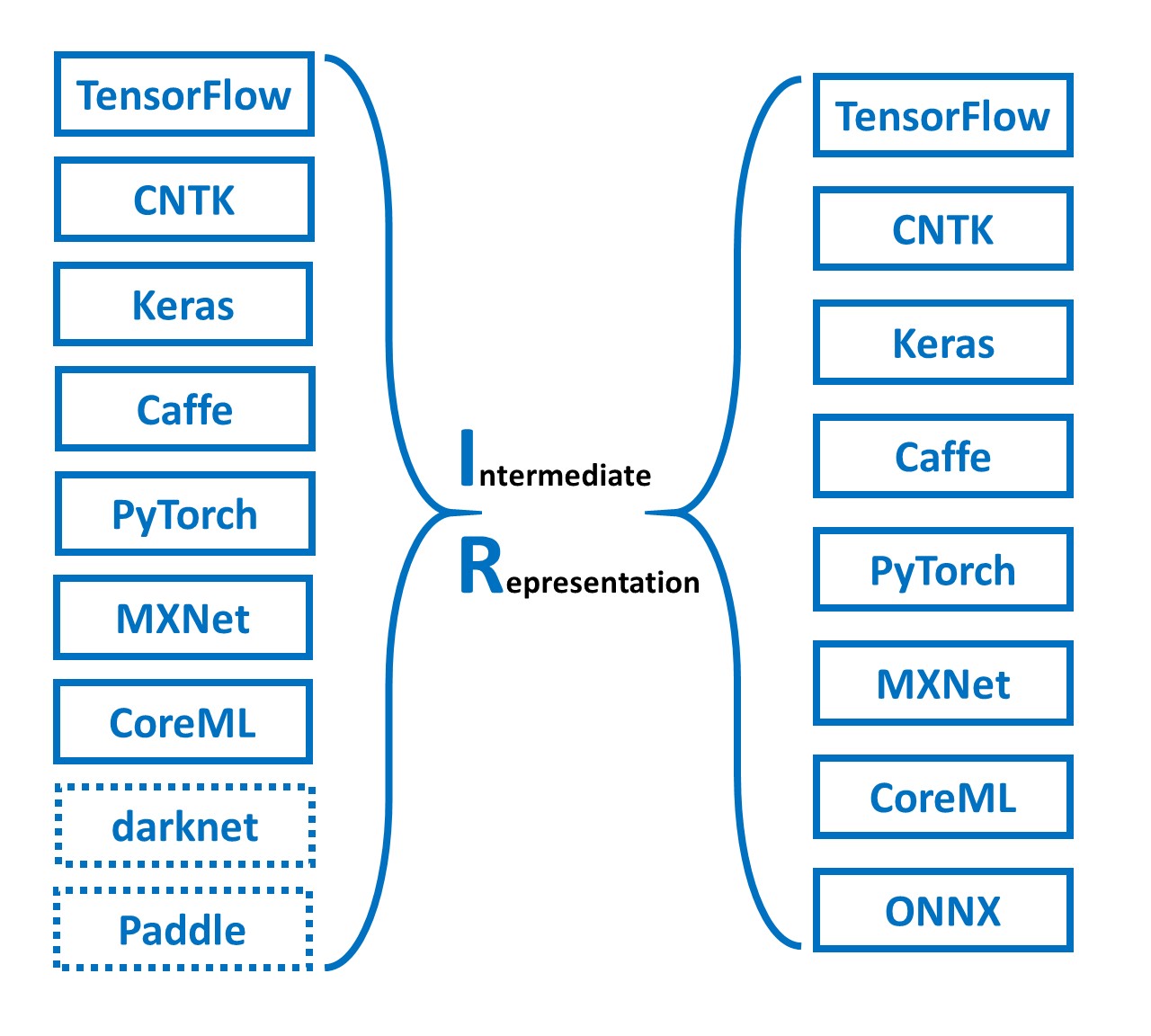
Simple tool to combine(merge) onnx models. Simple Network Combine Tool for ONNX.

Overview

snc4onnx

Simple tool to combine(merge) onnx models. Simple Network Combine Tool for ONNX.

https://github.com/PINTO0309/simple-onnx-processing-tools

Downloads GitHub PyPI CodeQL

1. Setup

1-1. HostPC

### option
$ echo export PATH="~/.local/bin:$PATH" >> ~/.bashrc \
&& source ~/.bashrc

### run
$ pip install -U onnx \
&& pip install -U onnx-simplifier \
&& python3 -m pip install -U onnx_graphsurgeon --index-url https://pypi.ngc.nvidia.com \
&& pip install -U snc4onnx

1-2. Docker

### docker pull
$ docker pull pinto0309/snc4onnx:latest

### docker build
$ docker build -t pinto0309/snc4onnx:latest .

### docker run
$ docker run --rm -it -v `pwd`:/workdir pinto0309/snc4onnx:latest
$ cd /workdir

2. CLI Usage

$ snc4onnx -h

usage:
  snc4onnx [-h]
    --input_onnx_file_paths INPUT_ONNX_FILE_PATHS [INPUT_ONNX_FILE_PATHS ...]
    --srcop_destop SRCOP_DESTOP [SRCOP_DESTOP ...]
    [--op_prefixes_after_merging OP_PREFIXES_AFTER_MERGING [OP_PREFIXES_AFTER_MERGING ...]]
    [--output_onnx_file_path OUTPUT_ONNX_FILE_PATH]
    [--output_of_onnx_file_in_the_process_of_fusion]
    [--non_verbose]

optional arguments:
  -h, --help
    show this help message and exit

  --input_onnx_file_paths INPUT_ONNX_FILE_PATHS [INPUT_ONNX_FILE_PATHS ...]
    Input onnx file paths. At least two onnx files must be specified.

  --srcop_destop SRCOP_DESTOP [SRCOP_DESTOP ...]
    The names of the output OP to join from and the input OP to join to are
    out1 in1 out2 in2 out3 in3 .... format.
    In other words, to combine model1 and model2,
    --srcop_destop model1_out1 model2_in1 model1_out2 model2_in2
    Also, --srcop_destop can be specified multiple times.
    The first --srcop_destop specifies the correspondence between model1 and model2,
    and the second --srcop_destop specifies the correspondence
    between model1 and model2 combined and model3.
    It is necessary to take into account that the prefix specified
    in op_prefixes_after_merging is given at the beginning of each OP name.
    e.g. To combine model1 with model2 and model3.
    --srcop_destop model1_src_op1 model2_dest_op1 model1_src_op2 model2_dest_op2 ...
    --srcop_destop comb_model12_src_op1 model3_dest_op1 comb_model12_src_op2 model3_dest_op2 ...

  --op_prefixes_after_merging OP_PREFIXES_AFTER_MERGING [OP_PREFIXES_AFTER_MERGING ...]
    Since a single ONNX file cannot contain multiple OPs with the same name,
    a prefix is added to all OPs in each input ONNX model to avoid duplication.
    Specify the same number of paths as input_onnx_file_paths.
    e.g. --op_prefixes_after_merging model1_prefix model2_prefix model3_prefix ...

  --output_onnx_file_path OUTPUT_ONNX_FILE_PATH
    Output onnx file path.

  --output_of_onnx_file_in_the_process_of_fusion
    Output of onnx files in the process of fusion.

  --non_verbose
    Do not show all information logs. Only error logs are displayed.

3. In-script Usage

$ python
>>> from snc4onnx import combine
>>> help(combine)

Help on function combine in module snc4onnx.onnx_network_combine:

combine(
  srcop_destop: List[str],
  op_prefixes_after_merging: Union[List[str], NoneType] = [],
  input_onnx_file_paths: Union[List[str], NoneType] = [],
  onnx_graphs: Union[List[onnx.onnx_ml_pb2.ModelProto], NoneType] = [],
  output_onnx_file_path: Union[str, NoneType] = '',
  output_of_onnx_file_in_the_process_of_fusion: Union[bool, NoneType] = False,
  non_verbose: Union[bool, NoneType] = False
) -> onnx.onnx_ml_pb2.ModelProto

    Parameters
    ----------
    srcop_destop: List[str]
        The names of the output OP to join from and the input OP to join to are
        [["out1","in1"], ["out2","in2"], ["out3","in3"]] format.

        In other words, to combine model1 and model2,
        srcop_destop =
            [
                ["model1_out1_opname","model2_in1_opname"],
                ["model1_out2_opname","model2_in2_opname"]
            ]

        The first srcop_destop specifies the correspondence between model1 and model2,
        and the second srcop_destop specifies the correspondence
        between model1 and model2 combined and model3.
        It is necessary to take into account that the prefix specified
        in op_prefixes_after_merging is given at the beginning of each OP name.

        e.g. To combine model1 with model2 and model3.
        srcop_destop =
            [
                [
                    ["model1_src_op1","model2_dest_op1"],
                    ["model1_src_op2","model2_dest_op2"]
                ],
                [
                    ["combined_model1.2_src_op1","model3_dest_op1"],
                    ["combined_model1.2_src_op2","model3_dest_op2"]
                ],
                ...
            ]

    op_prefixes_after_merging: List[str]
        Since a single ONNX file cannot contain multiple OPs with the same name,
        a prefix is added to all OPs in each input ONNX model to avoid duplication.
        Specify the same number of paths as input_onnx_file_paths.
        e.g. op_prefixes_after_merging = ["model1_prefix","model2_prefix","model3_prefix", ...]

    input_onnx_file_paths: Optional[List[str]]
        Input onnx file paths. At least two onnx files must be specified.
        Either input_onnx_file_paths or onnx_graphs must be specified.
        onnx_graphs If specified, ignore input_onnx_file_paths and process onnx_graphs.
        e.g. input_onnx_file_paths = ["model1.onnx", "model2.onnx", "model3.onnx", ...]

    onnx_graphs: Optional[List[onnx.ModelProto]]
        List of onnx.ModelProto. At least two onnx graphs must be specified.
        Either input_onnx_file_paths or onnx_graphs must be specified.
        onnx_graphs If specified, ignore input_onnx_file_paths and process onnx_graphs.
        e.g. onnx_graphs = [graph1, graph2, graph3, ...]

    output_onnx_file_path: Optional[str]
        Output onnx file path.
        If not specified, .onnx is not output.
        Default: ''

    output_of_onnx_file_in_the_process_of_fusion: Optional[bool]
        Output of onnx files in the process of fusion.
        Default: False

    non_verbose: Optional[bool]
        Do not show all information logs. Only error logs are displayed.
        Default: False

    Returns
    -------
    combined_graph: onnx.ModelProto
        Combined onnx ModelProto

4. CLI Execution

$ snc4onnx \
--input_onnx_file_paths crestereo_init_iter2_120x160.onnx crestereo_next_iter2_240x320.onnx \
--srcop_destop output flow_init \
--op_prefixes_after_merging init next

5. In-script Execution

5-1. ONNX files

from snc4onnx import combine

combined_graph = combine(
    srcop_destop = [
        ['output', 'flow_init']
    ],
    op_prefixes_after_merging = [
        'init',
        'next',
    ],
    input_onnx_file_paths = [
        'crestereo_init_iter2_120x160.onnx',
        'crestereo_next_iter2_240x320.onnx',
    ],
    non_verbose = True,
)

5-2. onnx.ModelProtos

from snc4onnx import combine

combined_graph = combine(
    srcop_destop = [
        ['output', 'flow_init']
    ],
    op_prefixes_after_merging = [
        'init',
        'next',
    ],
    onnx_graphs = [
        graph1,
        graph2,
        graph3,
    ],
    non_verbose = True,
)

6. Sample

6-1 INPUT <-> OUTPUT

  • Summary

    image

  • Model.1

    image

  • Model.2

    image

  • Merge

    $ snc4onnx \
    --input_onnx_file_paths crestereo_init_iter2_120x160.onnx crestereo_next_iter2_240x320.onnx \
    --op_prefixes_after_merging init next \
    --srcop_destop output flow_init
  • Result

    image image

6-2 INPUT + INPUT

  • Summary

    image

  • Model.1

    image

  • Model.2

    image

  • Merge

    $ snc4onnx \
    --input_onnx_file_paths objectron_camera_224x224.onnx objectron_chair_224x224.onnx \
    --srcop_destop input_1 input_1 \
    --op_prefixes_after_merging camera chair \
    --output_onnx_file_path objectron_camera_chair_224x224.onnx
  • Result

    image image

7. Reference

  1. https://github.com/onnx/onnx/blob/main/docs/PythonAPIOverview.md
  2. https://github.com/PINTO0309/sne4onnx
  3. https://github.com/PINTO0309/snd4onnx
  4. https://github.com/PINTO0309/scs4onnx
  5. https://github.com/PINTO0309/sog4onnx
  6. https://github.com/PINTO0309/PINTO_model_zoo

8. Issues

https://github.com/PINTO0309/simple-onnx-processing-tools/issues

You might also like...
Python scripts performing class agnostic object localization using the Object Localization Network model in ONNX.

ONNX Object Localization Network Python scripts performing class agnostic object localization using the Object Localization Network model in ONNX. Ori

MMdnn is a set of tools to help users inter-operate among different deep learning frameworks. E.g. model conversion and visualization. Convert models between Caffe, Keras, MXNet, Tensorflow, CNTK, PyTorch Onnx and CoreML.

MMdnn MMdnn is a comprehensive and cross-framework tool to convert, visualize and diagnose deep learning (DL) models. The "MM" stands for model manage

tf2onnx - Convert TensorFlow, Keras and Tflite models to ONNX.

tf2onnx converts TensorFlow (tf-1.x or tf-2.x), tf.keras and tflite models to ONNX via command line or python api.

This package proposes simplified exporting pytorch models to ONNX and TensorRT, and also gives some base interface for model inference.

PyTorch Infer Utils This package proposes simplified exporting pytorch models to ONNX and TensorRT, and also gives some base interface for model infer

Convert onnx models to pytorch.

onnx2torch onnx2torch is an ONNX to PyTorch converter. Our converter: Is easy to use – Convert the ONNX model with the function call convert; Is easy

Simple node deletion tool for onnx.

snd4onnx Simple node deletion tool for onnx. I only test very miscellaneous and limited patterns as a hobby. There are probably a large number of bugs

XtremeDistil framework for distilling/compressing massive multilingual neural network models to tiny and efficient models for AI at scale

XtremeDistilTransformers for Distilling Massive Multilingual Neural Networks ACL 2020 Microsoft Research [Paper] [Video] Releasing [XtremeDistilTransf

Ever felt tired after preprocessing the dataset, and not wanting to write any code further to train your model? Ever encountered a situation where you wanted to record the hyperparameters of the trained model and able to retrieve it afterward? Models Playground is here to help you do that. Models playground allows you to train your models right from the browser. PyTorch ,ONNX and TensorRT implementation of YOLOv4
PyTorch ,ONNX and TensorRT implementation of YOLOv4

PyTorch ,ONNX and TensorRT implementation of YOLOv4

Releases(1.0.11)
  • 1.0.11(Jan 2, 2023)

  • 1.0.10(Jan 2, 2023)

  • 1.0.9(Sep 7, 2022)

    • Add short form parameter

      $ snc4onnx -h
      
      usage:
        snc4onnx [-h]
          -if INPUT_ONNX_FILE_PATHS [INPUT_ONNX_FILE_PATHS ...]
          -sd SRCOP_DESTOP [SRCOP_DESTOP ...]
          [-opam OP_PREFIXES_AFTER_MERGING [OP_PREFIXES_AFTER_MERGING ...]]
          [-of OUTPUT_ONNX_FILE_PATH]
          [-f]
          [-n]
      
      optional arguments:
        -h, --help
          show this help message and exit.
      
        -if INPUT_ONNX_FILE_PATHS [INPUT_ONNX_FILE_PATHS ...], --input_onnx_file_paths INPUT_ONNX_FILE_PATHS [INPUT_ONNX_FILE_PATHS ...]
            Input onnx file paths. At least two onnx files must be specified.
      
        -sd SRCOP_DESTOP [SRCOP_DESTOP ...], --srcop_destop SRCOP_DESTOP [SRCOP_DESTOP ...]
            The names of the output OP to join from and the input OP to join to are
            out1 in1 out2 in2 out3 in3 ....
            format.
            In other words, to combine model1 and model2,
            --srcop_destop model1_out1 model2_in1 model1_out2 model2_in2
            Also, --srcop_destop can be specified multiple times.
            The first --srcop_destop specifies the correspondence between model1 and model2,
            and the second --srcop_destop specifies the correspondence between
            model1 and model2 combined and model3.
            It is necessary to take into account that the prefix specified
            in op_prefixes_after_merging is
            given at the beginning of each OP name.
            e.g. To combine model1 with model2 and model3.
            --srcop_destop model1_src_op1 model2_dest_op1 model1_src_op2 model2_dest_op2 ...
            --srcop_destop combined_model1.2_src_op1 model3_dest_op1 combined_model1.2_src_op2 model3_dest_op2 ...
      
        -opam OP_PREFIXES_AFTER_MERGING [OP_PREFIXES_AFTER_MERGING ...], --op_prefixes_after_merging OP_PREFIXES_AFTER_MERGING [OP_PREFIXES_AFTER_MERGING ...]
            Since a single ONNX file cannot contain multiple OPs with the same name,
            a prefix is added to all OPs in each input ONNX model to avoid duplication.
            Specify the same number of paths as input_onnx_file_paths.
            e.g. --op_prefixes_after_merging model1_prefix model2_prefix model3_prefix ...
      
        -of OUTPUT_ONNX_FILE_PATH, --output_onnx_file_path OUTPUT_ONNX_FILE_PATH
            Output onnx file path.
      
        -f, --output_of_onnx_file_in_the_process_of_fusion
            Output of onnx files in the process of fusion.
      
        -n, --non_verbose
            Do not show all information logs. Only error logs are displayed.
      
    Source code(tar.gz)
    Source code(zip)
  • 1.0.8(Sep 6, 2022)

    1. Fixed a bug that caused INPUT names to be corrupted. There was a problem with the removal of prefixes added during the model merging process.
      • before: main_input -> put (bug)
      • after: main_input -> input
      • Stop using lstrip and change to forward matching logic with re.sub
    2. Added process to clean up OUTPUT prefixes as much as possible image
    Source code(tar.gz)
    Source code(zip)
  • 1.0.7(May 25, 2022)

  • 1.0.6(May 7, 2022)

  • 1.0.5(May 1, 2022)

  • 1.0.4(Apr 27, 2022)

    • Change op_prefixes_after_merging to optional
    • Added duplicate OP name check
      • If there is a duplicate OP name, the model cannot be combined and the process is aborted with the following error message.
        ERROR: 
        There is a duplicate OP name after merging models.
        op_name:input count:2, op_name:output count:2
        Avoid duplicate OP names by specifying a prefix in op_prefixes_after_merging.
        
    Source code(tar.gz)
    Source code(zip)
  • 1.0.3(Apr 24, 2022)

  • 1.0.2(Apr 11, 2022)

  • 1.0.1(Apr 10, 2022)

  • 1.0.0(Apr 10, 2022)

Owner
Katsuya Hyodo
Hobby programmer. Intel Software Innovator Program member.
Katsuya Hyodo
Official PyTorch implementation of "Physics-aware Difference Graph Networks for Sparsely-Observed Dynamics".

Physics-aware Difference Graph Networks for Sparsely-Observed Dynamics This repository is the official PyTorch implementation of "Physics-aware Differ

USC-Melady 46 Nov 20, 2022
CLOCs: Camera-LiDAR Object Candidates Fusion for 3D Object Detection

CLOCs is a novel Camera-LiDAR Object Candidates fusion network. It provides a low-complexity multi-modal fusion framework that improves the performance of single-modality detectors. CLOCs operates on

Su Pang 254 Dec 16, 2022
PyTorch implementation of our ICCV 2019 paper: Liquid Warping GAN: A Unified Framework for Human Motion Imitation, Appearance Transfer and Novel View Synthesis

Impersonator PyTorch implementation of our ICCV 2019 paper: Liquid Warping GAN: A Unified Framework for Human Motion Imitation, Appearance Transfer an

SVIP Lab 1.7k Jan 06, 2023
Code for ICLR2018 paper: Improving GAN Training via Binarized Representation Entropy (BRE) Regularization - Y. Cao · W Ding · Y.C. Lui · R. Huang

code for "Improving GAN Training via Binarized Representation Entropy (BRE) Regularization" (ICLR2018 paper) paper: https://arxiv.org/abs/1805.03644 G

21 Oct 12, 2020
Efficient 3D Backbone Network for Temporal Modeling

VoV3D is an efficient and effective 3D backbone network for temporal modeling implemented on top of PySlowFast. Diverse Temporal Aggregation and

102 Dec 06, 2022
Official implementation of Rich Semantics Improve Few-Shot Learning (BMVC, 2021)

Rich Semantics Improve Few-Shot Learning Paper Link Abstract : Human learning benefits from multi-modal inputs that often appear as rich semantics (e.

Mohamed Afham 11 Jul 26, 2022
Official PyTorch implemention of our paper "Learning to Rectify for Robust Learning with Noisy Labels".

WarPI The official PyTorch implemention of our paper "Learning to Rectify for Robust Learning with Noisy Labels". Run python main.py --corruption_type

Haoliang Sun 3 Sep 03, 2022
Predicting lncRNA–protein interactions based on graph autoencoders and collaborative training

Predicting lncRNA–protein interactions based on graph autoencoders and collaborative training Code for our paper "Predicting lncRNA–protein interactio

zhanglabNKU 1 Nov 29, 2022
Winning solution of the Indoor Location & Navigation Kaggle competition

This repository contains the code to generate the winning solution of the Kaggle competition on indoor location and navigation organized by Microsoft

Tom Van de Wiele 62 Dec 28, 2022
Liver segmentation using MONAI and pytorch

Machine Learning use case in the field of Healthcare. In this project MONAI and pytorch frameworks are used for 3D Liver segmentation.

Abhishek Gajbhiye 2 May 30, 2022
🌳 A Python-inspired implementation of the Optimum-Path Forest classifier.

OPFython: A Python-Inspired Optimum-Path Forest Classifier Welcome to OPFython. Note that this implementation relies purely on the standard LibOPF. Th

Gustavo Rosa 30 Jan 04, 2023
[NeurIPS 2021] "G-PATE: Scalable Differentially Private Data Generator via Private Aggregation of Teacher Discriminators"

G-PATE This is the official code base for our NeurIPS 2021 paper: "G-PATE: Scalable Differentially Private Data Generator via Private Aggregation of T

AI Secure 14 Oct 12, 2022
Official code for CVPR2022 paper: Depth-Aware Generative Adversarial Network for Talking Head Video Generation

📖 Depth-Aware Generative Adversarial Network for Talking Head Video Generation (CVPR 2022) 🔥 If DaGAN is helpful in your photos/projects, please hel

Fa-Ting Hong 503 Jan 04, 2023
Fastshap: A fast, approximate shap kernel

fastshap: A fast, approximate shap kernel fastshap was designed to be: Fast Calculating shap values can take an extremely long time. fastshap utilizes

Samuel Wilson 22 Sep 24, 2022
A Simulated Optimal Intrusion Response Game

Optimal Intrusion Response An OpenAI Gym interface to a MDP/Markov Game model for optimal intrusion response of a realistic infrastructure simulated u

Kim Hammar 10 Dec 09, 2022
Oriented Response Networks, in CVPR 2017

Oriented Response Networks [Home] [Project] [Paper] [Supp] [Poster] Torch Implementation The torch branch contains: the official torch implementation

ZhouYanzhao 217 Dec 12, 2022
Selective Wavelet Attention Learning for Single Image Deraining

SWAL Code for Paper "Selective Wavelet Attention Learning for Single Image Deraining" Prerequisites Python 3 PyTorch Models We provide the models trai

Bobo 9 Jun 17, 2022
This is the formal code implementation of the CVPR 2022 paper 'Federated Class Incremental Learning'.

Official Pytorch Implementation for GLFC [CVPR-2022] Federated Class-Incremental Learning This is the official implementation code of our paper "Feder

Race Wang 57 Dec 27, 2022
Implementation of "Selection via Proxy: Efficient Data Selection for Deep Learning" from ICLR 2020.

Selection via Proxy: Efficient Data Selection for Deep Learning This repository contains a refactored implementation of "Selection via Proxy: Efficien

Stanford Future Data Systems 70 Nov 16, 2022
Implementation of PersonaGPT Dialog Model

PersonaGPT An open-domain conversational agent with many personalities PersonaGPT is an open-domain conversational agent cpable of decoding personaliz

ILLIDAN Lab 42 Jan 01, 2023