Orthogonal Over-Parameterized Training

Overview

Orthogonal Over-Parameterized Training

By Weiyang Liu, Rongmei Lin, Zhen Liu, James Rehg, Liam Paull, Li Xiong, Le Song, Adrian Weller

License

OPT is released under the MIT License (refer to the LICENSE file for details).

Contents

  1. Introduction
  2. Citation
  3. Short Video Introduction
  4. Requirements
  5. Usage

Introduction

The inductive bias of a neural network is largely determined by the architecture and the training algorithm. To achieve good generalization, how to effectively train a neural network is of great importance. We propose a novel orthogonal over-parameterized training (OPT) framework that can provably minimize the hyperspherical energy which characterizes the diversity of neurons on a hypersphere. See our previous work -- MHE for an in-depth introduction.

By maintaining the minimum hyperspherical energy during training, OPT can greatly improve the empirical generalization. Specifically, OPT fixes the randomly initialized weights of the neurons and learns an orthogonal transformation that applies to these neurons. We consider multiple ways to learn such an orthogonal transformation, including unrolling orthogonalization algorithms, applying orthogonal parameterization, and designing orthogonality-preserving gradient descent. For better scalability, we propose the stochastic OPT which performs orthogonal transformation stochastically for partial dimensions of neurons.

Our OPT is accepted to CVPR 2021 as oral presentation and the full paper is available on arXiv and here.

Citation

If you find our work useful in your research, please consider to cite:

@InProceedings{Liu2021OPT,
    title={Orthogonal Over-Parameterized Training},
    author={Liu, Weiyang and Lin, Rongmei and Liu, Zhen and Rehg, James M. and Paull, Liam 
     and Xiong, Li and Song, Le and Weller, Adrian},
    booktitle={CVPR},
    year={2021}
}

Short Video Introduction

We also provide a short video introduction to help interested readers quickly go over our work and understand the essence of OPT. Please click the following figure to watch the Youtube video.
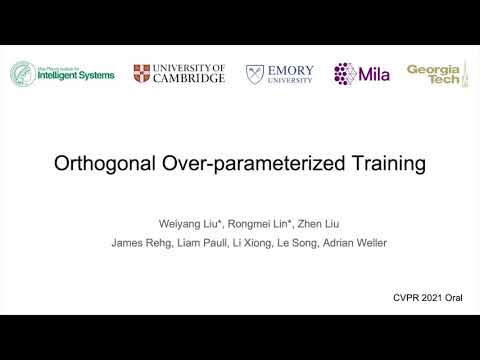
OPT_talk

Requirements

  1. Python 3.7
  2. TensorFlow 1.14.0

Usage

This repository provides both OPT and S-OPT implementations on CIFAR-100 as a demostration.

Part 1: Clone the repositary

git clone https://github.com/wy1iu/OPT.git

Part 2: Download the official CIFAR-100 training and testing data (python version)

wget https://www.cs.toronto.edu/~kriz/cifar-100-python.tar.gz

Part 3: Train and test with the following code in different folder.

# Run Cayley Parameterization OPT
cd opt_cp
python train.py
# Run Gram-Schmidt OPT
cd opt_gs
python train.py
# Run Householder Reflection OPT
cd opt_hr
python train.py
# Run Lowdin’s Symmetric OPT
cd opt_ls
python train.py
# Run Orthogonality-Preserving Gradient Descent OPT
cd opt_ogd
python train.py
# Run Stochastic OPT (Gram-Schmidt)
cd sopt_gs
python train.py

Contact

Owner
Weiyang Liu
Weiyang Liu
Statsmodels: statistical modeling and econometrics in Python

About statsmodels statsmodels is a Python package that provides a complement to scipy for statistical computations including descriptive statistics an

statsmodels 8.1k Jan 02, 2023
Google AI Open Images - Object Detection Track: Open Solution

Google AI Open Images - Object Detection Track: Open Solution This is an open solution to the Google AI Open Images - Object Detection Track 😃 More c

minerva.ml 46 Jun 22, 2022
Intro-to-dl - Resources for "Introduction to Deep Learning" course.

Introduction to Deep Learning course resources https://www.coursera.org/learn/intro-to-deep-learning Running on Google Colab (tested for all weeks) Go

Advanced Machine Learning specialisation by HSE 761 Dec 24, 2022
Official implement of Evo-ViT: Slow-Fast Token Evolution for Dynamic Vision Transformer

Evo-ViT: Slow-Fast Token Evolution for Dynamic Vision Transformer This repository contains the PyTorch code for Evo-ViT. This work proposes a slow-fas

YifanXu 53 Dec 05, 2022
A PyTorch implementation of Sharpness-Aware Minimization for Efficiently Improving Generalization

sam.pytorch A PyTorch implementation of Sharpness-Aware Minimization for Efficiently Improving Generalization ( Foret+2020) Paper, Official implementa

Ryuichiro Hataya 102 Dec 28, 2022
Inflated i3d network with inception backbone, weights transfered from tensorflow

I3D models transfered from Tensorflow to PyTorch This repo contains several scripts that allow to transfer the weights from the tensorflow implementat

Yana 479 Dec 08, 2022
Near-Duplicate Video Retrieval with Deep Metric Learning

Near-Duplicate Video Retrieval with Deep Metric Learning This repository contains the Tensorflow implementation of the paper Near-Duplicate Video Retr

2 Jan 24, 2022
DeepOBS: A Deep Learning Optimizer Benchmark Suite

DeepOBS - A Deep Learning Optimizer Benchmark Suite DeepOBS is a benchmarking suite that drastically simplifies, automates and improves the evaluation

Aaron Bahde 7 May 12, 2020
scalingscattering

Scaling The Scattering Transform : Deep Hybrid Networks This repository contains the experiments found in the paper: https://arxiv.org/abs/1703.08961

Edouard Oyallon 78 Dec 21, 2022
A research toolkit for particle swarm optimization in Python

PySwarms is an extensible research toolkit for particle swarm optimization (PSO) in Python. It is intended for swarm intelligence researchers, practit

Lj Miranda 1k Dec 30, 2022
Unified Pre-training for Self-Supervised Learning and Supervised Learning for ASR

UniSpeech The family of UniSpeech: UniSpeech (ICML 2021): Unified Pre-training for Self-Supervised Learning and Supervised Learning for ASR UniSpeech-

Microsoft 282 Jan 09, 2023
PointNetVLAD: Deep Point Cloud Based Retrieval for Large-Scale Place Recognition, CVPR 2018

PointNetVLAD: Deep Point Cloud Based Retrieval for Large-Scale Place Recognition PointNetVLAD: Deep Point Cloud Based Retrieval for Large-Scale Place

Mikaela Uy 294 Dec 12, 2022
CS583: Deep Learning

CS583: Deep Learning

Shusen Wang 2.6k Dec 30, 2022
Flow is a computational framework for deep RL and control experiments for traffic microsimulation.

Flow Flow is a computational framework for deep RL and control experiments for traffic microsimulation. See our website for more information on the ap

867 Jan 02, 2023
Pytorch implementation of SimSiam Architecture

SimSiam-pytorch A simple pytorch implementation of Exploring Simple Siamese Representation Learning which is developed by Facebook AI Research (FAIR)

Saeed Shurrab 1 Oct 20, 2021
A generator of point clouds dataset for PyPipes.

CloudPipesGenerator Documentation | Colab Notebooks | Video Tutorials | Master Degree website A generator of point clouds dataset for PyPipes. TODO Us

1 Jan 13, 2022
FEMDA: Robust classification with Flexible Discriminant Analysis in heterogeneous data

FEMDA: Robust classification with Flexible Discriminant Analysis in heterogeneous data. Flexible EM-Inspired Discriminant Analysis is a robust supervised classification algorithm that performs well i

0 Sep 06, 2022
Unofficial implementation of "Swin Transformer: Hierarchical Vision Transformer using Shifted Windows" (https://arxiv.org/abs/2103.14030)

Swin-Transformer-Tensorflow A direct translation of the official PyTorch implementation of "Swin Transformer: Hierarchical Vision Transformer using Sh

52 Dec 29, 2022
Line-level Handwritten Text Recognition (HTR) system implemented with TensorFlow.

Line-level Handwritten Text Recognition with TensorFlow This model is an extended version of the Simple HTR system implemented by @Harald Scheidl and

Hoàng Tùng Lâm (Linus) 72 May 07, 2022
Code for the ICCV 2021 paper "Pixel Difference Networks for Efficient Edge Detection" (Oral).

Microsoft365_devicePhish Abusing Microsoft 365 OAuth Authorization Flow for Phishing Attack This is a simple proof-of-concept script that allows an at

Alex 236 Dec 21, 2022