Project: Netflix Data Analysis and Visualization with Python
Overview

Project: Netflix Data Analysis and Visualization with Python

MyNetflixDashboard

Table of Contents

  1. General Info
  2. Installation
  3. Demo
  4. Usage and Main Functionalities
  5. Contributing

General Info

This is a compact Data Visualization project I worked on for fun and to deepen my knowledge about visualizations and graphs using python libraries.

From conception and design to every line of code, the entire Dashboard was worked on by myself. During this project, I was able to repeat and deepen what I had previously learned in my Data Science course of study. Especially, I was able to familiarize myself with pandas and work on my data visualization skills, which I greatly enjoied!

The dataset I used for the Netflix data analytics task consists of my personal Netflix data, which I requested through their website. You can get access to your own data through this link. Feel free to download it and use my code to look into your own viewing behaviour :)

Installation

Requirements: Make sure you have Python 3.7+ installed on your computer. You can download the latest version of Python here.

Req. Packages:

  • pandas
  • dash
  • dash_bootstrap_components
  • ploty.express
  • plotly.graph_objects

Demo

Demo_MyNetflixDashboard_komprimiert.mov

Usage and Main Functionalities

Want to know more about your own Netflix behaviour? For test usage you can download your own Netflix data. Just follow this link and Netflix will send you your personal data.

Please also refer to the comments within the code itself to get more information on the functionalities of the program.


0. Preparing the data for analysis

  • This part cleans up the original data and prepares it for analysis.
  • In the process, columns that are not needed are dropped.
  • Time data is converted into appropriate time formats and split into several columns. The days of the week are added.
  • In addition, the titles of the movies/series are split (title, season number, episode name).

1. Analysis

  • This part of the code is about analyzing the data.
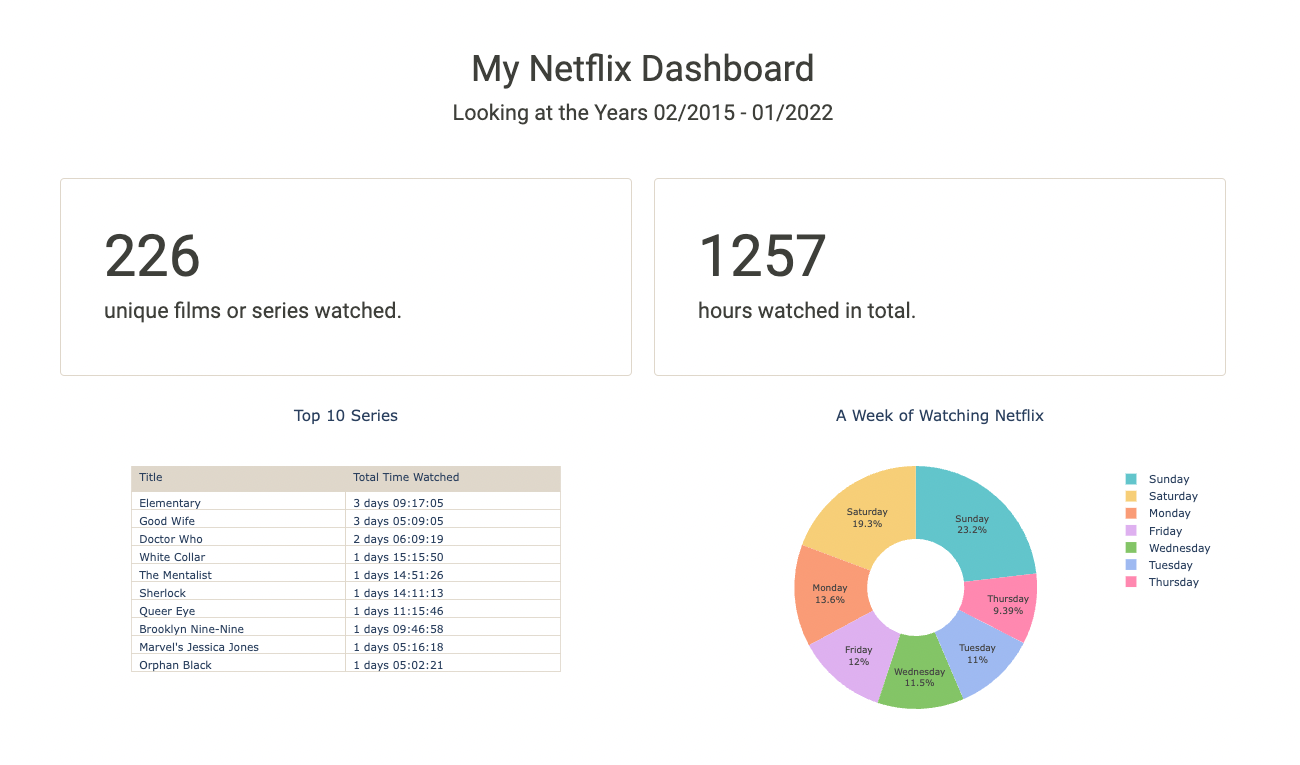
  • We find out how many movies or series were watched over the entire period. We also count the total number of hours Netflix was watched.
  • A pie chart is created that shows which days of the week are watched.
  • In addition, the top 10 series that were watched the longest (in terms of total duration) are displayed.
  • A line chart shows Netflix viewing behavior over the years, counting the total number of hours Netflix was watched.

NetflixOverTime

2. Dash App Layout

  • plotly's Dash is now used to create an Interactive Dashboard of Netflix data.
  • The individual graphics and texts are arranged in rows and containers.
  • This part also includes a dropdown menu that the user can interact with.

3. App Callback

  • Here we connect an interactive bar chart to the Dash Components.
  • The chart represents our total annual hours of Netflix watched, grouped by month. The chart is filterable by year.

MonthlyViews

Contributing

Your comments, suggestions, and contributions are welcome. Please feel free to contribute pull requests or create issues for bugs and feature requests.

Owner
Kathrin Hälbich
Data Science Student and PR- & Marketing-Expert
Kathrin Hälbich
This repository contains some analysis of possible nerdle answers

Nerdle Analysis https://nerdlegame.com/ This repository contains some analysis of possible nerdle answers. Here's a quick overview: nerdle.py contains

0 Dec 16, 2022
Elementary is an open-source data reliability framework for modern data teams. The first module of the framework is data lineage.

Data lineage made simple, reliable, and automated. Effortlessly track the flow of data, understand dependencies and analyze impact. Features Visualiza

898 Jan 09, 2023
Implementation in Python of the reliability measures such as Omega.

OmegaPy Summary Simple implementation in Python of the reliability measures: Omega Total, Omega Hierarchical and Omega Hierarchical Total. Name Link O

Rafael Valero Fernández 2 Apr 27, 2022
Pizza Orders Data Pipeline Usecase Solved by SQL, Sqoop, HDFS, Hive, Airflow.

PizzaOrders_DataPipeline There is a Tony who is owning a New Pizza shop. He knew that pizza alone was not going to help him get seed funding to expand

Melwin Varghese P 4 Jun 05, 2022
Find exposed data in Azure with this public blob scanner

BlobHunter A tool for scanning Azure blob storage accounts for publicly opened blobs. BlobHunter is a part of "Hunting Azure Blobs Exposes Millions of

CyberArk 250 Jan 03, 2023
Intercepting proxy + analysis toolkit for Second Life compatible virtual worlds

Hippolyzer Hippolyzer is a revival of Linden Lab's PyOGP library targeting modern Python 3, with a focus on debugging issues in Second Life-compatible

Salad Dais 6 Sep 01, 2022
Python package for processing UC module spectral data.

UC Module Python Package How To Install clone repo. cd UC-module pip install . How to Use uc.module.UC(measurment=str, dark=str, reference=str, heade

Nicolai Haaber Junge 1 Oct 20, 2021
nrgpy is the Python package for processing NRG Data Files

nrgpy nrgpy is the Python package for processing NRG Data Files Website and source: https://github.com/nrgpy/nrgpy Documentation: https://nrgpy.github

NRG Tech Services 23 Dec 08, 2022
fds is a tool for Data Scientists made by DAGsHub to version control data and code at once.

Fast Data Science, AKA fds, is a CLI for Data Scientists to version control data and code at once, by conveniently wrapping git and dvc

DAGsHub 359 Dec 22, 2022
Semi-Automated Data Processing

Perform semi automated exploratory data analysis, feature engineering and feature selection on provided dataset by visualizing every possibilities on each step and assisting the user to make a meanin

Arun Singh Babal 1 Jan 17, 2022
Tools for working with MARC data in Catalogue Bridge.

catbridge_tools Tools for working with MARC data in Catalogue Bridge. Borrows heavily from PyMarc

1 Nov 11, 2021
A Numba-based two-point correlation function calculator using a grid decomposition

A Numba-based two-point correlation function (2PCF) calculator using a grid decomposition. Like Corrfunc, but written in Numba, with simplicity and hackability in mind.

Lehman Garrison 3 Aug 24, 2022
In this tutorial, raster models of soil depth and soil water holding capacity for the United States will be sampled at random geographic coordinates within the state of Colorado.

Raster_Sampling_Demo (Resulting graph of this demo) Background Sampling values of a raster at specific geographic coordinates can be done with a numbe

2 Dec 13, 2022
Generates a simple report about the current Covid-19 cases and deaths in Malaysia

Generates a simple report about the current Covid-19 cases and deaths in Malaysia. Results are delay one day, data provided by the Ministry of Health Malaysia Covid-19 public data.

Yap Khai Chuen 7 Dec 15, 2022
Show you how to integrate Zeppelin with Airflow

Introduction This repository is to show you how to integrate Zeppelin with Airflow. The philosophy behind the ingtegration is to make the transition f

Jeff Zhang 11 Dec 30, 2022
This tool parses log data and allows to define analysis pipelines for anomaly detection.

logdata-anomaly-miner This tool parses log data and allows to define analysis pipelines for anomaly detection. It was designed to run the analysis wit

AECID 32 Nov 27, 2022
Stochastic Gradient Trees implementation in Python

Stochastic Gradient Trees - Python Stochastic Gradient Trees1 by Henry Gouk, Bernhard Pfahringer, and Eibe Frank implementation in Python. Based on th

John Koumentis 2 Nov 18, 2022
scikit-survival is a Python module for survival analysis built on top of scikit-learn.

scikit-survival scikit-survival is a Python module for survival analysis built on top of scikit-learn. It allows doing survival analysis while utilizi

Sebastian Pölsterl 876 Jan 04, 2023
Used for data processing in machine learning, and help us to construct ML model more easily from scratch

Used for data processing in machine learning, and help us to construct ML model more easily from scratch. Can be used in linear model, logistic regression model, and decision tree.

ShawnWang 0 Jul 05, 2022
General Assembly's 2015 Data Science course in Washington, DC

DAT8 Course Repository Course materials for General Assembly's Data Science course in Washington, DC (8/18/15 - 10/29/15). Instructor: Kevin Markham (

Kevin Markham 1.6k Jan 07, 2023