A visualization tool to show a TensorFlow's graph like TensorBoard

Overview

tfgraphviz

GitHub license

tfgraphviz is a module to visualize a TensorFlow's data flow graph like TensorBoard using Graphviz. tfgraphviz enables to provide a visualization of tensorflow graph on Jupyter Notebook without TensorBoard.

Links

Installation

Use pip to install:

$ pip install graphviz
$ pip install tfgraphviz

The only dependency is Graphviz.

macOS:

$ brew install graphviz

Ubuntu:

$ apt-get install graphviz

Quickstart

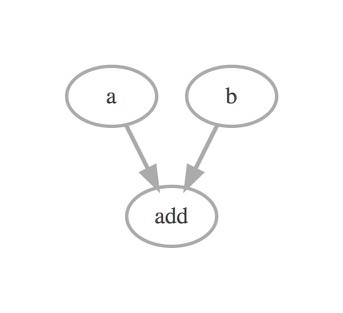
import tensorflow as tf
import tfgraphviz as tfg

g = tf.Graph()
with g.as_default():
    a = tf.constant(1, name="a")
    b = tf.constant(2, name="b")
    c = tf.add(a, b, name="add")
tfg.board(g)

https://raw.githubusercontent.com/akimach/tfgraphviz/master/img/graph.jpg

License

This package is distributed under the MIT license.

Author

Akimasa KIMURA

Comments
  • Add Binder support

    Add Binder support

    To get the example working in Binder the only required pip installable package is tensorflow and from apt-get is graphviz. The postBuild will install tfgraphviz from GitHub so that it always gets the master HEAD, so that if there is something broken for a bit on PyPI it won't continue to be a problem until a new release is made.

    opened by matthewfeickert 2
  • added pan and zoom support for jupyter

    added pan and zoom support for jupyter

    Added tfg.jupyter_pan_and_zoom helper to wrap generated SVG object In order to enable pan and zoom functionality in Jupyter:

    tfg.jupyter_pan_and_zoom(tfg.board(graph))
    

    Tested in JupyterLab and Colab.

    opened by vlasenkoalexey 1
  • Extending functionality

    Extending functionality

    • Added proper tooltips
    • Fixed logic to render function names to check op type, not op name
    • Added ability to override functions to create digraph, node and edge like:
    def custom_add_digraph_node(digraph, name, op, attributes=None):
        attributes=[]
        if op is not None and 'PartitionedCall' in op.type:
            attributes.append(('fillcolor', 'blue'))
        tfg.add_digraph_node(digraph, name, op, attributes)
    
    tfg.board(tf_g, depth=10, name_regex=".*", add_digraph_node_func=custom_add_digraph_node)
    
    opened by vlasenkoalexey 1
  • For Python3.x

    For Python3.x

    Fixed to work on Python 3.x:

    • Change IMPLICIT relative imports (from graphviz_wrapper import board) to EXPLICIT relative imports (from .graphviz_wrapper import board).
    • (In addition, ) remove unnecessary imports.

    Checked to work both Python 2.7.x/3.5.x with TensorFlow 1.0.

    opened by antimon2 1
  • UnicodeDecodeError on loading the graph.

    UnicodeDecodeError on loading the graph.

    I am getting the following error. Is unicode in tf variable/scope names not supported?

    <ipython-input-2-b2099ef84663> in load(self)
        143         # sess = tf.Session(graph=tf.get_default_graph())
        144         self.sess.run(self.init)
    --> 145         g = tfg.board(tf.get_default_graph())
        146         g.view()
        147         self.saver.restore(self.sess, model_path)
    
    /Users/activeai/.local/share/virtualenvs/spotter-67LXOL6z/lib/python2.7/site-packages/tfgraphviz/graphviz_wrapper.pyc in board(tfgraph, depth, name, style)
        212     _node_inpt_table, _node_inpt_shape_table = node_input_table(tfgraph, depth=depth)
        213     digraph = add_nodes(_node_table, name=name, style=style)
    --> 214     digraph = add_edges(digraph, _node_inpt_table, _node_inpt_shape_table)
        215     return digraph
    
    /Users/activeai/.local/share/virtualenvs/spotter-67LXOL6z/lib/python2.7/site-packages/tfgraphviz/graphviz_wrapper.pyc in add_edges(digraph, node_inpt_table, node_inpt_shape_table)
        195             else:
        196                 shape = node_inpt_shape_table[ni]
    --> 197                 digraph.edge(ni, node, label=edge_label(shape))
        198     return digraph
        199 
    
    /Users/activeai/.local/share/virtualenvs/spotter-67LXOL6z/lib/python2.7/site-packages/graphviz/dot.pyc in edge(self, tail_name, head_name, label, _attributes, **attrs)
        145         head_name = self._quote_edge(head_name)
        146         attr_list = self._attr_list(label, attrs, _attributes)
    --> 147         line = self._edge % (tail_name, head_name, attr_list)
        148         self.body.append(line)
        149 
    
    UnicodeDecodeError: 'ascii' codec can't decode byte 0xc3 in position 10: ordinal not in range(128)
    
    opened by malarinv 0
Releases(0.0.8)
Supervised Contrastive Learning for Downstream Optimized Sequence Representations

SupCL-Seq 📖 Supervised Contrastive Learning for Downstream Optimized Sequence representations (SupCS-Seq) accepted to be published in EMNLP 2021, ext

Hooman Sedghamiz 18 Oct 21, 2022
LocUNet is a deep learning method to localize a UE based solely on the reported signal strengths from a set of BSs.

LocUNet LocUNet is a deep learning method to localize a UE based solely on the reported signal strengths from a set of BSs. The method utilizes accura

4 Oct 05, 2022
Official implementation for: Blended Diffusion for Text-driven Editing of Natural Images.

Blended Diffusion for Text-driven Editing of Natural Images Blended Diffusion for Text-driven Editing of Natural Images Omri Avrahami, Dani Lischinski

328 Dec 30, 2022
Simple tutorials on Pytorch DDP training

pytorch-distributed-training Distribute Dataparallel (DDP) Training on Pytorch Features Easy to study DDP training You can directly copy this code for

Ren Tianhe 188 Jan 06, 2023
Blender Add-on that sets a Material's Base Color to one of Pantone's Colors of the Year

Blender PCOY (Pantone Color of the Year) MCMC (Mid-Century Modern Colors) HG71 (House & Garden Colors 1971) Blender Add-ons That Assign a Custom Color

Don Schnitzius 15 Nov 20, 2022
The official implementation of A Unified Game-Theoretic Interpretation of Adversarial Robustness.

This repository is the official implementation of A Unified Game-Theoretic Interpretation of Adversarial Robustness. Requirements pip install -r requi

Jie Ren 17 Dec 12, 2022
VR-Caps: A Virtual Environment for Active Capsule Endoscopy

VR-Caps: A Virtual Environment for Capsule Endoscopy Overview We introduce a virtual active capsule endoscopy environment developed in Unity that prov

DeepMIA Lab 90 Dec 27, 2022
A modular, research-friendly framework for high-performance and inference of sequence models at many scales

T5X T5X is a modular, composable, research-friendly framework for high-performance, configurable, self-service training, evaluation, and inference of

Google Research 1.1k Jan 08, 2023
Tensorflow implementation of "Learning Deep Features for Discriminative Localization"

Weakly_detector Tensorflow implementation of "Learning Deep Features for Discriminative Localization" B. Zhou, A. Khosla, A. Lapedriza, A. Oliva, and

Taeksoo Kim 363 Jun 29, 2022
Official Pytorch Implementation of Relational Self-Attention: What's Missing in Attention for Video Understanding

Relational Self-Attention: What's Missing in Attention for Video Understanding This repository is the official implementation of "Relational Self-Atte

mandos 43 Dec 07, 2022
Unofficial PyTorch Implementation for HifiFace (https://arxiv.org/abs/2106.09965)

HifiFace — Unofficial Pytorch Implementation Image source: HifiFace: 3D Shape and Semantic Prior Guided High Fidelity Face Swapping (figure 1, pg. 1)

MINDs Lab 218 Jan 04, 2023
The aim of this project is to build an AI bot that can play the Wordle game, or more generally Squabble

Wordle RL The aim of this project is to build an AI bot that can play the Wordle game, or more generally Squabble I know there are more deterministic

Aditya Arora 3 Feb 22, 2022
Adversarial Framework for (non-) Parametric Image Stylisation Mosaics

Fully Adversarial Mosaics (FAMOS) Pytorch implementation of the paper "Copy the Old or Paint Anew? An Adversarial Framework for (non-) Parametric Imag

Zalando Research 120 Dec 24, 2022
Embracing Single Stride 3D Object Detector with Sparse Transformer

SST: Single-stride Sparse Transformer This is the official implementation of paper: Embracing Single Stride 3D Object Detector with Sparse Transformer

TuSimple 385 Dec 28, 2022
Source code for CVPR 2020 paper "Learning to Forget for Meta-Learning"

L2F - Learning to Forget for Meta-Learning Sungyong Baik, Seokil Hong, Kyoung Mu Lee Source code for CVPR 2020 paper "Learning to Forget for Meta-Lear

Sungyong Baik 29 May 22, 2022
Temporal Knowledge Graph Reasoning Triggered by Memories

MTDM Temporal Knowledge Graph Reasoning Triggered by Memories To alleviate the time dependence, we propose a memory-triggered decision-making (MTDM) n

4 Sep 25, 2022
Pytorch implement of 'Unmixing based PAN guided fusion network for hyperspectral imagery'

Pgnet There's a improved version compared with the publication in Tgrs with the modification in the deduction of the PDIN block: https://arxiv.org/abs

5 Jul 01, 2022
GLODISMO: Gradient-Based Learning of Discrete Structured Measurement Operators for Signal Recovery

GLODISMO: Gradient-Based Learning of Discrete Structured Measurement Operators for Signal Recovery This is the code to the paper: Gradient-Based Learn

3 Feb 15, 2022
A complete end-to-end demonstration in which we collect training data in Unity and use that data to train a deep neural network to predict the pose of a cube. This model is then deployed in a simulated robotic pick-and-place task.

Object Pose Estimation Demo This tutorial will go through the steps necessary to perform pose estimation with a UR3 robotic arm in Unity. You’ll gain

Unity Technologies 187 Dec 24, 2022
Multi Agent Reinforcement Learning for ROS in 2D Simulation Environments

IROS21 information To test the code and reproduce the experiments, follow the installation steps in Installation.md. Afterwards, follow the steps in E

11 Oct 29, 2022