Denoising Diffusion Implicit Models

Related tags

Deep Learningddim
Overview

Denoising Diffusion Implicit Models (DDIM)

Jiaming Song, Chenlin Meng and Stefano Ermon, Stanford

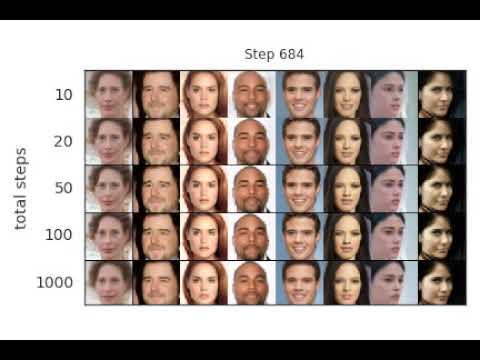
Implements sampling from an implicit model that is trained with the same procedure as Denoising Diffusion Probabilistic Model, but costs much less time and compute if you want to sample from it (click image below for a video demo):
Running the Experiments

The code has been tested on PyTorch 1.6.

Train a model

Training is exactly the same as DDPM with the following:

python main.py --config {DATASET}.yml --exp {PROJECT_PATH} --doc {MODEL_NAME} --ni

Sampling from the model

Sampling from the generalized model for FID evaluation

python main.py --config {DATASET}.yml --exp {PROJECT_PATH} --doc {MODEL_NAME} --sample --fid --timesteps {STEPS} --eta {ETA} --ni

where

  • ETA controls the scale of the variance (0 is DDIM, and 1 is one type of DDPM).
  • STEPS controls how many timesteps used in the process.
  • MODEL_NAME finds the pre-trained checkpoint according to its inferred path.

If you want to use the DDPM pretrained model:

python main.py --config {DATASET}.yml --exp {PROJECT_PATH} --use_pretrained --sample --fid --timesteps {STEPS} --eta {ETA} --ni

the --use_pretrained option will automatically load the model according to the dataset.

We provide a CelebA 64x64 model here, and use the DDPM version for CIFAR10 and LSUN.

If you want to use the version with the larger variance in DDPM: use the --sample_type ddpm_noisy option.

Sampling from the model for image inpainting

Use --interpolation option instead of --fid.

Sampling from the sequence of images that lead to the sample

Use --sequence option instead.

The above two cases contain some hard-coded lines specific to producing the image, so modify them according to your needs.

References and Acknowledgements

@article{song2020denoising,
  title={Denoising Diffusion Implicit Models},
  author={Song, Jiaming and Meng, Chenlin and Ermon, Stefano},
  journal={arXiv:2010.02502},
  year={2020},
  month={October},
  abbr={Preprint},
  url={https://arxiv.org/abs/2010.02502}
}

This implementation is based on / inspired by:

Code for Neurips2021 Paper "Topology-Imbalance Learning for Semi-Supervised Node Classification".

Topology-Imbalance Learning for Semi-Supervised Node Classification Introduction Code for NeurIPS 2021 paper "Topology-Imbalance Learning for Semi-Sup

Victor Chen 40 Nov 23, 2022
Simulation of moving particles under microscopic imaging

Simulation of moving particles under microscopic imaging Install scipy numpy scikit-image tiffile Run python simulation.py Read result https://imagej

Zehao Wang 2 Dec 14, 2021
Finding Biological Plausibility for Adversarially Robust Features via Metameric Tasks

Adversarially-Robust-Periphery Code + Data from the paper "Finding Biological Plausibility for Adversarially Robust Features via Metameric Tasks" by A

Anne Harrington 2 Feb 07, 2022
Discovering Dynamic Salient Regions with Spatio-Temporal Graph Neural Networks

Discovering Dynamic Salient Regions with Spatio-Temporal Graph Neural Networks This is the official code for DyReg model inroduced in Discovering Dyna

Bitdefender Machine Learning 11 Nov 08, 2022
KakaoBrain KoGPT (Korean Generative Pre-trained Transformer)

KoGPT KoGPT (Korean Generative Pre-trained Transformer) https://github.com/kakaobrain/kogpt https://huggingface.co/kakaobrain/kogpt Model Descriptions

Kakao Brain 799 Dec 28, 2022
CausaLM: Causal Model Explanation Through Counterfactual Language Models

CausaLM: Causal Model Explanation Through Counterfactual Language Models Authors: Amir Feder, Nadav Oved, Uri Shalit, Roi Reichart Abstract: Understan

Amir Feder 39 Jul 10, 2022
Code for the paper: On Pathologies in KL-Regularized Reinforcement Learning from Expert Demonstrations

Non-Parametric Prior Actor-Critic (N-PPAC) This repository contains the code for On Pathologies in KL-Regularized Reinforcement Learning from Expert D

Cong Lu 5 May 13, 2022
Human POSEitioning System (HPS): 3D Human Pose Estimation and Self-localization in Large Scenes from Body-Mounted Sensors, CVPR 2021

Human POSEitioning System (HPS): 3D Human Pose Estimation and Self-localization in Large Scenes from Body-Mounted Sensors Human POSEitioning System (H

Aymen Mir 66 Dec 21, 2022
A Python implementation of global optimization with gaussian processes.

Bayesian Optimization Pure Python implementation of bayesian global optimization with gaussian processes. PyPI (pip): $ pip install bayesian-optimizat

fernando 6.5k Jan 02, 2023
A Python framework for developing parallelized Computational Fluid Dynamics software to solve the hyperbolic 2D Euler equations on distributed, multi-block structured grids.

pyHype: Computational Fluid Dynamics in Python pyHype is a Python framework for developing parallelized Computational Fluid Dynamics software to solve

Mohamed Khalil 21 Nov 22, 2022
NaturalCC is a sequence modeling toolkit that allows researchers and developers to train custom models

NaturalCC NaturalCC is a sequence modeling toolkit that allows researchers and developers to train custom models for many software engineering tasks,

159 Dec 28, 2022
A Library for Modelling Probabilistic Hierarchical Graphical Models in PyTorch

A Library for Modelling Probabilistic Hierarchical Graphical Models in PyTorch

Korbinian Pöppel 47 Nov 28, 2022
A PyTorch implementation of "TokenLearner: What Can 8 Learned Tokens Do for Images and Videos?"

TokenLearner: What Can 8 Learned Tokens Do for Images and Videos? Source: Improving Vision Transformer Efficiency and Accuracy by Learning to Tokenize

Caiyong Wang 14 Sep 20, 2022
Moment-DETR code and QVHighlights dataset

Moment-DETR QVHighlights: Detecting Moments and Highlights in Videos via Natural Language Queries Jie Lei, Tamara L. Berg, Mohit Bansal For dataset de

Jie Lei 雷杰 133 Dec 22, 2022
Simple reference implementation of GraphSAGE.

Reference PyTorch GraphSAGE Implementation Author: William L. Hamilton Basic reference PyTorch implementation of GraphSAGE. This reference implementat

William L Hamilton 861 Jan 06, 2023
Part-Aware Data Augmentation for 3D Object Detection in Point Cloud

Part-Aware Data Augmentation for 3D Object Detection in Point Cloud This repository contains a reference implementation of our Part-Aware Data Augment

Jaeseok Choi 62 Jan 03, 2023
A program to recognize fruits on pictures or videos using yolov5

Yolov5 Fruits Detector Requirements Either Linux or Windows. We recommend Linux for better performance. Python 3.6+ and PyTorch 1.7+. Installation To

Fateme Zamanian 30 Jan 06, 2023
PyTorch implementation of "Learning to Discover Cross-Domain Relations with Generative Adversarial Networks"

DiscoGAN in PyTorch PyTorch implementation of Learning to Discover Cross-Domain Relations with Generative Adversarial Networks. * All samples in READM

Taehoon Kim 1k Jan 04, 2023
Semi-supervised Implicit Scene Completion from Sparse LiDAR

Semi-supervised Implicit Scene Completion from Sparse LiDAR Paper Created by Pengfei Li, Yongliang Shi, Tianyu Liu, Hao Zhao, Guyue Zhou and YA-QIN ZH

114 Nov 30, 2022
Emblaze - Interactive Embedding Comparison

Emblaze - Interactive Embedding Comparison Emblaze is a Jupyter notebook widget for visually comparing embeddings using animated scatter plots. It bun

CMU Data Interaction Group 77 Nov 24, 2022