CinnaMon is a Python library which offers a number of tools to detect, explain, and correct data drift in a machine learning system

Overview

CinnaMon


MIT_license


CinnaMon is a Python library which offers a number of tools to detect, explain, and correct data drift in a machine learning system. At its core, CinnaMon allows to study data drift between two given datasets. It is particularly useful in a monitoring context where the first dataset is the training (or validation) data and the second dataset is the production data.

⚡️ Quickstart

As a quick example, let's illustrate the use of CinnaMon on the breast cancer data where we voluntarily introduce some data drift.

Setup the data and build a model

>>> import pandas as pd
>>> from sklearn import datasets
>>> from sklearn.model_selection import train_test_split
>>> from xgboost import XGBClassifier

# load breast cancer data
>>> dataset = datasets.load_breast_cancer()
>>> X = pd.DataFrame(dataset.data, columns = dataset.feature_names)
>>> y = dataset.target

# split data in train and valid dataset
>>> X_train, X_valid, y_train, y_valid = train_test_split(X, y, test_size=0.3, random_state=2021)

# introduce some data drift in valid by filtering with 'worst symmetry' feature
>>> y_valid = y_valid[X_valid['worst symmetry'].values > 0.3]
>>> X_valid = X_valid.loc[X_valid['worst symmetry'].values > 0.3, :].copy()

# fit a XGBClassifier on the training data
>>> clf = XGBClassifier(use_label_encoder=False)
>>> clf.fit(X=X_train, y=y_train, verbose=10)

Initialize ModelDriftExplainer and fit it on train and validation data

>>> from cinnamon.drift import ModelDriftExplainer

# initialize a drift explainer with the built XGBClassifier and fit it on train
# and valid data
>>> drift_explainer = ModelDriftExplainer(model=clf)
>>> drift_explainer.fit(X1=X_train, X2=X_valid, y1=y_train, y2=y_valid)

Detect data drift by looking at main graphs and metrics

# Distribution of logit predictions
>>> drift_explainer.plot_prediction_drift(bins=15)

plot_prediction_drift

We can see on this graph that because of the data drift we introduced in validation data the distribution of predictions are different (they do not overlap well). We can also compute the corresponding drift metrics:

# Corresponding metrics
>>> drift_explainer.get_prediction_drift()
[{'mean_difference': -3.643428434667366,
  'wasserstein': 3.643428434667366,
  'kolmogorov_smirnov': KstestResult(statistic=0.2913775225333014, pvalue=0.00013914094110123454)}]

Comparing the distributions of predictions for two datasets is one of the main indicator we use in order to detect data drift. The two other indicators are:

  • distribution of the target (see get_target_drift)
  • performance metrics (see get_performance_metrics_drift)

Explain data drift by computing the drift values

Drift values can be thought as equivalent of feature importance but in terms of data drift.

# plot drift values
>>> drift_explainer.plot_tree_based_drift_values(n=7)

plot_drift_values

Here the feature worst symmetry is rightly identified as the one which contributes the most to the data drift.

More

See "notes" below to explore all the functionalities of CinnaMon.

🛠 Installation

CinnaMon is intended to work with Python 3.9 or above. Installation can be done with pip:

pip install cinnamon

🔗 Notes

  • The two main classes of CinnaMon are ModelDriftExplainer and AdversarialDriftExplainer

  • ModelDriftExplainer currently only support XGBoost models (both regression and classification are supported)

  • See notebooks in the examples/ directory to have an overview of all functionalities. Notably:

    These two notebooks also go deeper into the topic of how to correct data drift, making use of AdversarialDriftExplainer

  • See also the slide presentation of the CinnaMon library.

  • There is (yet) no formal documentation for CinnaMon but docstrings are up to date for the two main classes.

👍 Contributing

Check out the contribution section.

📝 License

CinnaMon is free and open-source software licensed under the MIT.

You might also like...
STUMPY is a powerful and scalable Python library for computing a Matrix Profile, which can be used for a variety of time series data mining tasks

STUMPY STUMPY is a powerful and scalable library that efficiently computes something called the matrix profile, which can be used for a variety of tim

🔬 A curated list of awesome machine learning strategies & tools in financial market.

🔬 A curated list of awesome machine learning strategies & tools in financial market.

Covid-polygraph - a set of Machine Learning-driven fact-checking tools

Covid-polygraph, a set of Machine Learning-driven fact-checking tools that aim to address the issue of misleading information related to COVID-19.

Python Automated Machine Learning library for tabular data.

Simple but powerful Automated Machine Learning library for tabular data. It uses efficient in-memory SAP HANA algorithms to automate routine Data Scie

Predico Disease Prediction system based on symptoms provided by patient- using Python-Django & Machine Learning

Predico Disease Prediction system based on symptoms provided by patient- using Python-Django & Machine Learning

This is a Machine Learning model which predicts the presence of Diabetes in Patients

Diabetes Disease Prediction This is a machine Learning mode which tries to determine if a person has a diabetes or not. Data The dataset is in comma s

Data science, Data manipulation and Machine learning package.

duality Data science, Data manipulation and Machine learning package. Use permitted according to the terms of use and conditions set by the attached l

Data Version Control or DVC is an open-source tool for data science and machine learning projects

Continuous Machine Learning project integration with DVC Data Version Control or DVC is an open-source tool for data science and machine learning proj

Upgini : data search library for your machine learning pipelines

Automated data search library for your machine learning pipelines → find & deliver relevant external data & features to boost ML accuracy :chart_with_upwards_trend:

Comments
  • Some feedback and some questions

    Some feedback and some questions

    Hi!

    This looks like a great project! I have a few concerns about using a hypothesis based test for comparison of drift - reason being, how do you account for the multiple comparison's problem? https://en.wikipedia.org/wiki/Multiple_comparisons_problem

    You do get some more explanatory power by looking at the plots, to be sure. I was thinking maybe you could include some permutation tests to deal with this, instead of relying on KS? Here is a reference: http://sia.webpopix.org/statisticalTests2.html and here is some in Python: https://ericschles.github.io/cuny_intro_to_ds_book/12/1/AB_Testing.html?highlight=permutation (important to note even though this is my teaching resource, it is lifted from some content from berkeley).

    Anyway, great job!

    opened by EricSchles 3
  • error after trying to execute the command:

    error after trying to execute the command: "from cinnamon.drift import ModelDriftExplainer"

    [1I ] am getting the following error when trying to execute code from Quickstart or [breast_cancer_xgboost_binary_classif.ipynb] in a section containing "from cinnamon.drift import ModelDriftExplainer":

    ModuleNotFoundError Traceback (most recent call last) ~\AppData\Local\Temp/ipykernel_10348/627594479.py in 1 # Initialize ModelDriftExplainer and fit it on train and validation data ----> 2 from cinnamon.drift import ModelDriftExplainer 3 4 # initialize a drift explainer with the built XGBClassifier and fit it on train 5 # and valid data

    ~\AppData\Roaming\Python\Python39\site-packages\cinnamon\drift_init_.py in 1 from .adversarial_drift_explainer import AdversarialDriftExplainer ----> 2 from .model_drift_explainer import ModelDriftExplainer

    ~\AppData\Roaming\Python\Python39\site-packages\cinnamon\drift\model_drift_explainer.py in 7 from ..model_parser.i_model_parser import IModelParser 8 from .adversarial_drift_explainer import AdversarialDriftExplainer ----> 9 from ..model_parser.xgboost_parser import XGBoostParser 10 11 from .drift_utils import compute_drift_num, plot_drift_num

    ~\AppData\Roaming\Python\Python39\site-packages\cinnamon\model_parser\xgboost_parser.py in 2 import pandas as pd 3 from typing import Tuple ----> 4 from .single_tree import BinaryTree 5 import xgboost 6 from .abstract_tree_ensemble_parser import AbstractTreeEnsembleParser

    ~\AppData\Roaming\Python\Python39\site-packages\cinnamon\model_parser\single_tree.py in 1 import numpy as np ----> 2 from treelib import Tree 3 from ..common.constants import TreeBasedDriftValueType 4 5 class BinaryTree:

    ModuleNotFoundError: No module named 'treelib'

    ​[2] When I'm executing the code chunk "# fit an XGBClassifier on the training data" from "Quickstart" I've got this warning:

    [20:53:12] WARNING: C:/Users/Administrator/workspace/xgboost-win64_release_1.5.1/src/learner.cc:1115: Starting in XGBoost 1.3.0, the default evaluation metric used with the objective 'binary:logistic' was changed from 'error' to 'logloss'. Explicitly set eval_metric if you'd like to restore the old behavior. XGBClassifier(base_score=0.5, booster='gbtree', colsample_bylevel=1, colsample_bynode=1, colsample_bytree=1, enable_categorical=False, gamma=0, gpu_id=-1, importance_type=None, interaction_constraints='', learning_rate=0.300000012, max_delta_step=0, max_depth=6, min_child_weight=1, missing=nan, monotone_constraints='()', n_estimators=100, n_jobs=6, num_parallel_tree=1, predictor='auto', random_state=0, reg_alpha=0, reg_lambda=1, scale_pos_weight=1, subsample=1, tree_method='exact', use_label_encoder=False, validate_parameters=1, verbosity=None)

    I use Python 3.8.8/ Win10 installed on the AMD Ryzen with integrated graphics (AMD). Environment: Anaconda

    opened by tomaszek0 2
  • build(deps): bump pillow from 8.4.0 to 9.0.0

    build(deps): bump pillow from 8.4.0 to 9.0.0

    Bumps pillow from 8.4.0 to 9.0.0.

    Release notes

    Sourced from pillow's releases.

    9.0.0

    https://pillow.readthedocs.io/en/stable/releasenotes/9.0.0.html

    Changes

    ... (truncated)

    Changelog

    Sourced from pillow's changelog.

    9.0.0 (2022-01-02)

    • Restrict builtins for ImageMath.eval(). CVE-2022-22817 #5923 [radarhere]

    • Ensure JpegImagePlugin stops at the end of a truncated file #5921 [radarhere]

    • Fixed ImagePath.Path array handling. CVE-2022-22815, CVE-2022-22816 #5920 [radarhere]

    • Remove consecutive duplicate tiles that only differ by their offset #5919 [radarhere]

    • Improved I;16 operations on big endian #5901 [radarhere]

    • Limit quantized palette to number of colors #5879 [radarhere]

    • Fixed palette index for zeroed color in FASTOCTREE quantize #5869 [radarhere]

    • When saving RGBA to GIF, make use of first transparent palette entry #5859 [radarhere]

    • Pass SAMPLEFORMAT to libtiff #5848 [radarhere]

    • Added rounding when converting P and PA #5824 [radarhere]

    • Improved putdata() documentation and data handling #5910 [radarhere]

    • Exclude carriage return in PDF regex to help prevent ReDoS #5912 [hugovk]

    • Fixed freeing pointer in ImageDraw.Outline.transform #5909 [radarhere]

    • Added ImageShow support for xdg-open #5897 [m-shinder, radarhere]

    • Support 16-bit grayscale ImageQt conversion #5856 [cmbruns, radarhere]

    • Convert subsequent GIF frames to RGB or RGBA #5857 [radarhere]

    ... (truncated)

    Commits

    Dependabot compatibility score

    Dependabot will resolve any conflicts with this PR as long as you don't alter it yourself. You can also trigger a rebase manually by commenting @dependabot rebase.


    Dependabot commands and options

    You can trigger Dependabot actions by commenting on this PR:

    • @dependabot rebase will rebase this PR
    • @dependabot recreate will recreate this PR, overwriting any edits that have been made to it
    • @dependabot merge will merge this PR after your CI passes on it
    • @dependabot squash and merge will squash and merge this PR after your CI passes on it
    • @dependabot cancel merge will cancel a previously requested merge and block automerging
    • @dependabot reopen will reopen this PR if it is closed
    • @dependabot close will close this PR and stop Dependabot recreating it. You can achieve the same result by closing it manually
    • @dependabot ignore this major version will close this PR and stop Dependabot creating any more for this major version (unless you reopen the PR or upgrade to it yourself)
    • @dependabot ignore this minor version will close this PR and stop Dependabot creating any more for this minor version (unless you reopen the PR or upgrade to it yourself)
    • @dependabot ignore this dependency will close this PR and stop Dependabot creating any more for this dependency (unless you reopen the PR or upgrade to it yourself)
    • @dependabot use these labels will set the current labels as the default for future PRs for this repo and language
    • @dependabot use these reviewers will set the current reviewers as the default for future PRs for this repo and language
    • @dependabot use these assignees will set the current assignees as the default for future PRs for this repo and language
    • @dependabot use this milestone will set the current milestone as the default for future PRs for this repo and language

    You can disable automated security fix PRs for this repo from the Security Alerts page.

    dependencies 
    opened by dependabot[bot] 1
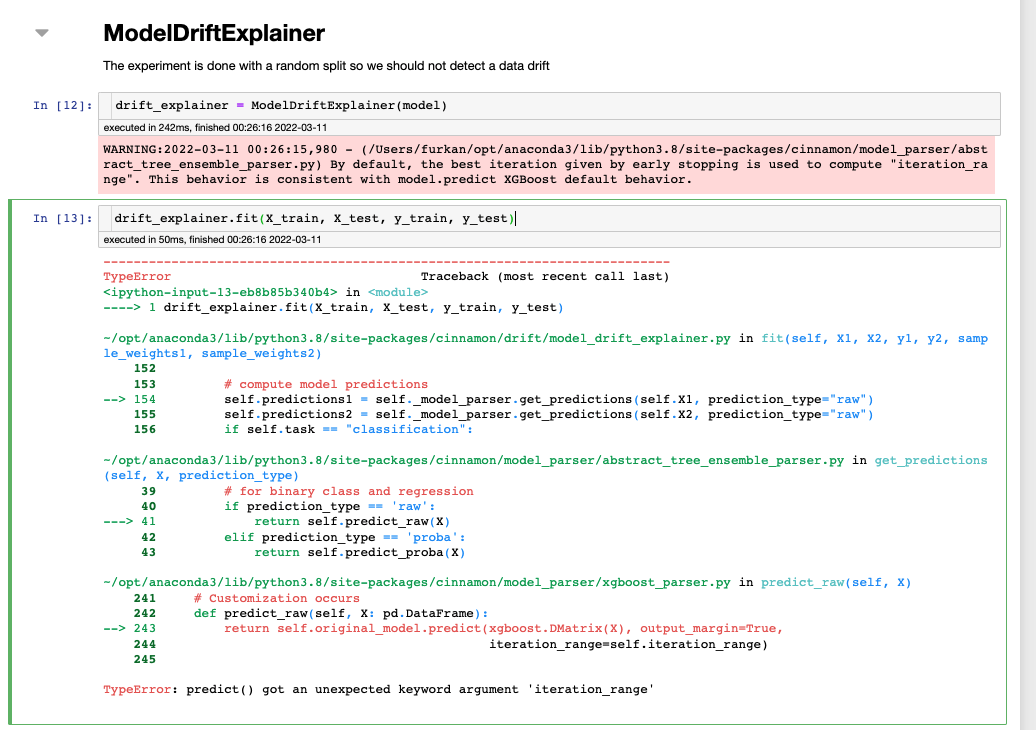
  • TypeError: predict() got an unexpected keyword argument 'iteration_range'

    TypeError: predict() got an unexpected keyword argument 'iteration_range'

    Hi cinnamon team, Firstly, thanks for bringing such a cool package!

    I was working with your package and I have come across the following error. Then, I checked your example notebook examples/boston_XGBoost_ModelDriftExplainer.ipynb, to be sure whether I used it correctly, but got the same error:

    TypeError: predict() got an unexpected keyword argument 'iteration_range'
    

    Screenshot 2022-03-11 at 00 26 44

    Could you please let me know how to overcome this issue (maybe I am using an obsolete version of a package)?

    Environment details:

    • macOS v.12.1
    • Python 3.8.8
    • cinnamon==0.1.2
    • xgboost==1.4.2

    Thanks for your help in advance!

    opened by furkanmtorun 0
Releases(0.2)
  • 0.2(Dec 9, 2022)

    Update to “ModelDriftExplainer”:

    • Add model agnostic support (deals with black box models / pipelines)
    • Add model specific support for CatBoost
    • Add support for categorical features
    • Add support for prediction_type = “class”

    Create a documentation website.

    Source code(tar.gz)
    Source code(zip)
Owner
Zelros
IA for Augmented Insurers
Zelros
30 Days Of Machine Learning Using Pytorch

Objective of the repository is to learn and build machine learning models using Pytorch. 30DaysofML Using Pytorch

Mayur 119 Nov 24, 2022
Kalman filter library

The kalman filter framework described here is an incredibly powerful tool for any optimization problem, but particularly for visual odometry, sensor fusion localization or SLAM.

comma.ai 276 Jan 01, 2023
Exemplary lightweight and ready-to-deploy machine learning project

Exemplary lightweight and ready-to-deploy machine learning project

snapADDY GmbH 6 Dec 20, 2022
ELI5 is a Python package which helps to debug machine learning classifiers and explain their predictions

A library for debugging/inspecting machine learning classifiers and explaining their predictions

154 Dec 17, 2022
Climin is a Python package for optimization, heavily biased to machine learning scenarios

climin climin is a Python package for optimization, heavily biased to machine learning scenarios distributed under the BSD 3-clause license. It works

Biomimetic Robotics and Machine Learning at Technische Universität München 177 Sep 02, 2022
nn-Meter is a novel and efficient system to accurately predict the inference latency of DNN models on diverse edge devices

A DNN inference latency prediction toolkit for accurately modeling and predicting the latency on diverse edge devices.

Microsoft 241 Dec 26, 2022
Machine Learning Model to predict the payment date of an invoice when it gets created in the system.

Payment-Date-Prediction Machine Learning Model to predict the payment date of an invoice when it gets created in the system.

15 Sep 09, 2022
CyLP is a Python interface to COIN-OR’s Linear and mixed-integer program solvers (CLP, CBC, and CGL)

CyLP CyLP is a Python interface to COIN-OR’s Linear and mixed-integer program solvers (CLP, CBC, and CGL). CyLP’s unique feature is that you can use i

COIN-OR Foundation 161 Dec 14, 2022
Data Efficient Decision Making

Data Efficient Decision Making

Microsoft 197 Jan 06, 2023
An MLOps framework to package, deploy, monitor and manage thousands of production machine learning models

Seldon Core: Blazing Fast, Industry-Ready ML An open source platform to deploy your machine learning models on Kubernetes at massive scale. Overview S

Seldon 3.5k Jan 01, 2023
Distributed deep learning on Hadoop and Spark clusters.

Note: we're lovingly marking this project as Archived since we're no longer supporting it. You are welcome to read the code and fork your own version

Yahoo 1.3k Dec 28, 2022
Python package for machine learning for healthcare using a OMOP common data model

This library was developed in order to facilitate rapid prototyping in Python of predictive machine-learning models using longitudinal medical data from an OMOP CDM-standard database.

Sontag Lab 75 Jan 03, 2023
MLR - Machine Learning Research

Machine Learning Research 1. Project Topic 1.1. Exsiting research Benmark: https://paperswithcode.com/sota ACL anthology for NLP papers: http://www.ac

Charles 69 Oct 20, 2022
50% faster, 50% less RAM Machine Learning. Numba rewritten Sklearn. SVD, NNMF, PCA, LinearReg, RidgeReg, Randomized, Truncated SVD/PCA, CSR Matrices all 50+% faster

[Due to the time taken @ uni, work + hell breaking loose in my life, since things have calmed down a bit, will continue commiting!!!] [By the way, I'm

Daniel Han-Chen 1.4k Jan 01, 2023
Machine Learning Algorithms

Machine-Learning-Algorithms In this project, the dataset was created through a survey opened on Google forms. The purpose of the form is to find the p

Göktuğ Ayar 3 Aug 10, 2022
A library of sklearn compatible categorical variable encoders

Categorical Encoding Methods A set of scikit-learn-style transformers for encoding categorical variables into numeric by means of different techniques

2.1k Jan 07, 2023
Crypto-trading - ML techiques are used to forecast short term returns in 14 popular cryptocurrencies

Crypto-trading - ML techiques are used to forecast short term returns in 14 popular cryptocurrencies. We have amassed a dataset of millions of rows of high-frequency market data dating back to 2018 w

Panagiotis (Panos) Mavritsakis 4 Sep 22, 2022
Machine-learning-dell - Repositório com as atividades desenvolvidas no curso de Machine Learning

📚 Descrição Neste curso da Dell aprofundamos nossos conhecimentos em Machine Learning. 🖥️ Aulas (Em curso) 1.1 - Python aplicado a Data Science 1.2

Claudia dos Anjos 1 Jan 05, 2022
Decision Tree Regression algorithm implemented on Python from scratch.

Decision_Tree_Regression I implemented the decision tree regression algorithm on Python. Unlike regular linear regression, this algorithm is used when

1 Dec 22, 2021
Titanic Traveller Survivability Prediction

The aim of the mini project is predict whether or not a passenger survived based on attributes such as their age, sex, passenger class, where they embarked and more.

John Phillip 0 Jan 20, 2022