Neural Module Network (NMN) for VQA in Pytorch
Note: This is NOT an official repository for Neural Module Networks.
NMN is a network that is assembled dynamically by composing shallow network fragments called modules into a deeper structure. These modules are jointly trained to be freely composable. This is a PyTorch implementation of Neural Module Networks for Visual Question Answering. Most Ideas are directly taken from the following paper:
Neural Module Networks: Jacob Andreas, Marcus Rohrbach, Trevor Darrell and Dan Klein. CVPR 2016.
Please cite the above paper in case you use this code in your work. The instructions to reproduce the results can be found below, but first some results demo:
Demo:
More results can be seen with visualize_model.ipynb.
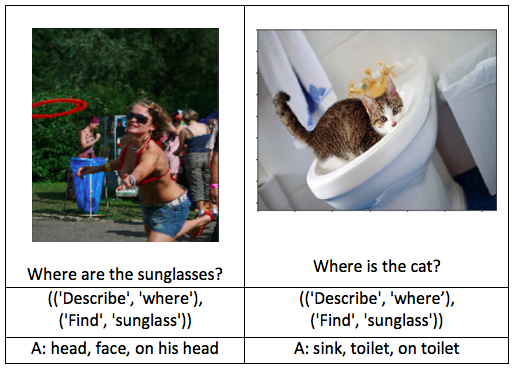 |
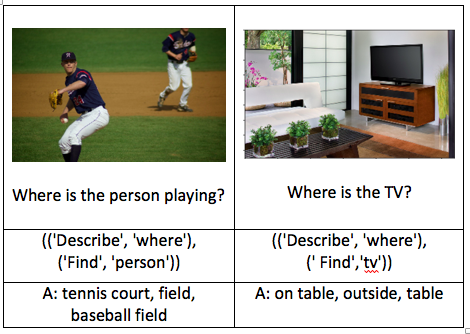 |
|---|---|
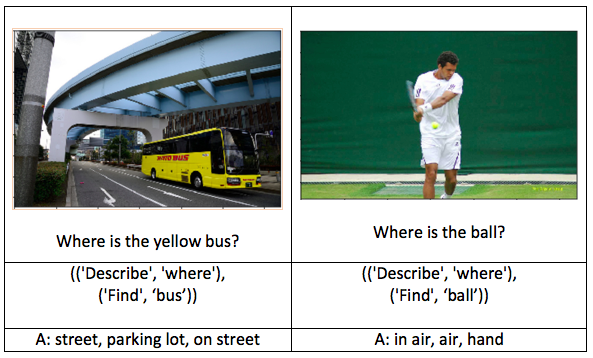 |
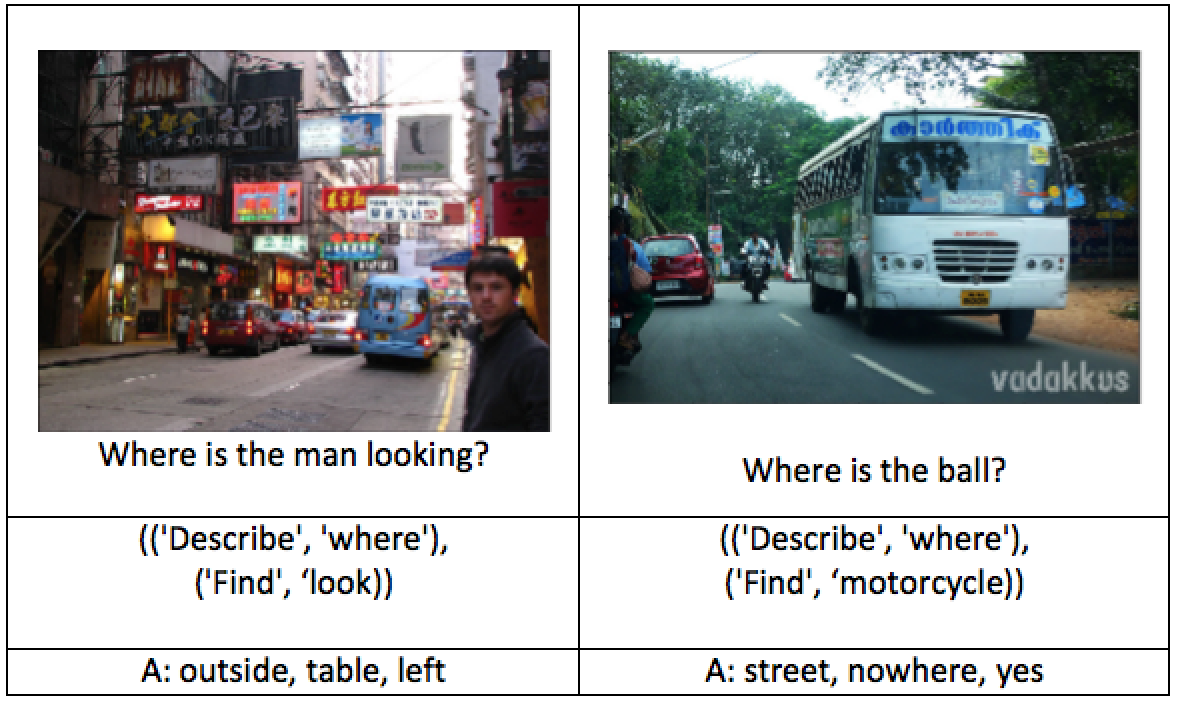 |
Dependencies:
Following are the main python dependencies of the project: torch, torchvision caffe, matplotlib, numpy, matplotlib and sexpdata.
You also need to have stanford parser available. Once dowloaded, make sure to set STANFORDPARSER in .bashrc so that directory $STANFORDPARSER/libexec/ has stanford-parser.jar
Download Data:
You need to download Images, Annotations and Questions from VQA website. And you need to download VGG model file used to preprocess the images. To save you some efforts of making sure downloaded files are appropriate placed in directory structure, I have prepared few download.txt's'
Run the following command in root directory find . | grep download.txt. You should be able to see the following directories containing download.txt:
./preprocessing/lib/download.txt
./raw_data/Annotations/download.txt
./raw_data/Images/download.txt
./raw_data/Questions/download.txt
Each download.txt has specific instruction with wget command that you need to run in the respective directory. Make sure files are as expected as mentioned in corresponding download.txt after downloading data.
Proprocessing:
preprocessing directory contains the scripts required to preprocess the raw_data. This preprocessed data is stored in preprocessed_data. All scripts in this repository operate on some set. When you download the data, the default sets (directory names) are train2014 and val2014. You can build a question type specific subsets like train2014-sub, val2014-sub by using pick_subset.py. You need to be sure that training / testing / validation set names are consistent in the following scripts (generally set at top of code). By default, everything would work on default sets, but if you need specific set, you need to follow the comments below. You need to run the following scripts in order:
1. python preprocessing/pick_subset.py 	[# Optional: If you want to operate on spcific question-type ]
2. python preprocessing/build_answer_vocab.py         [# Run on your Training Set only]
3. python preprocessing/build_layouts.py              [# Run on your Training Set only]
4. python preprocessing/build_module_input_vocab.py   [# Run on your Training Set only]
5. python preprocessing/extract_image_vgg_features.py [# Run on all Train/ Test / Val Sets]
ToDo: Add setting.py to make sure set-names can be globally configured for experiment.
Run Experiments:
You can start training the model with python train_cmp_nn_vqa.py. The accuracy/loss logs will be piped to logs/cmp_nn_vqa.log. Once training is done, the selected model will be automatically saved at saved_models/cmp_nn_vqa.pt
Visualize Model:
The results can be visualized by running visualize_model.ipynb and selecting model name which was saved.
Evaluate Model:
The model can be evaluated by running python evaluation/evaluate.py. A short summary report should be seen on stdout.
To Do:
- Add more documentation
- Some more code cleaning
- Document results of this implementation on VQA datset
- Short blog on implementing NMN in PyTorch
Any Issues?
Please shoot me an email at [email protected]. I will try to fix it as soon as possible.

 25 Mar 14, 2022
 64 Oct 11, 2022
 18 Aug 11, 2022
 104 Dec 08, 2022
 2 Jan 05, 2023
 74 Dec 28, 2022
 1 Jan 17, 2022
 161 Dec 31, 2022
 19 Dec 04, 2022
 2.8k Dec 30, 2022
 20 May 17, 2022
 14 Aug 30, 2022
 4 Nov 14, 2022
 192 Jan 05, 2023
 684 Jan 09, 2023
 42 Jul 25, 2022
 24 Nov 24, 2022
 58 Jan 01, 2023
 1 Jan 04, 2022
 28 Dec 15, 2022