FNet Implementation with TensorFlow & PyTorch

Overview

FNet Implementation with TensorFlow & PyTorch.

TensorFlow & PyTorch implementation of the paper "FNet: Mixing Tokens with Fourier Transforms".

Overview

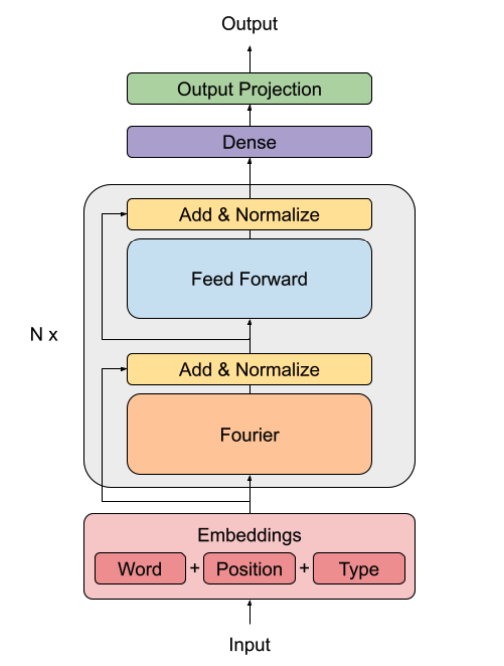
The FNet model was proposed in "FNet: Mixing Tokens with Fourier Transforms" by James Lee-Thorp, Joshua Ainslie, Ilya Eckstein, Santiago Ontanon. The model replaces the self-attention layer in a BERT model with a Fourier transform which returns only the real parts of the transform. The model is significantly faster than the BERT model since it has fewer parameters and is more memory efficient. The model achieves about 92%~97% accuracy of BERT counterparts on the GLUE benchmark and trains much faster than the BERT model. Find the abstract from the paper below.

Abstract

We show that Transformer encoder architectures can be sped up, with limited accuracy costs, by replacing the self-attention sublayers with simple linear transformations that "mix" input tokens. These linear mixers, along with standard nonlinearities in feed-forward layers, prove competent at modeling semantic relationships in several text classification tasks. Most surprisingly, we find that replacing the self-attention sublayer in a Transformer encoder with a standard, unparameterized Fourier Transform achieves 92-97% of the accuracy of BERT counterparts on the GLUE benchmark, but trains 80% faster on GPUs and 70% faster on TPUs at standard 512 input lengths. At longer input lengths, our FNet model is significantly faster: when compared to the "efficient" Transformers on the Long Range Arena benchmark, FNet matches the accuracy of the most accurate models, while outpacing the fastest models across all sequence lengths on GPUs (and across relatively shorter lengths on TPUs). Finally, FNet has a light memory footprint and is particularly efficient at smaller model sizes; for a fixed speed and accuracy budget, small FNet models outperform Transformer counterparts.
Additional Links

Reference

Lee-Thorp, J., Ainslie, J., Eckstein, I., & Ontanon S. (2021). FNet: Mixing Tokens with Fourier Transforms. arXiv preprint arXiv:2105.03824)

Contributing

Github issues and pull requests are welcome. Your feedback is much appreciated!

February 2022, Abdelghani Belgaid

Owner
Abdelghani Belgaid
Abdelghani Belgaid
A human-readable PyTorch implementation of "Self-attention Does Not Need O(n^2) Memory"

memory_efficient_attention.pytorch A human-readable PyTorch implementation of "Self-attention Does Not Need O(n^2) Memory" (Rabe&Staats'21). def effic

Ryuichiro Hataya 7 Dec 26, 2022
A learning-based data collection tool for human segmentation

FullBodyFilter A Learning-Based Data Collection Tool For Human Segmentation Contents Documentation Source Code and Scripts Overview of Project Usage O

Robert Jiang 4 Jun 24, 2022
Source code for our Paper "Learning in High-Dimensional Feature Spaces Using ANOVA-Based Matrix-Vector Multiplication"

NFFT4ANOVA Source code for our Paper "Learning in High-Dimensional Feature Spaces Using ANOVA-Based Matrix-Vector Multiplication" This package uses th

Theresa Wagner 1 Aug 10, 2022
(Personalized) Page-Rank computation using PyTorch

torch-ppr This package allows calculating page-rank and personalized page-rank via power iteration with PyTorch, which also supports calculation on GP

Max Berrendorf 69 Dec 03, 2022
This is a Pytorch implementation of the paper: Self-Supervised Graph Transformer on Large-Scale Molecular Data.

This is a Pytorch implementation of the paper: Self-Supervised Graph Transformer on Large-Scale Molecular Data.

212 Dec 25, 2022
The object detection pipeline is based on Ultralytics YOLOv5

AYOLOv2 The main goal of this repository is to rewrite the object detection pipeline with a better code structure for better portability and adaptabil

153 Dec 22, 2022
MDMM - Learning multi-domain multi-modality I2I translation

Multi-Domain Multi-Modality I2I translation Pytorch implementation of multi-modality I2I translation for multi-domains. The project is an extension to

Hsin-Ying Lee 107 Nov 04, 2022
Google Brain - Ventilator Pressure Prediction

Google Brain - Ventilator Pressure Prediction https://www.kaggle.com/c/ventilator-pressure-prediction The ventilator data used in this competition was

Samuele Cucchi 1 Feb 11, 2022
The implementation of ICASSP 2020 paper "Pixel-level self-paced learning for super-resolution"

Pixel-level Self-Paced Learning for Super-Resolution This is an official implementaion of the paper Pixel-level Self-Paced Learning for Super-Resoluti

Elon Lin 41 Dec 15, 2022
Drslmarkov - Distributionally Robust Structure Learning for Discrete Pairwise Markov Networks

Distributionally Robust Structure Learning for Discrete Pairwise Markov Networks

1 Nov 24, 2022
Lightweight library to build and train neural networks in Theano

Lasagne Lasagne is a lightweight library to build and train neural networks in Theano. Its main features are: Supports feed-forward networks such as C

Lasagne 3.8k Dec 29, 2022
COVINS -- A Framework for Collaborative Visual-Inertial SLAM and Multi-Agent 3D Mapping

COVINS -- A Framework for Collaborative Visual-Inertial SLAM and Multi-Agent 3D Mapping Version 1.0 COVINS is an accurate, scalable, and versatile vis

ETHZ V4RL 183 Dec 27, 2022
MPRNet-Cloud-removal: Progressive cloud removal

MPRNet-Cloud-removal Progressive cloud removal Requirements 1.Pytorch = 1.0 2.Python 3 3.NVIDIA GPU + CUDA 9.0 4.Tensorboard Installation 1.Clone the

Semi 95 Dec 18, 2022
Pretty Tensor - Fluent Neural Networks in TensorFlow

Pretty Tensor provides a high level builder API for TensorFlow. It provides thin wrappers on Tensors so that you can easily build multi-layer neural networks.

Google 1.2k Dec 29, 2022
Implementation of 'X-Linear Attention Networks for Image Captioning' [CVPR 2020]

Introduction This repository is for X-Linear Attention Networks for Image Captioning (CVPR 2020). The original paper can be found here. Please cite wi

JDAI-CV 240 Dec 17, 2022
Supporting code for the Neograd algorithm

Neograd This repo supports the paper Neograd: Gradient Descent with a Near-Ideal Learning Rate, which introduces the algorithm "Neograd". The paper an

Michael Zimmer 12 May 01, 2022
On the model-based stochastic value gradient for continuous reinforcement learning

On the model-based stochastic value gradient for continuous reinforcement learning This repository is by Brandon Amos, Samuel Stanton, Denis Yarats, a

Facebook Research 46 Dec 15, 2022
Diabet Feature Engineering - Predict whether people have diabetes when their characteristics are specified

Diabet Feature Engineering - Predict whether people have diabetes when their characteristics are specified

Şebnem 6 Jan 18, 2022
Allows including an action inside another action (by preprocessing the Yaml file). This is how composite actions should have worked.

actions-includes Allows including an action inside another action (by preprocessing the Yaml file). Instead of using uses or run in your action step,

Tim Ansell 70 Nov 04, 2022
Train robotic agents to learn pick and place with deep learning for vision-based manipulation in PyBullet.

Ravens is a collection of simulated tasks in PyBullet for learning vision-based robotic manipulation, with emphasis on pick and place. It features a Gym-like API with 10 tabletop rearrangement tasks,

Google Research 367 Jan 09, 2023