BABEL: Bodies, Action and Behavior with English Labels [CVPR 2021]
Related tags

Deep LearningBABEL
Overview

BABEL: Bodies, Action and Behavior with English Labels [CVPR 2021]

Abhinanda R. Punnakkal*, Arjun Chandrasekaran*, Nikos Athanasiou, Alejandra Quiros-Ramirez, Michael J. Black. * denotes equal contribution

Project Website | Paper | Video | Poster


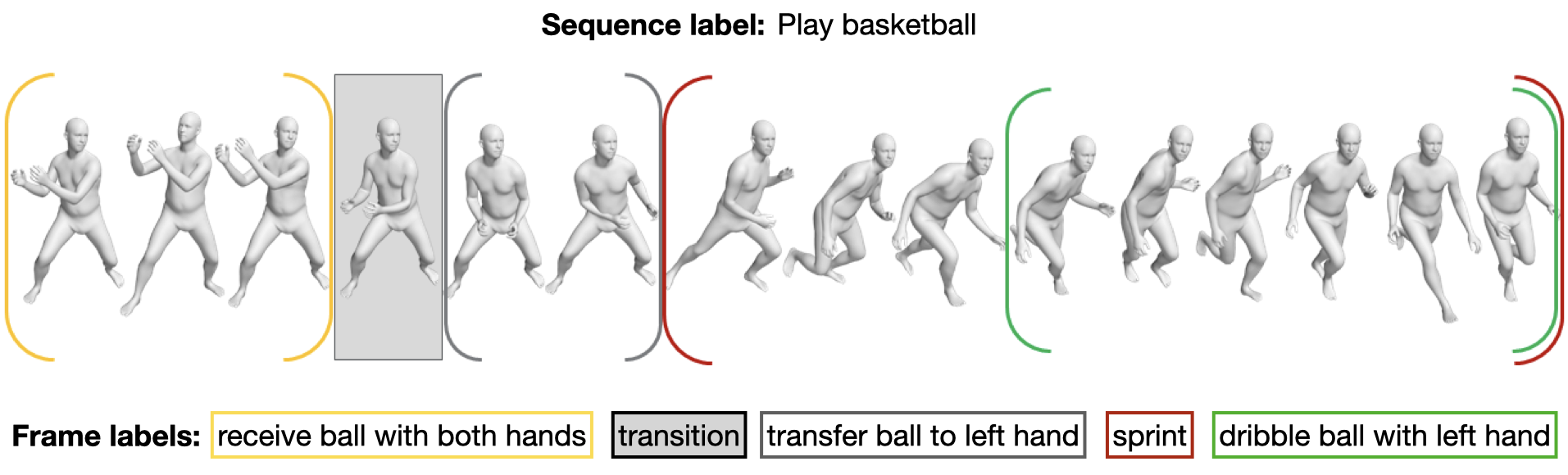
BABEL is a large dataset with language labels describing the actions being performed in mocap sequences. BABEL labels about 43 hours of mocap sequences from AMASS [1] with action labels. Sequences have action labels at two possible levels of abstraction:

  • Sequence labels which describe the overall action in the sequence
  • Frame labels which describe all actions in every frame of the sequence. Each frame label is precisely aligned with the duration of the corresponding action in the mocap sequence, and multiple actions can overlap.

To download the BABEL action labels, visit our 'Data' page. You can download the mocap sequences from AMASS.

Tutorials

We release some helper code in Jupyter notebooks to load the BABEL dataset, visualize mocap sequences and their action labels, search BABEL for sequences containing specific actions, etc.

See notebooks/ for more details.

Action Recognition

We provide features, training and inference code, and pre-trained checkpoints for 3D skeleton-based action recognition.

Please see action_recognition/ for more details.

Acknowledgements

The notebooks in this repo are inspired by the those provided by AMASS. The Action Recognition code is based on the 2s-AGCN implementation.

References

[1] Mahmood, Naureen, et al. "AMASS: Archive of motion capture as surface shapes." Proceedings of the IEEE/CVF International Conference on Computer Vision. 2019.

License

Software Copyright License for non-commercial scientific research purposes. Please read carefully the terms and conditions and any accompanying documentation before you download and/or use the AMASS dataset, and software, (the "Model & Software"). By downloading and/or using the Model & Software (including downloading, cloning, installing, and any other use of this GitHub repository), you acknowledge that you have read these terms and conditions, understand them, and agree to be bound by them. If you do not agree with these terms and conditions, you must not download and/or use the Model & Software. Any infringement of the terms of this agreement will automatically terminate your rights under this License.

Contact

The code in this repository is developed by Abhinanda Punnakkal and Arjun Chandrasekaran.

If you have any questions you can contact us at [email protected].

Download files from DSpace systems (because for some reason DSpace won't let you)

DSpaceDL A tool for downloading files from DSpace items. For some reason, DSpace systems have a dogshit UI, and Universities absolutely LOOOVE to use

Soumitra Shewale 5 Dec 01, 2022
Logistic Bandit experiments. Official code for the paper "Jointly Efficient and Optimal Algorithms for Logistic Bandits".

Code for the paper Jointly Efficient and Optimal Algorithms for Logistic Bandits, by Louis Faury, Marc Abeille, Clément Calauzènes and Kwang-Sun Jun.

Faury Louis 1 Jan 22, 2022
A light-weight image labelling tool for Python designed for creating segmentation data sets.

An image labelling tool for creating segmentation data sets, for Django and Flask.

117 Nov 21, 2022
DGCNN - Dynamic Graph CNN for Learning on Point Clouds

DGCNN is the author's re-implementation of Dynamic Graph CNN, which achieves state-of-the-art performance on point-cloud-related high-level tasks including category classification, semantic segmentat

Wang, Yue 1.3k Dec 26, 2022
📖 Deep Attentional Guided Image Filtering

📖 Deep Attentional Guided Image Filtering [Paper] Zhiwei Zhong, Xianming Liu, Junjun Jiang, Debin Zhao ,Xiangyang Ji Harbin Institute of Technology,

9 Dec 23, 2022
JUSTICE: A Benchmark Dataset for Supreme Court’s Judgment Prediction

JUSTICE: A Benchmark Dataset for Supreme Court’s Judgment Prediction CSCI 544 Final Project done by: Mohammed Alsayed, Shaayan Syed, Mohammad Alali, S

Smit Patel 3 Dec 28, 2022
We present a regularized self-labeling approach to improve the generalization and robustness properties of fine-tuning.

Overview This repository provides the implementation for the paper "Improved Regularization and Robustness for Fine-tuning in Neural Networks", which

NEU-StatsML-Research 21 Sep 08, 2022
The code for paper "Learning Implicit Fields for Generative Shape Modeling".

implicit-decoder The tensorflow code for paper "Learning Implicit Fields for Generative Shape Modeling", Zhiqin Chen, Hao (Richard) Zhang. Project pag

Zhiqin Chen 353 Dec 30, 2022
The Turing Change Point Detection Benchmark: An Extensive Benchmark Evaluation of Change Point Detection Algorithms on real-world data

Turing Change Point Detection Benchmark Welcome to the repository for the Turing Change Point Detection Benchmark, a benchmark evaluation of change po

The Alan Turing Institute 85 Dec 28, 2022
Code for "Causal autoregressive flows" - AISTATS, 2021

Code for "Causal Autoregressive Flow" This repository contains code to run and reproduce experiments presented in Causal Autoregressive Flows, present

Ricardo Pio Monti 35 Dec 16, 2022
Continual reinforcement learning baselines: experiment specifications, implementation of existing methods, and common metrics. Easily extensible to new methods.

Continual Reinforcement Learning This repository provides a simple way to run continual reinforcement learning experiments in PyTorch, including evalu

55 Dec 24, 2022
ParaGen is a PyTorch deep learning framework for parallel sequence generation

ParaGen is a PyTorch deep learning framework for parallel sequence generation. Apart from sequence generation, ParaGen also enhances various NLP tasks, including sequence-level classification, extrac

Bytedance Inc. 169 Dec 22, 2022
Understanding and Improving Encoder Layer Fusion in Sequence-to-Sequence Learning (ICLR 2021)

Understanding and Improving Encoder Layer Fusion in Sequence-to-Sequence Learning (ICLR 2021) Citation Please cite as: @inproceedings{liu2020understan

Sunbow Liu 22 Nov 25, 2022
Code for "Modeling Indirect Illumination for Inverse Rendering", CVPR 2022

Modeling Indirect Illumination for Inverse Rendering Project Page | Paper | Data Preparation Set up the python environment conda create -n invrender p

ZJU3DV 116 Jan 03, 2023
Code for Learning Manifold Patch-Based Representations of Man-Made Shapes, in ICLR 2021.

LearningPatches | Webpage | Paper | Video Learning Manifold Patch-Based Representations of Man-Made Shapes Dmitriy Smirnov, Mikhail Bessmeltsev, Justi

Dima Smirnov 22 Nov 14, 2022
PFFDTD is an open-source FDTD simulator for 3D room acoustics

PFFDTD is an open-source FDTD simulator for 3D room acoustics

Brian Hamilton 34 Nov 24, 2022
Object-aware Contrastive Learning for Debiased Scene Representation

Object-aware Contrastive Learning Official PyTorch implementation of "Object-aware Contrastive Learning for Debiased Scene Representation" by Sangwoo

43 Dec 14, 2022
Attention-based Transformation from Latent Features to Point Clouds (AAAI 2022)

Attention-based Transformation from Latent Features to Point Clouds This repository contains a PyTorch implementation of the paper: Attention-based Tr

12 Nov 11, 2022
An official reimplementation of the method described in the INTERSPEECH 2021 paper - Speech Resynthesis from Discrete Disentangled Self-Supervised Representations.

Speech Resynthesis from Discrete Disentangled Self-Supervised Representations Implementation of the method described in the Speech Resynthesis from Di

Facebook Research 253 Jan 06, 2023
Research code for the paper "How Good is Your Tokenizer? On the Monolingual Performance of Multilingual Language Models"

Introduction This repository contains research code for the ACL 2021 paper "How Good is Your Tokenizer? On the Monolingual Performance of Multilingual

AdapterHub 20 Aug 04, 2022