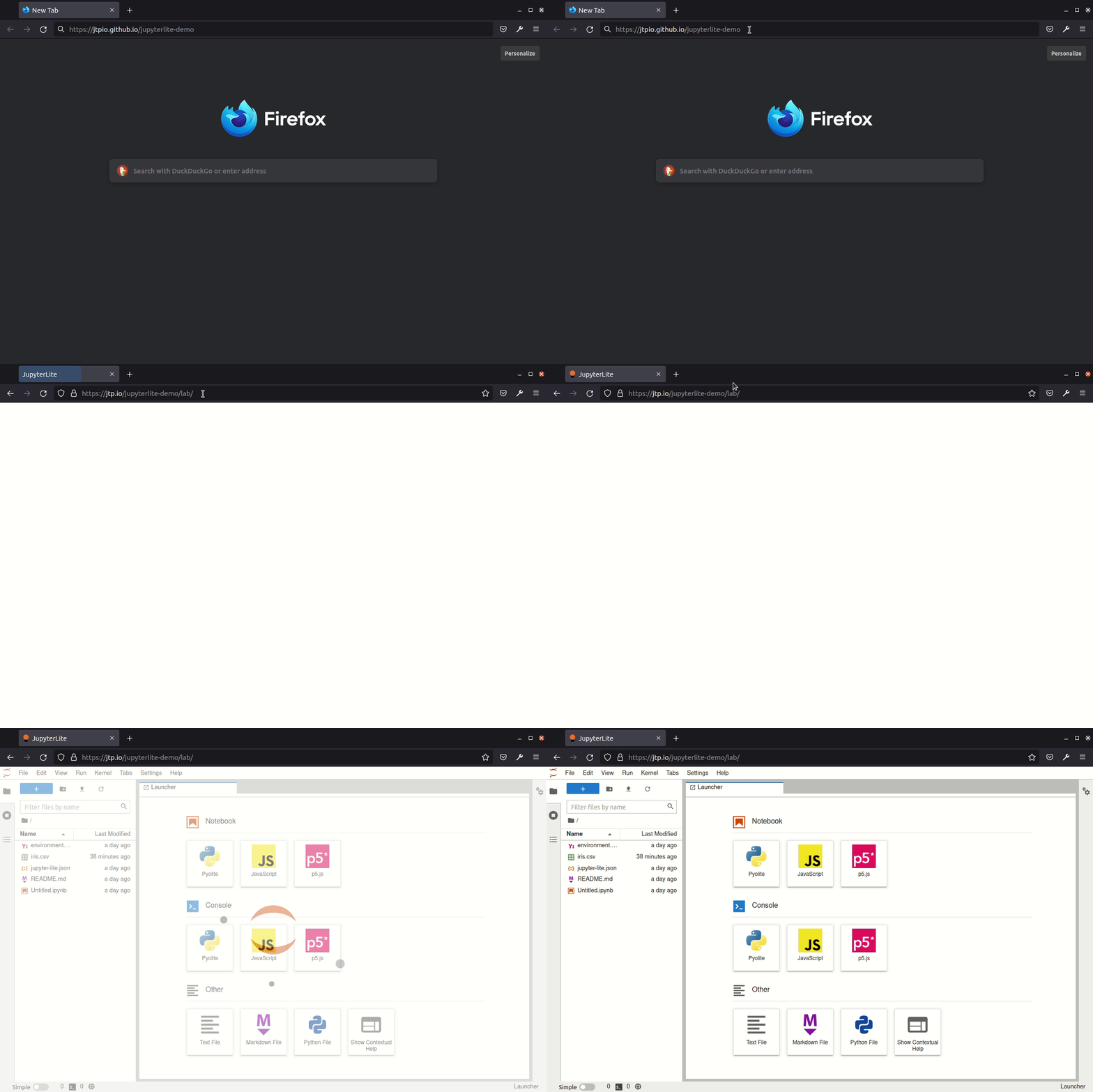
JupyterLite demo deployed to GitHub Pages 🚀

Related tags

Deep Learningdemo
Overview

JupyterLite Demo

lite-badge

JupyterLite deployed as a static site to GitHub Pages, for demo purposes.

Try it in your browser

➡️ https://jupyterlite.github.io/demo

github-pages

Requirements

JupyterLite is being tested against modern web browsers:

  • Firefox 90+
  • Chromium 89+

Usage

This repository provides a demonstration of how to:

  • build a JupyterLite release using prebuilt JupyterLite assets that bundles a collection of pre-existing Jupyter notebooks as part of the distribution;
  • deploy the release to GitHub Pages.

The process is automated using Github Actions.

You can use this repository in two main ways:

  • generate a new repository from this template repository and build and deploy your own site to the corresponding Github Pages site;
  • build a release from a PR made to this repository and download the release from the created GitHub Actions artifact.

Using Your Own Repository to Build a Release and Deploy it to Github Pages

Requires Github account.

Click on "Use this template" to generate a repository of your own from this template:

template

From the Actions tab on your repository, ensure that workflows are enabled. When you make a commit to the main branch, a Github Action will run to build your JupoyterLite release and deploy it to the repository's Github Pages site. By default, the Github Pages site will be found at YOUR_GITHUB_USERNAME.github.io/YOUR_REPOSITORY-NAME. You can also check the URL from the Repository Settings tab Pages menu item.

If the deployment failed, go to "Settings - Actions - General", in the "Workflow permissions" section, check "Read and write permissions". Update files such as readme, and commit so that GitHub rebuids and re-deploys the project. Go to "Settings - Pages", choose "gh-pages" as the source.

Add any additional requirements as required to the requirements.txt file.

You can do this via the Github website by selecting the requirements.txt file, clicking to edit it, making the required changes then saving ("committing") the result to the main branch of your repository.

Modify the contents of the contents folder to include the notebooks you want to distribute as part of your distribution.

You can do this by clicking on the contents directory and dragging notebooks from your desktop onto the contents listing. Wait for the files to be uploaded and then save them ("commit" them) to the main branch of the repository.

Check that you have Github Pages enabled for your repository: from your repository Settings tab, select the Pages menu item and ensure that the source is set to gh-pages.

When you commit a file, an updated release will be built and published on the Github Pages site. Note that it may take a few minutes for the Github Pages site to be updated. Do a hard refresh on your Github Pages site in your web browser to see the new release.

Further Information and Updates

For more info, keep an eye on the JupyterLite documentation:

Deploy a new version of JupyterLite

To change the version of the prebuilt JupyterLite assets, update the jupyterlite package version in the requirements.txt file.

The requirements.txt file can also be used to add extra prebuilt ("federated") JupyterLab extensions to the deployed JupyterLite website.

Commit and push any changes. The site will be deployed on the next push to the main branch.

Development

Create a new environment:

mamba create -n jupyterlite-demo
conda activate jupyterlite-demo
pip install -r requirements.txt

Then follow the steps documented in the Configuring section.

Owner
JupyterLite
Wasm powered Jupyter running in the browser 💡
JupyterLite
CUda Matrix Multiply library.

cumm CUda Matrix Multiply library. cumm is developed during learning of CUTLASS, which use too much c++ template and make code unmaintainable. So I de

49 Dec 27, 2022
[ICCV 2021] A Simple Baseline for Semi-supervised Semantic Segmentation with Strong Data Augmentation

[ICCV 2021] A Simple Baseline for Semi-supervised Semantic Segmentation with Strong Data Augmentation

CodingMan 45 Dec 12, 2022
Deep Watershed Transform for Instance Segmentation

Deep Watershed Transform Performs instance level segmentation detailed in the following paper: Min Bai and Raquel Urtasun, Deep Watershed Transformati

193 Nov 20, 2022
Official PyTorch implementation of Learning Intra-Batch Connections for Deep Metric Learning (ICML 2021) published at International Conference on Machine Learning

About This repository the official PyTorch implementation of Learning Intra-Batch Connections for Deep Metric Learning. The config files contain the s

Dynamic Vision and Learning Group 41 Dec 10, 2022
Source code for models described in the paper "AudioCLIP: Extending CLIP to Image, Text and Audio" (https://arxiv.org/abs/2106.13043)

AudioCLIP Extending CLIP to Image, Text and Audio This repository contains implementation of the models described in the paper arXiv:2106.13043. This

458 Jan 02, 2023
Exploring Image Deblurring via Blur Kernel Space (CVPR'21)

Exploring Image Deblurring via Encoded Blur Kernel Space About the project We introduce a method to encode the blur operators of an arbitrary dataset

VinAI Research 118 Dec 19, 2022
Optimizers-visualized - Visualization of different optimizers on local minimas and saddle points.

Optimizers Visualized Visualization of how different optimizers handle mathematical functions for optimization. Contents Installation Usage Functions

Gautam J 1 Jan 01, 2022
A Python Reconnection Tool for alt:V

altv-reconnect What? It invokes a reconnect in the altV Client Dev Console. You get to determine when your local client should reconnect when developi

8 Jun 30, 2022
Robust Instance Segmentation through Reasoning about Multi-Object Occlusion [CVPR 2021]

Robust Instance Segmentation through Reasoning about Multi-Object Occlusion [CVPR 2021] Abstract Analyzing complex scenes with DNN is a challenging ta

Irene Yuan 24 Jun 27, 2022
A modular domain adaptation library written in PyTorch.

A modular domain adaptation library written in PyTorch.

Kevin Musgrave 225 Dec 29, 2022
Seasonal Contrast: Unsupervised Pre-Training from Uncurated Remote Sensing Data

Seasonal Contrast: Unsupervised Pre-Training from Uncurated Remote Sensing Data This is the official PyTorch implementation of the SeCo paper: @articl

ElementAI 101 Dec 12, 2022
An extremely simple, intuitive, hardware-friendly, and well-performing network structure for LiDAR semantic segmentation on 2D range image. IROS21

FIDNet_SemanticKITTI Motivation Implementing complicated network modules with only one or two points improvement on hardware is tedious. So here we pr

YimingZhao 54 Dec 12, 2022
An Open-Source Toolkit for Prompt-Learning.

An Open-Source Framework for Prompt-learning. Overview • Installation • How To Use • Docs • Paper • Citation • What's New? Nov 2021: Now we have relea

THUNLP 2.3k Jan 07, 2023
The source codes for TME-BNA: Temporal Motif-Preserving Network Embedding with Bicomponent Neighbor Aggregation.

TME The source codes for TME-BNA: Temporal Motif-Preserving Network Embedding with Bicomponent Neighbor Aggregation. Our implementation is based on TG

2 Feb 10, 2022
Extreme Lightwegith Portrait Segmentation

Extreme Lightwegith Portrait Segmentation Please go to this link to download code Requirements python 3 pytorch = 0.4.1 torchvision==0.2.1 opencv-pyt

HYOJINPARK 59 Dec 16, 2022
Locally cache assets that are normally streamed in POPULATION: ONE

Population One Localizer This is no longer needed as of the build shipped on 03/03/22, thank you bigbox :) Locally cache assets that are normally stre

Ahman Woods 2 Mar 04, 2022
A Deep learning based streamlit web app which can tell with which bollywood celebrity your face resembles.

Project Name: Which Bollywood Celebrity You look like A Deep learning based streamlit web app which can tell with which bollywood celebrity your face

BAPPY AHMED 20 Dec 28, 2021
The openspoor package is intended to allow easy transformation between different geographical and topological systems commonly used in Dutch Railway

Openspoor The openspoor package is intended to allow easy transformation between different geographical and topological systems commonly used in Dutch

7 Aug 22, 2022
Code for NeurIPS2021 submission "A Surrogate Objective Framework for Prediction+Programming with Soft Constraints"

This repository is the code for NeurIPS 2021 submission "A Surrogate Objective Framework for Prediction+Programming with Soft Constraints". Edit 2021/

10 Dec 20, 2022
Repository for reproducing `Model-Based Robust Deep Learning`

Model-Based Robust Deep Learning (MBRDL) In this repository, we include the code necessary for reproducing the code used in Model-Based Robust Deep Le

Alex Robey 16 Sep 19, 2022