Orthogonal Over-Parameterized Training

Overview

Orthogonal Over-Parameterized Training

By Weiyang Liu, Rongmei Lin, Zhen Liu, James Rehg, Liam Paull, Li Xiong, Le Song, Adrian Weller

License

OPT is released under the MIT License (refer to the LICENSE file for details).

Contents

  1. Introduction
  2. Citation
  3. Short Video Introduction
  4. Requirements
  5. Usage

Introduction

The inductive bias of a neural network is largely determined by the architecture and the training algorithm. To achieve good generalization, how to effectively train a neural network is of great importance. We propose a novel orthogonal over-parameterized training (OPT) framework that can provably minimize the hyperspherical energy which characterizes the diversity of neurons on a hypersphere. See our previous work -- MHE for an in-depth introduction.

By maintaining the minimum hyperspherical energy during training, OPT can greatly improve the empirical generalization. Specifically, OPT fixes the randomly initialized weights of the neurons and learns an orthogonal transformation that applies to these neurons. We consider multiple ways to learn such an orthogonal transformation, including unrolling orthogonalization algorithms, applying orthogonal parameterization, and designing orthogonality-preserving gradient descent. For better scalability, we propose the stochastic OPT which performs orthogonal transformation stochastically for partial dimensions of neurons.

Our OPT is accepted to CVPR 2021 as oral presentation and the full paper is available on arXiv and here.

Citation

If you find our work useful in your research, please consider to cite:

@InProceedings{Liu2021OPT,
    title={Orthogonal Over-Parameterized Training},
    author={Liu, Weiyang and Lin, Rongmei and Liu, Zhen and Rehg, James M. and Paull, Liam 
     and Xiong, Li and Song, Le and Weller, Adrian},
    booktitle={CVPR},
    year={2021}
}

Short Video Introduction

We also provide a short video introduction to help interested readers quickly go over our work and understand the essence of OPT. Please click the following figure to watch the Youtube video.
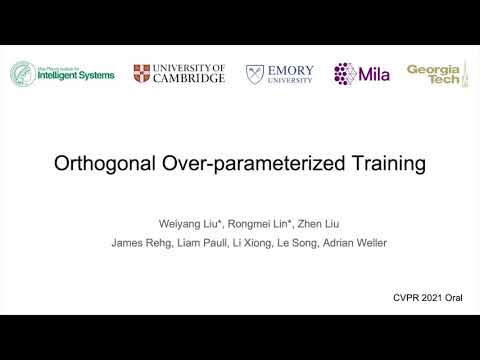
OPT_talk

Requirements

  1. Python 3.7
  2. TensorFlow 1.14.0

Usage

This repository provides both OPT and S-OPT implementations on CIFAR-100 as a demostration.

Part 1: Clone the repositary

git clone https://github.com/wy1iu/OPT.git

Part 2: Download the official CIFAR-100 training and testing data (python version)

wget https://www.cs.toronto.edu/~kriz/cifar-100-python.tar.gz

Part 3: Train and test with the following code in different folder.

# Run Cayley Parameterization OPT
cd opt_cp
python train.py
# Run Gram-Schmidt OPT
cd opt_gs
python train.py
# Run Householder Reflection OPT
cd opt_hr
python train.py
# Run Lowdin’s Symmetric OPT
cd opt_ls
python train.py
# Run Orthogonality-Preserving Gradient Descent OPT
cd opt_ogd
python train.py
# Run Stochastic OPT (Gram-Schmidt)
cd sopt_gs
python train.py

Contact

Owner
Weiyang Liu
Weiyang Liu
9th place solution

AllDataAreExt-Galixir-Kaggle-HPA-2021-Solution Team Members Qishen Ha is Master of Engineering from the University of Tokyo. Machine Learning Engineer

daishu 5 Nov 18, 2021
A script written in Python that returns a consensus string and profile matrix of a given DNA string(s) in FASTA format.

A script written in Python that returns a consensus string and profile matrix of a given DNA string(s) in FASTA format.

Zain 1 Feb 01, 2022
Fang Zhonghao 13 Nov 19, 2022
Code for "Intra-hour Photovoltaic Generation Forecasting based on Multi-source Data and Deep Learning Methods."

pv_predict_unet-lstm Code for "Intra-hour Photovoltaic Generation Forecasting based on Multi-source Data and Deep Learning Methods." IEEE Transactions

FolkScientistInDL 8 Oct 08, 2022
[NeurIPS'21] Projected GANs Converge Faster

[Project] [PDF] [Supplementary] [Talk] This repository contains the code for our NeurIPS 2021 paper "Projected GANs Converge Faster" by Axel Sauer, Ka

798 Jan 04, 2023
Bonnet: An Open-Source Training and Deployment Framework for Semantic Segmentation in Robotics.

Bonnet: An Open-Source Training and Deployment Framework for Semantic Segmentation in Robotics. By Andres Milioto @ University of Bonn. (for the new P

Photogrammetry & Robotics Bonn 314 Dec 30, 2022
Flexible-Modal Face Anti-Spoofing: A Benchmark

Flexible-Modal FAS This is the official repository of "Flexible-Modal Face Anti-

Zitong Yu 22 Nov 10, 2022
AAI supports interdisciplinary research to help better understand human, animal, and artificial cognition.

AnimalAI 3 AAI supports interdisciplinary research to help better understand human, animal, and artificial cognition. It aims to support AI research t

Matthew Crosby 58 Dec 12, 2022
ManipulaTHOR, a framework that facilitates visual manipulation of objects using a robotic arm

ManipulaTHOR: A Framework for Visual Object Manipulation Kiana Ehsani, Winson Han, Alvaro Herrasti, Eli VanderBilt, Luca Weihs, Eric Kolve, Aniruddha

AI2 65 Dec 30, 2022
Official source code of paper 'IterMVS: Iterative Probability Estimation for Efficient Multi-View Stereo'

IterMVS official source code of paper 'IterMVS: Iterative Probability Estimation for Efficient Multi-View Stereo' Introduction IterMVS is a novel lear

Fangjinhua Wang 127 Jan 04, 2023
A Neural Net Training Interface on TensorFlow, with focus on speed + flexibility

Tensorpack is a neural network training interface based on TensorFlow. Features: It's Yet Another TF high-level API, with speed, and flexibility built

Tensorpack 6.2k Jan 01, 2023
Official PyTorch implementation of "Evolving Search Space for Neural Architecture Search"

Evolving Search Space for Neural Architecture Search Usage Install all required dependencies in requirements.txt and replace all ..path/..to in the co

Yuanzheng Ci 10 Oct 24, 2022
[ICLR 2021] "CPT: Efficient Deep Neural Network Training via Cyclic Precision" by Yonggan Fu, Han Guo, Meng Li, Xin Yang, Yining Ding, Vikas Chandra, Yingyan Lin

CPT: Efficient Deep Neural Network Training via Cyclic Precision Yonggan Fu, Han Guo, Meng Li, Xin Yang, Yining Ding, Vikas Chandra, Yingyan Lin Accep

26 Oct 25, 2022
🔮 Execution time predictions for deep neural network training iterations across different GPUs.

Habitat: A Runtime-Based Computational Performance Predictor for Deep Neural Network Training Habitat is a tool that predicts a deep neural network's

Geoffrey Yu 44 Dec 27, 2022
Tree Nested PyTorch Tensor Lib

DI-treetensor treetensor is a generalized tree-based tensor structure mainly developed by OpenDILab Contributors. Almost all the operation can be supp

OpenDILab 167 Dec 29, 2022
Custom implementation of Corrleation Module

Pytorch Correlation module this is a custom C++/Cuda implementation of Correlation module, used e.g. in FlowNetC This tutorial was used as a basis for

Clément Pinard 361 Dec 12, 2022
Genetic Programming in Python, with a scikit-learn inspired API

Welcome to gplearn! gplearn implements Genetic Programming in Python, with a scikit-learn inspired and compatible API. While Genetic Programming (GP)

Trevor Stephens 1.3k Jan 03, 2023
Adversarial Robustness Comparison of Vision Transformer and MLP-Mixer to CNNs

Adversarial Robustness Comparison of Vision Transformer and MLP-Mixer to CNNs ArXiv Abstract Convolutional Neural Networks (CNNs) have become the de f

Philipp Benz 12 Oct 24, 2022
SeqFormer: a Frustratingly Simple Model for Video Instance Segmentation

SeqFormer: a Frustratingly Simple Model for Video Instance Segmentation SeqFormer SeqFormer: a Frustratingly Simple Model for Video Instance Segmentat

Junfeng Wu 298 Dec 22, 2022
PyTorch implementation of Anomaly Transformer: Time Series Anomaly Detection with Association Discrepancy

Anomaly Transformer in PyTorch This is an implementation of Anomaly Transformer: Time Series Anomaly Detection with Association Discrepancy. This pape

spencerbraun 160 Dec 19, 2022