This repository contains the source code of an efficient 1D probabilistic model for music time analysis proposed in ICASSP2022 venue.

Overview

Jump Reward Inference for 1D Music Rhythmic State Spaces

An implementation of the probablistic jump reward inference model for music rhythmic information retrieval using the proposed 1D state space.


PyPI CC BY 4.0

This repository contains the source code and demo videos of a joint music rhythmic analyzer system using the 1D state space and jump reward technique proposed in ICASSP-2022. This implementation includes music beat, downbeat, tempo, and meter tracking jointly and in a causal fashion.

arXiv 2111.00704

The model first takes the waveform to the spectral domain and then feeds them into one of the pre-trained BeatNet models to obtain beat/downbeat activations. Finally, the activations are used in a jump-reward inference model to infer beats, downbeats, tempo, and meter.

System Input:

Raw audio waveform

System Output:

A vector including beats, downbeats, local tempo, and local meter columns, respectively and with the following shape: numpy_array(num_beats, 4).

Installation Command:

Approach #1: Installing binaries from the pypi website:

pip install jump-reward-inference

Approach #2: Installing directly from the Git repository:

pip install git+https://github.com/mjhydri/1D-StateSpace

Usage Example:

estimator = joint_inference(1, plot=True) 

output = estimator.process("music file directory")

Video Demos:

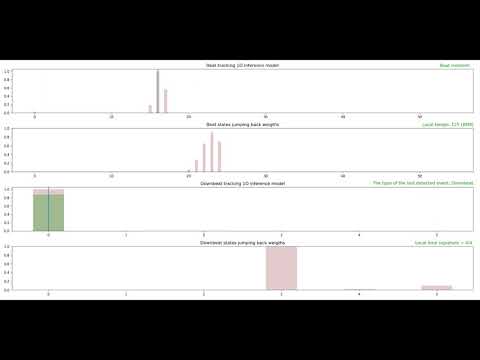
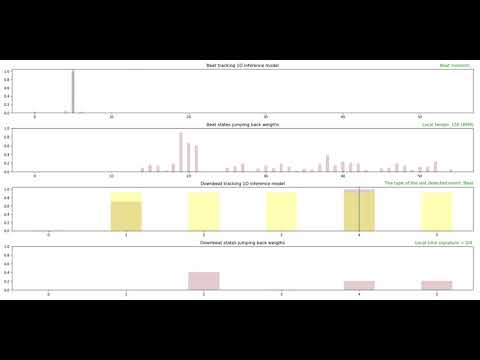
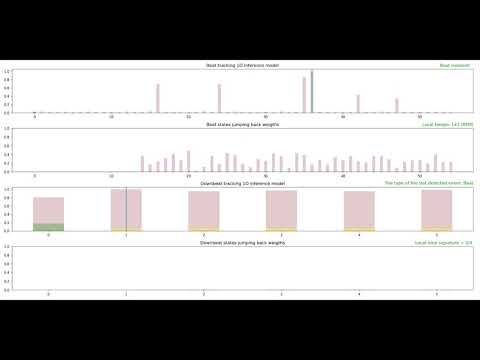
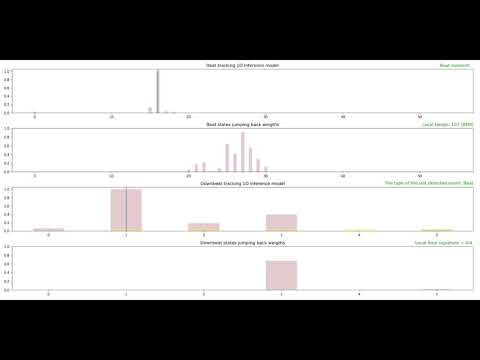
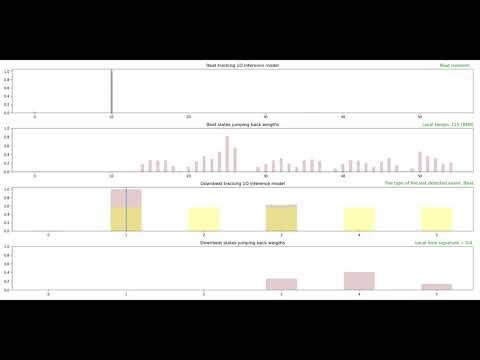
This section demonstrates the system performance for several music genres. Each demo comprises four plots that are described as follows:

  • The first plot: 1D state space for music beat and tempo tracking. Each bar represents the posterior probability of the corresponding state at each time frame.
  • The second plot: The jump-back reward vector for the corresponding beat states.
  • The third plot:1D state space for music downbeat and meter tracking.
  • The fourth plot: The jump-back reward vector for the corresponding downbeat states.

1: Music Genre: Pop
Easy song

2: Music Genre: Country

Easy song

3: Music Genre: Reggae

Easy song

4: Music Genre: Blues

Easy song

5: Music Genre: Classical

Easy song

Demos Discussion:

1- As demo videos suggest, the system infers multiple music rhythmic parameters, including music beat, downbeat, tempo and meter jointly and in an online fashion using very compact 1D state spaces and jump back reward technique. The system works suitably for different music genres. However, the process is relatively more straightforward for some genres such as pop and country due to the rich percussive content, solid attacks, and simpler rhythmic structures. In contrast, it is more challenging for genres with poor percussive profile, longer attack times, and more complex rhythmic structures such as classical music.

2- Since both neural networks and inference models are designed for online/real-time applications, the causalilty constrains are applied and future data is not accessible. It makes the jumpback weigths weaker initially and become stronger over time.

3- Given longer listening time is required to infer higher hierarchies, i.e., downbeat and meter, within the very early few seconds, downbeat results are less confident than lower hierarchies, i.e., beat and tempo, however, they get accurate after observing a bar period.

Acknowledgement

This work has been partially supported by the National Science Foundation grant 1846184.

References:

M. Heydari, M. McCallum, A. Ehmann and Z. Duan, "A Novel 1D State Space for Efficient Music Rhythmic Analysis", In Proc. IEEE Int. Conf. Acoust. Speech Signal Process. (ICASSP), 2022. #(Submitted)

M. Heydari, F. Cwitkowitz, and Z. Duan, “BeatNet:CRNN and particle filtering for online joint beat down-beat and meter tracking,” in Proc. of the 22th Intl. Conf.on Music Information Retrieval (ISMIR), 2021.

M. Heydari and Z. Duan, “Don’t Look Back: An online beat tracking method using RNN and enhanced particle filtering,” in Proc. IEEE Int. Conf. Acoust. Speech Signal Process. (ICASSP), 2021.

You might also like...
Code and data of the Fine-Grained R2R Dataset proposed in paper Sub-Instruction Aware Vision-and-Language Navigation

Fine-Grained R2R Code and data of the Fine-Grained R2R Dataset proposed in the EMNLP2020 paper Sub-Instruction Aware Vision-and-Language Navigation. C

Code for CMaskTrack R-CNN (proposed in Occluded Video Instance Segmentation)

CMaskTrack R-CNN for OVIS This repo serves as the official code release of the CMaskTrack R-CNN model on the Occluded Video Instance Segmentation data

Symbolic Parallel Adaptive Importance Sampling for Probabilistic Program Analysis in JAX

SYMPAIS: Symbolic Parallel Adaptive Importance Sampling for Probabilistic Program Analysis Overview | Installation | Documentation | Examples | Notebo

This repository contains various models targetting multimodal representation learning, multimodal fusion for downstream tasks such as multimodal sentiment analysis.

Multimodal Deep Learning 🎆 🎆 🎆 Announcing the multimodal deep learning repository that contains implementation of various deep learning-based model

This repository contains the implementations related to the experiments of a set of publicly available datasets that are used in the time series forecasting research space.

TSForecasting This repository contains the implementations related to the experiments of a set of publicly available datasets that are used in the tim

This is the official source code for SLATE. We provide the code for the model, the training code, and a dataset loader for the 3D Shapes dataset. This code is implemented in Pytorch.

SLATE This is the official source code for SLATE. We provide the code for the model, the training code and a dataset loader for the 3D Shapes dataset.

This Repostory contains the pretrained DTLN-aec model for real-time acoustic echo cancellation.

This Repostory contains the pretrained DTLN-aec model for real-time acoustic echo cancellation.

NU-Wave: A Diffusion Probabilistic Model for Neural Audio Upsampling

NU-Wave: A Diffusion Probabilistic Model for Neural Audio Upsampling For Official repo of NU-Wave: A Diffusion Probabilistic Model for Neural Audio Up

A denoising diffusion probabilistic model (DDPM) tailored for conditional generation of protein distograms

Denoising Diffusion Probabilistic Model for Proteins Implementation of Denoising Diffusion Probabilistic Model in Pytorch. It is a new approach to gen

Comments
  • Tempo off by 5 consistently

    Tempo off by 5 consistently

    Hi Mojtaba,

    I was trying out your package but find that the reported tempo is off consistently by 5. The easiest test of this is to use 808kick120bpm.mp3 from the beatnet package, though I found the same thing with another music sample. Beatnet reports the. correct tempo.

    Any idea what might cause this?

    Best, Alex

    opened by akhudek 0
Releases(v0.0.6)
Owner
Mojtaba Heydari
Ph.D. student at Audio Information Retrieval (AIR) Lab-University of Rochester, Research Intern at SiriusXM/Pandora
Mojtaba Heydari
Sentiment analysis translations of the Bhagavad Gita

Sentiment and Semantic Analysis of Bhagavad Gita Translations It is well known that translations of songs and poems not only breaks rhythm and rhyming

Machine learning and Bayesian inference @ UNSW Sydney 3 Aug 01, 2022
An NVDA add-on to split screen reader and audio from other programs to different sound channels

An NVDA add-on to split screen reader and audio from other programs to different sound channels (add-on idea credit: Tony Malykh)

Joseph Lee 7 Dec 25, 2022
Learnable Boundary Guided Adversarial Training (ICCV2021)

Learnable Boundary Guided Adversarial Training This repository contains the implementation code for the ICCV2021 paper: Learnable Boundary Guided Adve

DV Lab 27 Sep 25, 2022
PyTorch implementation code for the paper MixCo: Mix-up Contrastive Learning for Visual Representation

How to Reproduce our Results This repository contains PyTorch implementation code for the paper MixCo: Mix-up Contrastive Learning for Visual Represen

opcrisis 46 Dec 15, 2022
This is the repository for the paper "Have I done enough planning or should I plan more?"

Metacognitive Learning Tool box https://re.is.mpg.de What Is This? This repository contains two modules used to analyse metacognitive learning in huma

0 Dec 01, 2021
PyTorch Code of "Memory In Memory: A Predictive Neural Network for Learning Higher-Order Non-Stationarity from Spatiotemporal Dynamics"

Memory In Memory Networks It is based on the paper Memory In Memory: A Predictive Neural Network for Learning Higher-Order Non-Stationarity from Spati

Yang Li 12 May 30, 2022
Hyperparameter tuning for humans

KerasTuner KerasTuner is an easy-to-use, scalable hyperparameter optimization framework that solves the pain points of hyperparameter search. Easily c

Keras 2.6k Dec 27, 2022
A small demonstration of using WebDataset with ImageNet and PyTorch Lightning

A small demonstration of using WebDataset with ImageNet and PyTorch Lightning This is a small repo illustrating how to use WebDataset on ImageNet. usi

50 Dec 16, 2022
Single-step adversarial training (AT) has received wide attention as it proved to be both efficient and robust.

Subspace Adversarial Training Single-step adversarial training (AT) has received wide attention as it proved to be both efficient and robust. However,

15 Sep 02, 2022
[CVPR 2022] Official Pytorch code for OW-DETR: Open-world Detection Transformer

OW-DETR: Open-world Detection Transformer (CVPR 2022) [Paper] Akshita Gupta*, Sanath Narayan*, K J Joseph, Salman Khan, Fahad Shahbaz Khan, Mubarak Sh

Akshita Gupta 127 Dec 27, 2022
Heart Arrhythmia Classification

This program takes and input of an ECG in European Data Format (EDF) and outputs the classification for heartbeats into normal vs different types of arrhythmia . It uses a deep learning model for cla

4 Nov 02, 2022
[CVPR 2021] Exemplar-Based Open-Set Panoptic Segmentation Network (EOPSN)

EOPSN: Exemplar-Based Open-Set Panoptic Segmentation Network (CVPR 2021) PyTorch implementation for EOPSN. We propose open-set panoptic segmentation t

Jaedong Hwang 49 Dec 30, 2022
Official pytorch implementation for Learning to Listen: Modeling Non-Deterministic Dyadic Facial Motion (CVPR 2022)

Learning to Listen: Modeling Non-Deterministic Dyadic Facial Motion This repository contains a pytorch implementation of "Learning to Listen: Modeling

50 Dec 17, 2022
WaveFake: A Data Set to Facilitate Audio DeepFake Detection

WaveFake: A Data Set to Facilitate Audio DeepFake Detection This is the code repository for our NeurIPS 2021 (Track on Datasets and Benchmarks) paper

Chair for Sys­tems Se­cu­ri­ty 27 Dec 22, 2022
A project for developing transformer-based models for clinical relation extraction

Clinical Relation Extration with Transformers Aim This package is developed for researchers easily to use state-of-the-art transformers models for ext

uf-hobi-informatics-lab 101 Dec 19, 2022
Multi-Modal Fingerprint Presentation Attack Detection: Evaluation On A New Dataset

PADISI USC Dataset This repository analyzes the PADISI-Finger dataset introduced in Multi-Modal Fingerprint Presentation Attack Detection: Evaluation

USC ISI VISTA Computer Vision 6 Feb 06, 2022
Code to train models from "Paraphrastic Representations at Scale".

Paraphrastic Representations at Scale Code to train models from "Paraphrastic Representations at Scale". The code is written in Python 3.7 and require

John Wieting 71 Dec 19, 2022
A Comparative Framework for Multimodal Recommender Systems

Cornac Cornac is a comparative framework for multimodal recommender systems. It focuses on making it convenient to work with models leveraging auxilia

Preferred.AI 671 Jan 03, 2023
PiCIE: Unsupervised Semantic Segmentation using Invariance and Equivariance in clustering (CVPR2021)

PiCIE: Unsupervised Semantic Segmentation using Invariance and Equivariance in Clustering Jang Hyun Cho1, Utkarsh Mall2, Kavita Bala2, Bharath Harihar

Jang Hyun Cho 164 Dec 30, 2022
Code for Massive-scale Decoding for Text Generation using Lattices

Massive-scale Decoding for Text Generation using Lattices Jiacheng Xu, Greg Durrett TL;DR: a new search algorithm to construct lattices encoding many

Jiacheng Xu 37 Dec 18, 2022