Implementation for the paper SMPLicit: Topology-aware Generative Model for Clothed People (CVPR 2021)

Related tags

Deep LearningSMPLicit
Overview

SMPLicit: Topology-aware Generative Model for Clothed People
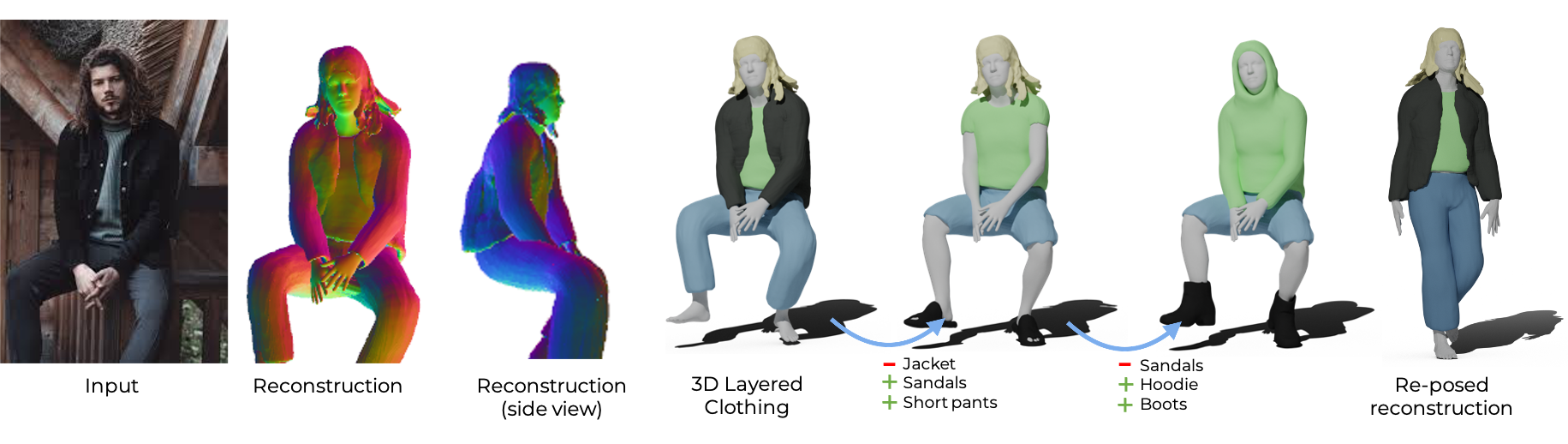
[Project] [arXiv]

License

Software Copyright License for non-commercial scientific research purposes. Please read carefully the terms and conditions and any accompanying documentation before you download and/or use the SMPLicit model, data and software, (the "Model & Software"), including 3D meshes, blend weights, blend shapes, textures, software, scripts, and animations. By downloading and/or using the Model & Software (including downloading, cloning, installing, and any other use of this github repository), you acknowledge that you have read these terms and conditions, understand them, and agree to be bound by them. If you do not agree with these terms and conditions, you must not download and/or use the Model & Software. Any infringement of the terms of this agreement will automatically terminate your rights under this License.

Installation

Follow these commands to install SMPLicit in your environment. The required libraries are standard, with the possible exception of Kaolin which requires a particular version to run with the current code.

  • git clone https://github.com/ecorona/SMPLicit

  • cd SMPLicit

  • Install the dependencies listed in requirements.txt:

    • pip install -r requirements.txt
  • In particular, we use Kaolin v0.1 (see installation command) which should be easy to install. However, if you want to use a later version, you might need to update the import to TriangleMesh in SMPLicit/SMPLicit.py

  • Download the SMPL model from here and place it in SMPLicit/utils/

To be able to import and use SMPLicit in another project, just use run python setup.py install in the main folder.

Usage

To check that everything is going well, run one of the test scripts under the examples folder. The first example will just show a simple T-Shirt on a standard shaped SMPL and visualize it using trimesh, to make sure everything is working.

cd examples/
python example.py

SMPLicit can represent clothes of different types, so the following example will also add lower-body clothes, hair and shoes into the example:

python example_fullbody.py

And finally one can interpolate between clothes of different types. For instance, moving between a jacket, tops, short or long sleeved T-Shirts. The following script will generate object meshes that represent these clothes and will be saved in interpolation/, below the main folder.

python interpolate.py

Citation

If you find the code useful, please cite:

@inproceedings{corona2021smplicit,
    Author = {Enric Corona and Albert Pumarola and Guillem Aleny{\`a} and Pons-Moll, Gerard and Moreno-Noguer, Francesc},
    Title = {SMPLicit: Topology-aware Generative Model for Clothed People},
    Year = {2021},
    booktitle = {CVPR},
}
Source code for From Stars to Subgraphs

GNNAsKernel Official code for From Stars to Subgraphs: Uplifting Any GNN with Local Structure Awareness Visualizations GNN-AK(+) GNN-AK(+) with Subgra

44 Dec 19, 2022
The code for the NeurIPS 2021 paper "A Unified View of cGANs with and without Classifiers".

Energy-based Conditional Generative Adversarial Network (ECGAN) This is the code for the NeurIPS 2021 paper "A Unified View of cGANs with and without

sianchen 22 May 28, 2022
SCNet: Learning Semantic Correspondence

SCNet Code Region matching code is contributed by Kai Han ([email protected]). Dense

Kai Han 34 Sep 06, 2022
AutoML library for deep learning

Official Website: autokeras.com AutoKeras: An AutoML system based on Keras. It is developed by DATA Lab at Texas A&M University. The goal of AutoKeras

Keras 8.7k Jan 08, 2023
Source Code For Template-Based Named Entity Recognition Using BART

Template-Based NER Source Code For Template-Based Named Entity Recognition Using BART Training Training train.py Inference inference.py Corpus ATIS (h

174 Dec 19, 2022
Implementation of the ivis algorithm as described in the paper Structure-preserving visualisation of high dimensional single-cell datasets.

Implementation of the ivis algorithm as described in the paper Structure-preserving visualisation of high dimensional single-cell datasets.

beringresearch 285 Jan 04, 2023
Open source implementation of AceNAS: Learning to Rank Ace Neural Architectures with Weak Supervision of Weight Sharing

AceNAS This repo is the experiment code of AceNAS, and is not considered as an official release. We are working on integrating AceNAS as a built-in st

Yuge Zhang 6 Sep 07, 2022
Re-implementation of 'Grokking: Generalization beyond overfitting on small algorithmic datasets'

Re-implementation of the paper 'Grokking: Generalization beyond overfitting on small algorithmic datasets' Paper Original paper can be found here Data

Tom Lieberum 38 Aug 09, 2022
Neural HMMs are all you need (for high-quality attention-free TTS)

Neural HMMs are all you need (for high-quality attention-free TTS) Shivam Mehta, Éva Székely, Jonas Beskow, and Gustav Eje Henter This is the official

Shivam Mehta 0 Oct 28, 2022
Evaluation framework for testing segmentation networks in PyTorch

Evaluation framework for testing segmentation networks in PyTorch. What segmentation network to choose for next Kaggle competition? This benchmark knows the answer!

Eugene Khvedchenya 37 Apr 27, 2022
A bunch of random PyTorch models using PyTorch's C++ frontend

PyTorch Deep Learning Models using the C++ frontend Gettting started Clone the repo 1. https://github.com/mrdvince/pytorchcpp 2. cd fashionmnist or

Vince 0 Jul 13, 2021
VIL-100: A New Dataset and A Baseline Model for Video Instance Lane Detection (ICCV 2021)

Preparation Please see dataset/README.md to get more details about our datasets-VIL100 Please see INSTALL.md to install environment and evaluation too

82 Dec 15, 2022
Official Pytorch implementation of 'GOCor: Bringing Globally Optimized Correspondence Volumes into Your Neural Network' (NeurIPS 2020)

Official implementation of GOCor This is the official implementation of our paper : GOCor: Bringing Globally Optimized Correspondence Volumes into You

Prune Truong 71 Nov 18, 2022
ULMFiT for Genomic Sequence Data

Genomic ULMFiT This is an implementation of ULMFiT for genomics classification using Pytorch and Fastai. The model architecture used is based on the A

Karl 276 Dec 12, 2022
Official PyTorch implementation for Generic Attention-model Explainability for Interpreting Bi-Modal and Encoder-Decoder Transformers, a novel method to visualize any Transformer-based network. Including examples for DETR, VQA.

PyTorch Implementation of Generic Attention-model Explainability for Interpreting Bi-Modal and Encoder-Decoder Transformers 1 Using Colab Please notic

Hila Chefer 489 Jan 07, 2023
Fuzzing the Kernel Using Unicornafl and AFL++

Unicorefuzz Fuzzing the Kernel using UnicornAFL and AFL++. For details, skim through the WOOT paper or watch this talk at CCCamp19. Is it any good? ye

Security in Telecommunications 283 Dec 26, 2022
A pytorch implementation of Detectron. Both training from scratch and inferring directly from pretrained Detectron weights are available.

Use this instead: https://github.com/facebookresearch/maskrcnn-benchmark A Pytorch Implementation of Detectron Example output of e2e_mask_rcnn-R-101-F

Roy 2.8k Dec 29, 2022
PyTorch implementation for STIN

STIN This repository contains PyTorch implementation for STIN. Abstract: In single-photon LiDAR, photon-efficient imaging captures the 3D structure of

Yiweins 2 Nov 22, 2022
Code for DeepXML: A Deep Extreme Multi-Label Learning Framework Applied to Short Text Documents

DeepXML Code for DeepXML: A Deep Extreme Multi-Label Learning Framework Applied to Short Text Documents Architectures and algorithms DeepXML supports

Extreme Classification 49 Nov 06, 2022
This is the code for the paper "Jinkai Zheng, Xinchen Liu, Wu Liu, Lingxiao He, Chenggang Yan, Tao Mei: Gait Recognition in the Wild with Dense 3D Representations and A Benchmark. (CVPR 2022)"

Gait3D-Benchmark This is the code for the paper "Jinkai Zheng, Xinchen Liu, Wu Liu, Lingxiao He, Chenggang Yan, Tao Mei: Gait Recognition in the Wild

82 Jan 04, 2023