Training RNNs as Fast as CNNs

Related tags

Text Data & NLPsru
Overview

News

SRU++, a new SRU variant, is released. [tech report] [blog]

The experimental code and SRU++ implementation are available on the dev branch which will be merged into master later.

About

SRU is a recurrent unit that can run over 10 times faster than cuDNN LSTM, without loss of accuracy tested on many tasks.
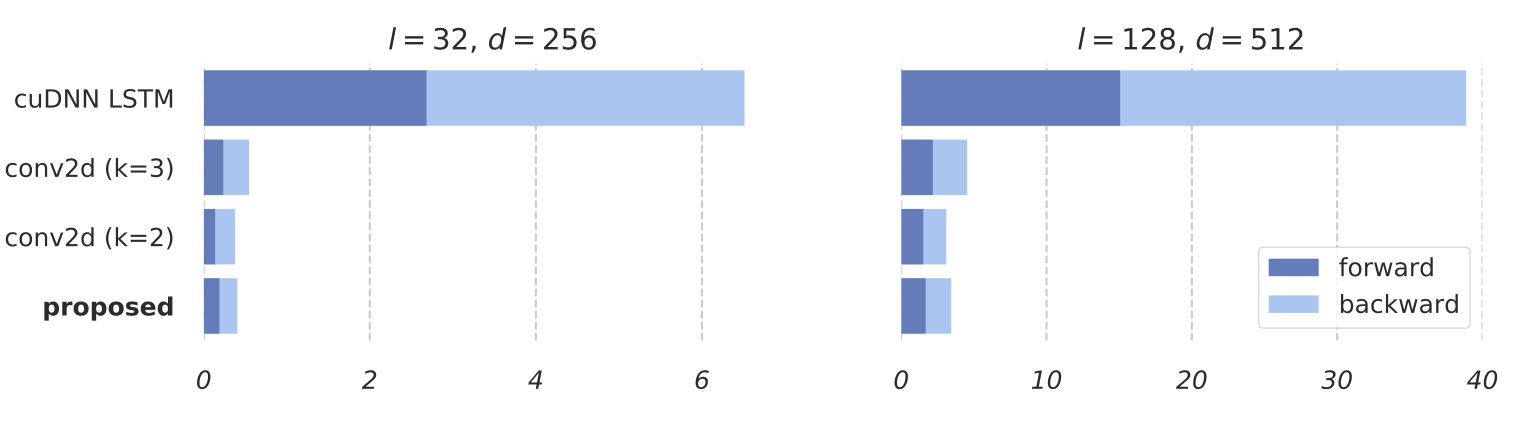

Average processing time of LSTM, conv2d and SRU, tested on GTX 1070

For example, the figure above presents the processing time of a single mini-batch of 32 samples. SRU achieves 10 to 16 times speed-up compared to LSTM, and operates as fast as (or faster than) word-level convolution using conv2d.

Reference:

Simple Recurrent Units for Highly Parallelizable Recurrence [paper]

@inproceedings{lei2018sru,
  title={Simple Recurrent Units for Highly Parallelizable Recurrence},
  author={Tao Lei and Yu Zhang and Sida I. Wang and Hui Dai and Yoav Artzi},
  booktitle={Empirical Methods in Natural Language Processing (EMNLP)},
  year={2018}
}

When Attention Meets Fast Recurrence: Training Language Models with Reduced Compute [paper]

@article{lei2021srupp,
  title={When Attention Meets Fast Recurrence: Training Language Models with Reduced Compute},
  author={Tao Lei},
  journal={arXiv preprint arXiv:2102.12459},
  year={2021}
}

Requirements

Install requirements via pip install -r requirements.txt.


Installation

From source:

SRU can be installed as a regular package via python setup.py install or pip install ..

From PyPi:

pip install sru

Directly use the source without installation:

Make sure this repo and CUDA library can be found by the system, e.g.

export PYTHONPATH=path_to_repo/sru
export LD_LIBRARY_PATH=/usr/local/cuda/lib64

Examples

The usage of SRU is similar to nn.LSTM. SRU likely requires more stacking layers than LSTM. We recommend starting by 2 layers and use more if necessary (see our report for more experimental details).

import torch
from sru import SRU, SRUCell

# input has length 20, batch size 32 and dimension 128
x = torch.FloatTensor(20, 32, 128).cuda()

input_size, hidden_size = 128, 128

rnn = SRU(input_size, hidden_size,
    num_layers = 2,          # number of stacking RNN layers
    dropout = 0.0,           # dropout applied between RNN layers
    bidirectional = False,   # bidirectional RNN
    layer_norm = False,      # apply layer normalization on the output of each layer
    highway_bias = -2,        # initial bias of highway gate (<= 0)
)
rnn.cuda()

output_states, c_states = rnn(x)      # forward pass

# output_states is (length, batch size, number of directions * hidden size)
# c_states is (layers, batch size, number of directions * hidden size)

Contributing

Please read and follow the guidelines.

Other Implementations

@musyoku had a very nice SRU implementaion in chainer.

@adrianbg implemented the first CPU version.


Owner
Tao Lei
Tao Lei
spaCy-wrap: For Wrapping fine-tuned transformers in spaCy pipelines

spaCy-wrap: For Wrapping fine-tuned transformers in spaCy pipelines spaCy-wrap is minimal library intended for wrapping fine-tuned transformers from t

Kenneth Enevoldsen 32 Dec 29, 2022
Analyse japanese ebooks using MeCab to determine the difficulty level for japanese learners

japanese-ebook-analysis This aim of this project is to make analysing the contents of a japanese ebook easy and streamline the process for non-technic

Christoffer Aakre 14 Jul 23, 2022
Natural Language Processing library built with AllenNLP 🌲🌱

Custom Natural Language Processing with big and small models 🌲🌱

Recognai 65 Sep 13, 2022
Codes for coreference-aware machine reading comprehension

Data and code for the paper "Tracing Origins: Coreference-aware Machine Reading Comprehension" at ACL2022. Dataset There are three folders for our thr

11 Sep 29, 2022
A python project made to generate code using either OpenAI's codex or GPT-J (Although not as good as codex)

CodeJ A python project made to generate code using either OpenAI's codex or GPT-J (Although not as good as codex) Install requirements pip install -r

TheProtagonist 1 Dec 06, 2021
Malware-Related Sentence Classification

Malware-Related Sentence Classification This repo contains the code for the ICTAI 2021 paper "Enrichment of Features for Malware-Related Sentence Clas

Chau Nguyen 1 Mar 26, 2022
Sentiment Classification using WSD, Maximum Entropy & Naive Bayes Classifiers

Sentiment Classification using WSD, Maximum Entropy & Naive Bayes Classifiers

Pulkit Kathuria 173 Jan 04, 2023
A PyTorch implementation of paper "Learning Shared Semantic Space for Speech-to-Text Translation", ACL (Findings) 2021

Chimera: Learning Shared Semantic Space for Speech-to-Text Translation This is a Pytorch implementation for the "Chimera" paper Learning Shared Semant

Chi Han 43 Dec 28, 2022
Simple, Pythonic, text processing--Sentiment analysis, part-of-speech tagging, noun phrase extraction, translation, and more.

TextBlob: Simplified Text Processing Homepage: https://textblob.readthedocs.io/ TextBlob is a Python (2 and 3) library for processing textual data. It

Steven Loria 8.4k Dec 26, 2022
This Project is based on NLTK It generates a RANDOM WORD from a predefined list of words, From that random word it read out the word, its meaning with parts of speech , its antonyms, its synonyms

This Project is based on NLTK(Natural Language Toolkit) It generates a RANDOM WORD from a predefined list of words, From that random word it read out the word, its meaning with parts of speech , its

SaiVenkatDhulipudi 2 Nov 17, 2021
Search-Engine - 📖 AI based search engine

Search Engine AI based search engine that was trained on 25000 samples, feel free to train on up to 1.2M sample from kaggle dataset, link below StackS

Vladislav Kruglikov 2 Nov 29, 2022
A PyTorch Implementation of End-to-End Models for Speech-to-Text

speech Speech is an open-source package to build end-to-end models for automatic speech recognition. Sequence-to-sequence models with attention, Conne

Awni Hannun 647 Dec 25, 2022
Full Spectrum Bioinformatics - a free online text designed to introduce key topics in Bioinformatics using the Python

Full Spectrum Bioinformatics is a free online text designed to introduce key topics in Bioinformatics using the Python programming language. The text is written in interactive Jupyter Notebooks, whic

Jesse Zaneveld 33 Dec 28, 2022
This repository contains (not all) code from my project on Named Entity Recognition in philosophical text

NERphilosophy 👋 Welcome to the github repository of my BsC thesis. This repository contains (not all) code from my project on Named Entity Recognitio

Ruben 1 Jan 27, 2022
Takes a string and puts it through different languages in Google Translate a requested amount of times, returning nonsense.

PythonTextObfuscator Takes a string and puts it through different languages in Google Translate a requested amount of times, returning nonsense. Requi

2 Aug 29, 2022
Learning to Rewrite for Non-Autoregressive Neural Machine Translation

RewriteNAT This repo provides the code for reproducing our proposed RewriteNAT in EMNLP 2021 paper entitled "Learning to Rewrite for Non-Autoregressiv

Xinwei Geng 20 Dec 25, 2022
Sequence model architectures from scratch in PyTorch

This repository implements a variety of sequence model architectures from scratch in PyTorch. Effort has been put to make the code well structured so that it can serve as learning material. The train

Brando Koch 11 Mar 28, 2022
BERTAC (BERT-style transformer-based language model with Adversarially pretrained Convolutional neural network)

BERTAC (BERT-style transformer-based language model with Adversarially pretrained Convolutional neural network) BERTAC is a framework that combines a

6 Jan 24, 2022
This repository describes our reproducible framework for assessing self-supervised representation learning from speech

LeBenchmark: a reproducible framework for assessing SSL from speech Self-Supervised Learning (SSL) using huge unlabeled data has been successfully exp

49 Aug 24, 2022
Implemented shortest-circuit disambiguation, maximum probability disambiguation, HMM-based lexical annotation and BiLSTM+CRF-based named entity recognition

Implemented shortest-circuit disambiguation, maximum probability disambiguation, HMM-based lexical annotation and BiLSTM+CRF-based named entity recognition

0 Feb 13, 2022