Invertible conditional GANs for image editing

Related tags

Deep LearningIcGAN
Overview

Invertible Conditional GANs
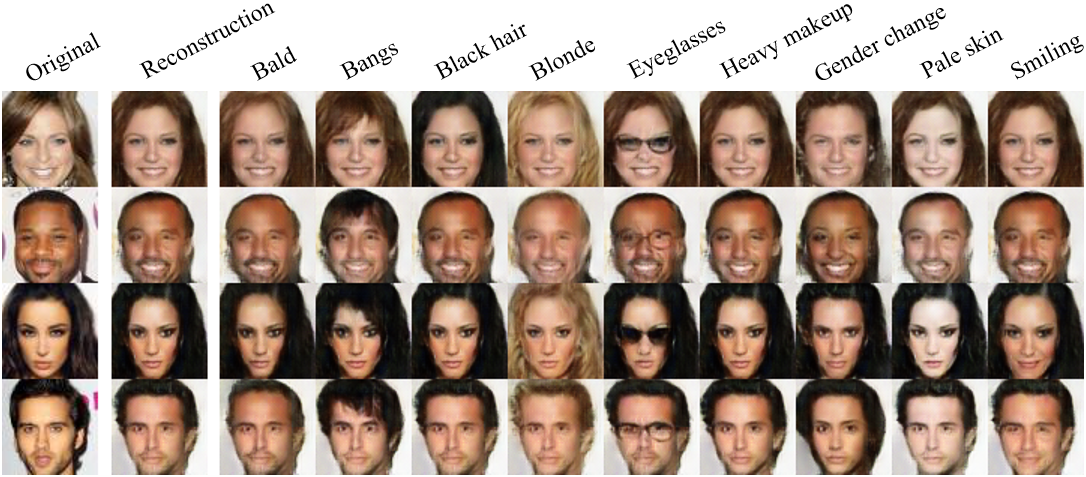
A real image is encoded into a latent representation z and conditional information y, and then decoded into a new image. We fix z for every row, and modify y for each column to obtain variations in real samples.

This is the implementation of the IcGAN model proposed in our paper:

Invertible Conditional GANs for image editing. November 2016.

This paper is a summarized and updated version of my master thesis, which you can find here:

Master thesis: Invertible Conditional Generative Adversarial Networks. September 2016.

The baseline used is the Torch implementation of the DCGAN by Radford et al.

  1. Training the model
    1. Face dataset: CelebA
    2. Digit dataset: MNIST
  2. Visualize the results
    1. Reconstruct and modify real images
    2. Swap attributes
    3. Interpolate between faces

Requisites

Please refer to DCGAN torch repository to know the requirements and dependencies to run the code. Additionally, you will need to install the threads and optnet package:

luarocks install threads

luarocks install optnet

In order to interactively display the results, follow these steps.

1. Training the model

Model overview

The IcGAN is trained in four steps.

  1. Train the generator.
  2. Create a dataset of generated images with the generator.
  3. Train the encoder Z to map an image x to a latent representation z with the dataset generated images.
  4. Train the encoder Y to map an image x to a conditional information vector y with the dataset of real images.

All the parameters of the training phase are located in cfg/mainConfig.lua.

There is already a pre-trained model for CelebA available in case you want to skip the training part. Here you can find instructions on how to use it.

1.1 Train with a face dataset: CelebA

Note: for speed purposes, the whole dataset will be loaded into RAM during training time, which requires about 10 GB of RAM. Therefore, 12 GB of RAM is a minimum requirement. Also, the dataset will be stored as a tensor to load it faster, make sure that you have around 25 GB of free space.

Preprocess

mkdir celebA; cd celebA

Download img_align_celeba.zip here under the link "Align&Cropped Images". Also, you will need to download list_attr_celeba.txt from the same link, which is found under Anno folder.

unzip img_align_celeba.zip; cd ..
DATA_ROOT=celebA th data/preprocess_celebA.lua

Now move list_attr_celeba.txt to celebA folder.

mv list_attr_celeba.txt celebA

Training

  • Conditional GAN: parameters are already configured to run CelebA (dataset=celebA, dataRoot=celebA).

     th trainGAN.lua
  • Generate encoder dataset:

     net=[GENERATOR_PATH] outputFolder=celebA/genDataset/ samples=182638 th data/generateEncoderDataset.lua

    (GENERATOR_PATH example: checkpoints/celebA_25_net_G.t7)

  • Train encoder Z:

     datasetPath=celebA/genDataset/ type=Z th trainEncoder.lua
    
  • Train encoder Y:

     datasetPath=celebA/ type=Y th trainEncoder.lua
    

1.2 Train with a digit dataset: MNIST

Preprocess

Download MNIST as a luarocks package: luarocks install mnist

Training

  • Conditional GAN:

     name=mnist dataset=mnist dataRoot=mnist th trainGAN.lua
  • Generate encoder dataset:

     net=[GENERATOR_PATH] outputFolder=mnist/genDataset/ samples=60000 th data/generateEncoderDataset.lua

    (GENERATOR_PATH example: checkpoints/mnist_25_net_G.t7)

  • Train encoder Z:

     datasetPath=mnist/genDataset/ type=Z th trainEncoder.lua
    
  • Train encoder Y:

     datasetPath=mnist type=Y th trainEncoder.lua
    

2 Pre-trained CelebA model:

CelebA model is available for download here. The file includes the generator and both encoders (encoder Z and encoder Y).

3. Visualize the results

For visualizing the results you will need an already trained IcGAN (i.e. a generator and two encoders). The parameters for generating results are in cfg/generateConfig.lua.

3.1 Reconstruct and modify real images

Reconstrucion example

decNet=celeba_24_G.t7 encZnet=celeba_encZ_7.t7 encYnet=celeba_encY_5.t7 loadPath=[PATH_TO_REAL_IMAGES] th generation/reconstructWithVariations.lua

3.2 Swap attributes

Swap attributes

Swap the attribute information between two pairs of faces.

decNet=celeba_24_G.t7 encZnet=celeba_encZ_7.t7 encYnet=celeba_encY_5.t7 im1Path=[IM1] im2Path=[IM2] th generation/attributeTransfer.lua

3.3 Interpolate between faces

Interpolation

decNet=celeba_24_G.t7 encZnet=celeba_encZ_7.t7 encYnet=celeba_encY_5.t7 im1Path=[IM1] im2Path=[IM2] th generation/interpolate.lua

Do you like or use our work? Please cite us as

@inproceedings{Perarnau2016,
  author    = {Guim Perarnau and
               Joost van de Weijer and
               Bogdan Raducanu and
               Jose M. \'Alvarez},
  title     = {{Invertible Conditional GANs for image editing}},
  booktitle   = {NIPS Workshop on Adversarial Training},
  year      = {2016},
}
Owner
Guim
Guim
🎁 3,000,000+ Unsplash images made available for research and machine learning

The Unsplash Dataset The Unsplash Dataset is made up of over 250,000+ contributing global photographers and data sourced from hundreds of millions of

Unsplash 2k Jan 03, 2023
The implementation of PEMP in paper "Prior-Enhanced Few-Shot Segmentation with Meta-Prototypes"

Prior-Enhanced network with Meta-Prototypes (PEMP) This is the PyTorch implementation of PEMP. Overview of PEMP Meta-Prototypes & Adaptive Prototypes

Jianwei ZHANG 8 Oct 14, 2021
The BCNet related data and inference model.

BCNet This repository includes the some source code and related dataset of paper BCNet: Learning Body and Cloth Shape from A Single Image, ECCV 2020,

81 Dec 12, 2022
TensorFlow, PyTorch and Numpy layers for generating Orthogonal Polynomials

OrthNet TensorFlow, PyTorch and Numpy layers for generating multi-dimensional Orthogonal Polynomials 1. Installation 2. Usage 3. Polynomials 4. Base C

Chuan 29 May 25, 2022
ReferFormer - Official Implementation of ReferFormer

The official implementation of the paper: Language as Queries for Referring Vide

Jonas Wu 232 Dec 29, 2022
Unofficial implementation of the Involution operation from CVPR 2021

involution_pytorch Unofficial PyTorch implementation of "Involution: Inverting the Inherence of Convolution for Visual Recognition" by Li et al. prese

Rishabh Anand 46 Dec 07, 2022
Explore the Expression: Facial Expression Generation using Auxiliary Classifier Generative Adversarial Network

Explore the Expression: Facial Expression Generation using Auxiliary Classifier Generative Adversarial Network This is the official implementation of

azad 2 Jul 09, 2022
Disentangled Cycle Consistency for Highly-realistic Virtual Try-On, CVPR 2021

Disentangled Cycle Consistency for Highly-realistic Virtual Try-On, CVPR 2021 [WIP] The code for CVPR 2021 paper 'Disentangled Cycle Consistency for H

ChongjianGE 94 Dec 11, 2022
scikit-learn inspired API for CRFsuite

sklearn-crfsuite sklearn-crfsuite is a thin CRFsuite (python-crfsuite) wrapper which provides interface simlar to scikit-learn. sklearn_crfsuite.CRF i

417 Dec 20, 2022
📖 Deep Attentional Guided Image Filtering

📖 Deep Attentional Guided Image Filtering [Paper] Zhiwei Zhong, Xianming Liu, Junjun Jiang, Debin Zhao ,Xiangyang Ji Harbin Institute of Technology,

9 Dec 23, 2022
A Python parser that takes the content of a text file and then reads it into variables.

Text-File-Parser A Python parser that takes the content of a text file and then reads into variables. Input.text File 1. What is your ***? 1. 18 -

Kelvin 0 Jul 26, 2021
Automatically erase objects in the video, such as logo, text, etc.

Video-Auto-Wipe Read English Introduction:Here   本人不定期的基于生成技术制作一些好玩有趣的算法模型,这次带来的作品是“视频擦除”方向的应用模型,它实现的功能是自动感知到视频中我们不想看见的部分(譬如广告、水印、字幕、图标等等)然后进行擦除。由于图标擦

seeprettyface.com 141 Dec 26, 2022
Why Are You Weird? Infusing Interpretability in Isolation Forest for Anomaly Detection

Why, hello there! This is the supporting notebook for the research paper — Why Are You Weird? Infusing Interpretability in Isolation Forest for Anomal

2 Dec 14, 2021
Real-ESRGAN aims at developing Practical Algorithms for General Image Restoration.

Real-ESRGAN Colab Demo for Real-ESRGAN . Portable Windows executable file. You can find more information here. Real-ESRGAN aims at developing Practica

Xintao 17.2k Jan 02, 2023
Deep Learning Interviews book: Hundreds of fully solved job interview questions from a wide range of key topics in AI.

This book was written for you: an aspiring data scientist with a quantitative background, facing down the gauntlet of the interview process in an increasingly competitive field. For most of you, the

4.1k Dec 28, 2022
A PyTorch Library for Accelerating 3D Deep Learning Research

Kaolin: A Pytorch Library for Accelerating 3D Deep Learning Research Overview NVIDIA Kaolin library provides a PyTorch API for working with a variety

NVIDIA GameWorks 3.5k Jan 07, 2023
Python suite to construct benchmark machine learning datasets from the MIMIC-III clinical database.

MIMIC-III Benchmarks Python suite to construct benchmark machine learning datasets from the MIMIC-III clinical database. Currently, the benchmark data

Chengxi Zang 6 Jan 02, 2023
TensorFlow implementation for Bayesian Modeling and Uncertainty Quantification for Learning to Optimize: What, Why, and How

Bayesian Modeling and Uncertainty Quantification for Learning to Optimize: What, Why, and How TensorFlow implementation for Bayesian Modeling and Unce

Shen Lab at Texas A&M University 8 Sep 02, 2022
Official PyTorch code for CVPR 2020 paper "Deep Active Learning for Biased Datasets via Fisher Kernel Self-Supervision"

Deep Active Learning for Biased Datasets via Fisher Kernel Self-Supervision https://arxiv.org/abs/2003.00393 Abstract Active learning (AL) aims to min

Denis 29 Nov 21, 2022
Official implementation of the paper ``Unifying Nonlocal Blocks for Neural Networks'' (ICCV'21)

Spectral Nonlocal Block Overview Official implementation of the paper: Unifying Nonlocal Blocks for Neural Networks (ICCV'21) Spectral View of Nonloca

91 Dec 14, 2022