MatchGAN: A Self-supervised Semi-supervised Conditional Generative Adversarial Network
This repository is the official implementation of MatchGAN: A Self-supervised Semi-supervised Conditional Generative Adversarial Network.
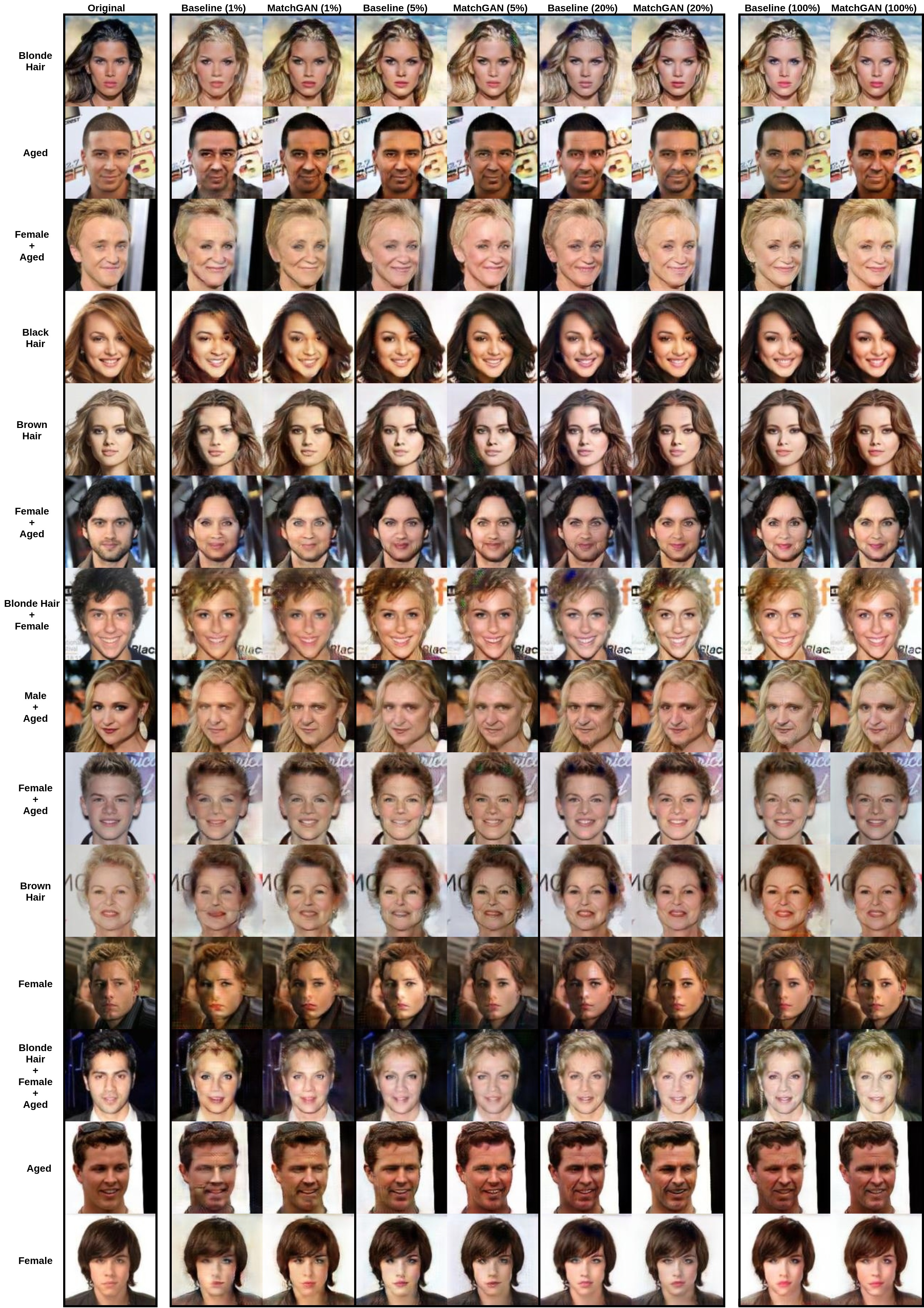
This repository is built upon the framework of StarGAN.
1. Cloning the repository
Clone the repository and navigate to it.
$ git clone https://github.com/justin941208/MatchGAN.git
$ cd MatchGAN/
2. Installing requirements
The following libraries should be separately installed. Instructions are available on their respective websites:
- Python 3.7+ (https://www.python.org/downloads/)
- PyTorch 1.4.0+ with GPU support (https://pytorch.org/)
- TensorFlow 1.14.0+ with GPU support (https://www.tensorflow.org/)
Additional requirements can be installed by running:
pip install -r requirements.txt
To evaluate MatchGAN using GAN-train and GAN-test, the following files should be downloaded and unzipped directly under MatchGAN/.
- checkpoints_train_on_real.zip (https://drive.google.com/file/d/1_b7mVdg0RNdGzgSiUus0PaDcBmo6ot1E/view?usp=sharing).
- tfrecords_test.zip (https://drive.google.com/file/d/1x46OAVW9u519mLI_88d-g2ENA5yUmVaz/view?usp=sharing).
2. Downloading the datasets
To download the CelebA dataset:
$ bash download.sh
In addition, the partition file list_eval_partition.txt should be downloaded from the official CelebA google drive and placed immediately under the directory ./data/celeba/.
To download the RaFD dataset, one must request access to the dataset from the Radboud Faces Database website. Once all the image files are obtained, they need to be placed under the subdirectory ./data/RaFD/data. To preprocess the dataset, run the following command:
$ python preprocess_rafd.py
This will crop all images to 256x256 (centred on face) and split the data into 90% for training and 10% for testing.
3. Training
The command format for training MatchGAN is given by:
$ ./run [dataset] [mode] [labelled percentage] [device]
For example, to train MatchGAN on CelebA with 5% of the training examples labelled on GPU 0, run the following command:
$ ./run celeba train 5 0
To train on RaFD, simply replace "celeba" by "rafd".
4. Testing and evaluating
To test MatchGAN following the above example on CelebA, run the command
$ ./run celeba test 5 0
This will generate synthetic images from the test set and save them to the directory ./matchgan_celeba/results.
To evaluate the model using Frechet Inception Distance (FID), Inception Score (IS), and GAN-test, run the following command:
$ ./run celeba eval 5 0
The following commands trains an external classifier using the synthetic images generated by MatchGAN and then evaluates GAN-train.
$ ./run celeba synth 5 0
$ ./run celeba synth_test 5 0
5. Pretrained model
Pretrained models of MatchGAN (generator only) can be downloaded from this link. To test or evaluate these models, the checkpoint file 200000-G.ckpt should be placed under the directory ./matchgan_celeba/models (for CelebA) or ./matchgan_rafd/models (for RaFD) before running the relevant commands detailed above.
6. Results
Here are some of the results of our pre-trained model from the previous section.
FID
| Percentage of training data labelled | 1% | 5% | 10% | 20% | 50% | 100% |
|---|---|---|---|---|---|---|
| CelebA | 12.31 | 9.34 | 8.81 | 6.34 | - | 5.58 |
| RaFD | - | - | 22.75 | 9.94 | 6.65 | 5.06 |
IS
| Percentage of training data labelled | 1% | 5% | 10% | 20% | 50% | 100% |
|---|---|---|---|---|---|---|
| CelebA | 2.95 | 2.95 | 2.99 | 3.03 | - | 3.07 |
| RaFD | - | - | 1.64 | 1.61 | 1.59 | 1.58 |
GAN-train and GAN-test
These numbers are obtained under the 100% setup.
| GAN-train | GAN-test | |
|---|---|---|
| CelebA | 87.43% | 82.26% |
| RaFD | 97.78% | 75.95% |

 65 Dec 10, 2022
 140 Jan 02, 2023
 6 Oct 14, 2022
 3 Apr 10, 2022
 70 Dec 29, 2022
 504 Dec 30, 2022
 146 Nov 29, 2022
 239 Dec 28, 2022
 12 Nov 22, 2022
 58 Dec 23, 2022
 2 Feb 07, 2022
 25 Nov 15, 2022
 1 Mar 12, 2022
 615 Jan 03, 2023
 2 Mar 28, 2022
 1 Jan 09, 2022
 62 Dec 25, 2022
 42 Jan 02, 2023
 181 Dec 19, 2022
 1 Jan 14, 2022