[CoRL 2021] A robotics benchmark for cross-embodiment imitation.

Overview

x-magical

build license

x-magical is a benchmark extension of MAGICAL specifically geared towards cross-embodiment imitation. The tasks still provide the Demo/Test structure that allows one to evaluate how well imitation or reward learning techniques can generalize the demonstrator's intent to substantially different deployment settings, but there's an added axis of variation focusing on how well these techniques can adapt to systematic embodiment gaps between the demonstrator and the learner. This is a challenging problem, as different embodiments are likely to use unique and suitable strategies that allow them to make progress on a task.

Embodiments in an x-magical task must still learn the same set of general skills like 2D perception and manipulation, but they are specifically designed such that they solve the task in different ways due to differences in their end-effector, shapes, dynamics, etc. For example, in the sweeping task, some agents can sweep all debris in one motion while others need to sweep them one at a time. These differences in execution speeds and state-action trajectories pose challenges for current LfD techniques, and the ability to generalize across embodiments is precisely what this benchmark evaluates.

x-magical is under active development - stay tuned for more tasks and embodiments!

Tasks, Embodiments and Variants

Each task in x-magical can be instantiated with a particular embodiment, which changes the nature of the robotic agent. Additionally, the task can be instantiated in a particular variant, which changes one or more semantic aspects the environment. Both axes of variation are meant to evaluate combinatorial generalization. We list the task-embodiment pairings below, with a picture of the initial state of the Demo variant:

Task Description
SweepToTop: The agent must sweep all three debris to the goal zone shaded in pink. Embodiments: Gripper, Shortstick, MediumStick, Longstick. Variants: all except Jitter.

Here is a description (source) of what each variant modifies:

Variant Description
Demo The default variant with no randomization, i.e. the same initial state across reset().
Jitter The rotations and orientations of all objects, and the size of goal regions, are jittered by up to 5% of the maximum range.
Layout Positions and rotations of all objects are completely randomized. The definition of what constitutes an "object" is task-dependent, i.e. some tasks might not randomize the pose of the robotic agent, just the pushable shapes.
Color The color of blocks and goal regions is randomized, subject to task-specific constraints.
Shape The shape of pushable blocks is randomized, again subject to task-specific constraints.
Dynamics The mass and friction of objects are randomized.
All All applicable randomizations are applied.

Usage

x-magical environments are available in the Gym registry and can be constructed via string specifiers that take on the form <task>-<embodiment>-<observation_space>-<view_mode>-<variant>-v0, where:

  • task: The name of the desired task. See above for the full list of available tasks.
  • embodiment: The embodiment to use for the robotic agent. See above for the list of supported embodiments per task.
  • observation_space: Whether to use pixel or state-based observations. All environments support pixel observations but they may not necessarily provide state-based observation spaces.
  • view_mode: Whether to use an allocentric or egocentric agent view.
  • variant: The variant of the task to use. See above for the full list of variants.

For example, here's a short code snippet that illustrates this usage:

import gym
import xmagical

# This must be called before making any Gym envs.
xmagical.register_envs()

# List all available environments.
print(xmagical.ALL_REGISTERED_ENVS)

# Create a demo variant for the SweepToTop task with a gripper agent.
env = gym.make('SweepToTop-Gripper-Pixels-Allo-Demo-v0')
obs = env.reset()
print(obs.shape)  # (384, 384, 3)
env.render(mode='human')
env.close()

# Now create a test variant of this task with a shortstick agent,
# an egocentric view and a state-based observation space.
env = gym.make('SweepToTop-Shortstick-State-Ego-TestLayout-v0')
init_obs = env.reset()
print(init_obs.shape)  # (16,)
env.close()

Installation

x-magical requires Python 3.8 or higher. We recommend using an Anaconda environment for installation. You can create one with the following:

conda create -n xmagical python=3.8
conda activate xmagical

Installing PyPI release

pip install x-magical

Installing from source

Clone the repository and install in editable mode:

git clone https://github.com/kevinzakka/x-magical.git
cd x-magical
pip install -r requirements.txt
pip install -e .

Contributing

If you'd like to contribute to this project, you should install the extra development dependencies as follows:

pip install -e .[dev]

Acknowledgments

A big thank you to Sam Toyer, the developer of MAGICAL, for the valuable help and discussions he provided during the development of this benchmark. Please consider citing MAGICAL if you find this repository useful:

@inproceedings{toyer2020magical,
  author    = {Sam Toyer and Rohin Shah and Andrew Critch and Stuart Russell},
  title     = {The {MAGICAL} Benchmark for Robust Imitation},
  booktitle = {Advances in Neural Information Processing Systems},
  year      = {2020}
}

Additionally, we'd like to thank Brent Yi for fruitful technical discussions and various debugging sessions.

You might also like...
Disagreement-Regularized Imitation Learning

Due to a normalization bug the expert trajectories have lower performance than the rl_baseline_zoo reported experts. Please see the following link in

PyTorch implementation of Advantage Actor Critic (A2C), Proximal Policy Optimization (PPO), Scalable trust-region method for deep reinforcement learning using Kronecker-factored approximation (ACKTR) and Generative Adversarial Imitation Learning (GAIL). Scripts for training an AI to play the endless runner Subway Surfers using a supervised machine learning approach by imitation and a convolutional neural network (CNN) for image classification
Scripts for training an AI to play the endless runner Subway Surfers using a supervised machine learning approach by imitation and a convolutional neural network (CNN) for image classification

About subwAI subwAI - a project for training an AI to play the endless runner Subway Surfers using a supervised machine learning approach by imitation

ilpyt: imitation learning library with modular, baseline implementations in Pytorch

ilpyt The imitation learning toolbox (ilpyt) contains modular implementations of common deep imitation learning algorithms in PyTorch, with unified in

PyTorch implementation of Advantage Actor Critic (A2C), Proximal Policy Optimization (PPO), Scalable trust-region method for deep reinforcement learning using Kronecker-factored approximation (ACKTR) and Generative Adversarial Imitation Learning (GAIL).

PyTorch implementation of Advantage Actor Critic (A2C), Proximal Policy Optimization (PPO), Scalable trust-region method for deep reinforcement learning using Kronecker-factored approximation (ACKTR) and Generative Adversarial Imitation Learning (GAIL).

Visual Adversarial Imitation Learning using Variational Models (VMAIL)

Visual Adversarial Imitation Learning using Variational Models (VMAIL) This is the official implementation of the NeurIPS 2021 paper. Project website

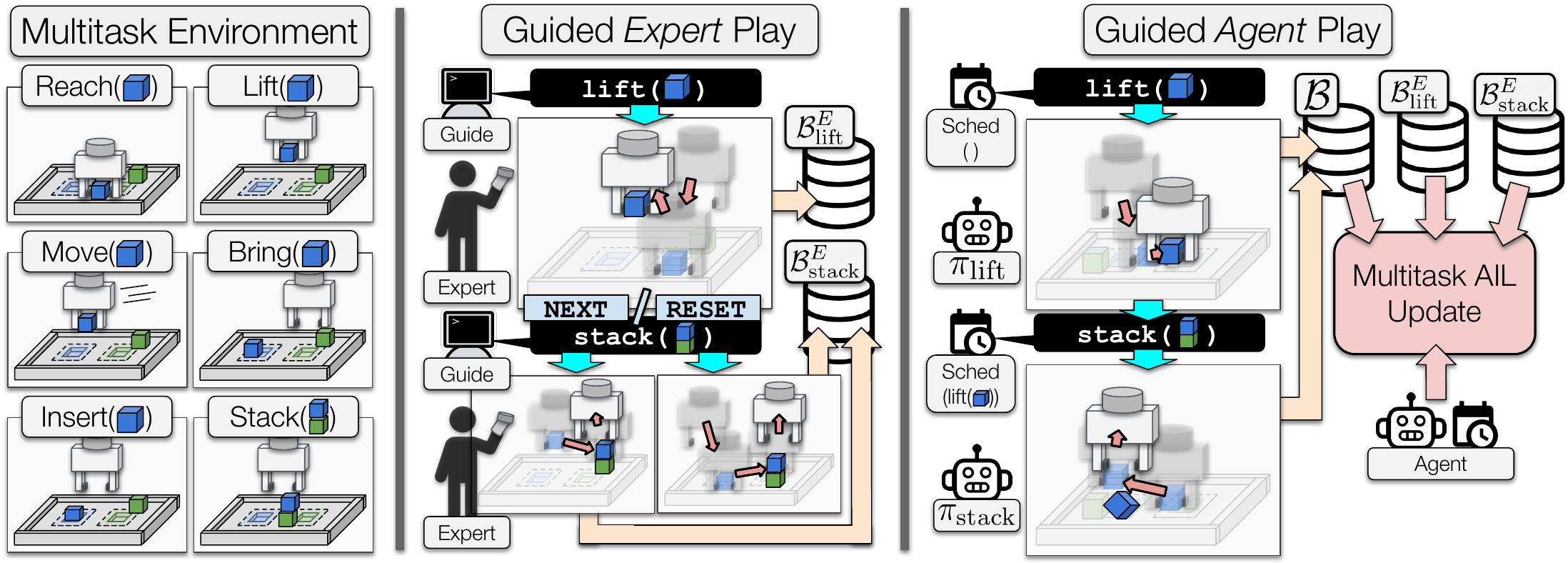
Learning from Guided Play: A Scheduled Hierarchical Approach for Improving Exploration in Adversarial Imitation Learning Source Code

Learning from Guided Play: A Scheduled Hierarchical Approach for Improving Exploration in Adversarial Imitation Learning Source Code

PyTorch implementation of SMODICE: Versatile Offline Imitation Learning via State Occupancy Matching

SMODICE: Versatile Offline Imitation Learning via State Occupancy Matching This is the official PyTorch implementation of SMODICE: Versatile Offline I

[CVPR 2022] PoseTriplet: Co-evolving 3D Human Pose Estimation, Imitation, and Hallucination under Self-supervision (Oral)
[CVPR 2022] PoseTriplet: Co-evolving 3D Human Pose Estimation, Imitation, and Hallucination under Self-supervision (Oral)

PoseTriplet: Co-evolving 3D Human Pose Estimation, Imitation, and Hallucination under Self-supervision Kehong Gong*, Bingbing Li*, Jianfeng Zhang*, Ta

Comments
  • Pymunk error when trying to run the basic example

    Pymunk error when trying to run the basic example

    I created a new conda env with python 3.8 and tried to run the basic example,

    import gym
    import xmagical
    
    # This must be called before making any Gym envs.
    xmagical.register_envs()
    
    # List all available environments.
    print(xmagical.ALL_REGISTERED_ENVS)
    
    # Create a demo variant for the SweepToTop task with a gripper agent.
    env = gym.make('SweepToTop-Gripper-Pixels-Allo-Demo-v0')
    obs = env.reset()
    

    I get the following error trace,

    Traceback (most recent call last):
      File "<stdin>", line 1, in <module>
      File "/home/ramans/miniconda3/envs/xmagical/lib/python3.8/site-packages/gym/wrappers/order_enforcing.py", line 16, in reset
        return self.env.reset(**kwargs)
      File "/home/ramans/miniconda3/envs/xmagical/lib/python3.8/site-packages/xmagical/benchmarks/sweep_to_top.py", line 192, in reset
        obs = super().reset()
      File "/home/ramans/miniconda3/envs/xmagical/lib/python3.8/site-packages/xmagical/base_env.py", line 201, in reset
        self.add_entities([self._arena])
      File "/home/ramans/miniconda3/envs/xmagical/lib/python3.8/site-packages/xmagical/base_env.py", line 140, in add_entities
        entity.setup(self.renderer, self._space, self._phys_vars)
      File "/home/ramans/miniconda3/envs/xmagical/lib/python3.8/site-packages/xmagical/entities/arena.py", line 38, in setup
        self.add_to_space(*arena_segments)
      File "/home/ramans/miniconda3/envs/xmagical/lib/python3.8/site-packages/xmagical/entities/base.py", line 100, in add_to_space
        _add(obj)
      File "/home/ramans/miniconda3/envs/xmagical/lib/python3.8/site-packages/xmagical/entities/base.py", line 80, in _add
        self.space.add(obj)
      File "/home/ramans/miniconda3/envs/xmagical/lib/python3.8/site-packages/pymunk/space.py", line 401, in add
        self._add_shape(o)
      File "/home/ramans/miniconda3/envs/xmagical/lib/python3.8/site-packages/pymunk/space.py", line 441, in _add_shape
        assert (
    AssertionError: The shape's body must be added to the space before (or at the same time) as the shape.
    

    Would this be due to some version pinning issue?

    opened by sai-prasanna 6
  • Bump pillow from 8.2.0 to 8.3.2

    Bump pillow from 8.2.0 to 8.3.2

    Bumps pillow from 8.2.0 to 8.3.2.

    Release notes

    Sourced from pillow's releases.

    8.3.2

    https://pillow.readthedocs.io/en/stable/releasenotes/8.3.2.html

    Security

    • CVE-2021-23437 Raise ValueError if color specifier is too long [hugovk, radarhere]

    • Fix 6-byte OOB read in FliDecode [wiredfool]

    Python 3.10 wheels

    • Add support for Python 3.10 #5569, #5570 [hugovk, radarhere]

    Fixed regressions

    • Ensure TIFF RowsPerStrip is multiple of 8 for JPEG compression #5588 [kmilos, radarhere]

    • Updates for ImagePalette channel order #5599 [radarhere]

    • Hide FriBiDi shim symbols to avoid conflict with real FriBiDi library #5651 [nulano]

    8.3.1

    https://pillow.readthedocs.io/en/stable/releasenotes/8.3.1.html

    Changes

    8.3.0

    https://pillow.readthedocs.io/en/stable/releasenotes/8.3.0.html

    Changes

    ... (truncated)

    Changelog

    Sourced from pillow's changelog.

    8.3.2 (2021-09-02)

    • CVE-2021-23437 Raise ValueError if color specifier is too long [hugovk, radarhere]

    • Fix 6-byte OOB read in FliDecode [wiredfool]

    • Add support for Python 3.10 #5569, #5570 [hugovk, radarhere]

    • Ensure TIFF RowsPerStrip is multiple of 8 for JPEG compression #5588 [kmilos, radarhere]

    • Updates for ImagePalette channel order #5599 [radarhere]

    • Hide FriBiDi shim symbols to avoid conflict with real FriBiDi library #5651 [nulano]

    8.3.1 (2021-07-06)

    • Catch OSError when checking if fp is sys.stdout #5585 [radarhere]

    • Handle removing orientation from alternate types of EXIF data #5584 [radarhere]

    • Make Image.array take optional dtype argument #5572 [t-vi, radarhere]

    8.3.0 (2021-07-01)

    • Use snprintf instead of sprintf. CVE-2021-34552 #5567 [radarhere]

    • Limit TIFF strip size when saving with LibTIFF #5514 [kmilos]

    • Allow ICNS save on all operating systems #4526 [baletu, radarhere, newpanjing, hugovk]

    • De-zigzag JPEG's DQT when loading; deprecate convert_dict_qtables #4989 [gofr, radarhere]

    • Replaced xml.etree.ElementTree #5565 [radarhere]

    ... (truncated)

    Commits
    • 8013f13 8.3.2 version bump
    • 23c7ca8 Update CHANGES.rst
    • 8450366 Update release notes
    • a0afe89 Update test case
    • 9e08eb8 Raise ValueError if color specifier is too long
    • bd5cf7d FLI tests for Oss-fuzz crash.
    • 94a0cf1 Fix 6-byte OOB read in FliDecode
    • cece64f Add 8.3.2 (2021-09-02) [CI skip]
    • e422386 Add release notes for Pillow 8.3.2
    • 08dcbb8 Pillow 8.3.2 supports Python 3.10 [ci skip]
    • Additional commits viewable in compare view

    Dependabot compatibility score

    Dependabot will resolve any conflicts with this PR as long as you don't alter it yourself. You can also trigger a rebase manually by commenting @dependabot rebase.


    Dependabot commands and options

    You can trigger Dependabot actions by commenting on this PR:

    • @dependabot rebase will rebase this PR
    • @dependabot recreate will recreate this PR, overwriting any edits that have been made to it
    • @dependabot merge will merge this PR after your CI passes on it
    • @dependabot squash and merge will squash and merge this PR after your CI passes on it
    • @dependabot cancel merge will cancel a previously requested merge and block automerging
    • @dependabot reopen will reopen this PR if it is closed
    • @dependabot close will close this PR and stop Dependabot recreating it. You can achieve the same result by closing it manually
    • @dependabot ignore this major version will close this PR and stop Dependabot creating any more for this major version (unless you reopen the PR or upgrade to it yourself)
    • @dependabot ignore this minor version will close this PR and stop Dependabot creating any more for this minor version (unless you reopen the PR or upgrade to it yourself)
    • @dependabot ignore this dependency will close this PR and stop Dependabot creating any more for this dependency (unless you reopen the PR or upgrade to it yourself)
    • @dependabot use these labels will set the current labels as the default for future PRs for this repo and language
    • @dependabot use these reviewers will set the current reviewers as the default for future PRs for this repo and language
    • @dependabot use these assignees will set the current assignees as the default for future PRs for this repo and language
    • @dependabot use this milestone will set the current milestone as the default for future PRs for this repo and language

    You can disable automated security fix PRs for this repo from the Security Alerts page.

    dependencies 
    opened by dependabot[bot] 1
Releases(v0.0.4)
Owner
Kevin Zakka
PhD at UC Berkeley. Trying to teach 🤖 skills from videos and natural language instructions.
Kevin Zakka
Object Detection and Multi-Object Tracking

Object Detection and Multi-Object Tracking

Bobby Chen 1.6k Jan 04, 2023
Face recognition system using MTCNN, FACENET, SVM and FAST API to track participants of Big Brother Brasil in real time.

BBB Face Recognizer Face recognition system using MTCNN, FACENET, SVM and FAST API to track participants of Big Brother Brasil in real time. Instalati

Rafael Azevedo 232 Dec 24, 2022
Woosung Choi 63 Nov 14, 2022
Rainbow is all you need! A step-by-step tutorial from DQN to Rainbow

Do you want a RL agent nicely moving on Atari? Rainbow is all you need! This is a step-by-step tutorial from DQN to Rainbow. Every chapter contains bo

Jinwoo Park (Curt) 1.4k Dec 29, 2022
GAN-based 3D human pose estimation model for 3DV'17 paper

Tensorflow implementation for 3DV 2017 conference paper "Adversarially Parameterized Optimization for 3D Human Pose Estimation". @inproceedings{jack20

Dominic Jack 15 Feb 27, 2021
Scenic: A Jax Library for Computer Vision and Beyond

Scenic Scenic is a codebase with a focus on research around attention-based models for computer vision. Scenic has been successfully used to develop c

Google Research 1.6k Dec 27, 2022
SVG Icon processing tool for C++

BAWR This is a tool to automate the icons generation from sets of svg files into fonts and atlases. The main purpose of this tool is to add it to the

Frank David Martínez M 66 Dec 14, 2022
True Few-Shot Learning with Language Models

This codebase supports using language models (LMs) for true few-shot learning: learning to perform a task using a limited number of examples from a single task distribution.

Ethan Perez 124 Jan 04, 2023
An implementation of Deep Graph Infomax (DGI) in PyTorch

DGI Deep Graph Infomax (Veličković et al., ICLR 2019): https://arxiv.org/abs/1809.10341 Overview Here we provide an implementation of Deep Graph Infom

Petar Veličković 491 Jan 03, 2023
HistoKT: Cross Knowledge Transfer in Computational Pathology

HistoKT: Cross Knowledge Transfer in Computational Pathology Exciting News! HistoKT has been accepted to ICASSP 2022. HistoKT: Cross Knowledge Transfe

Mahdi S. Hosseini 5 Jan 05, 2023
Proposal, Tracking and Segmentation (PTS): A Cascaded Network for Video Object Segmentation

Proposal, Tracking and Segmentation (PTS): A Cascaded Network for Video Object Segmentation By Qiang Zhou*, Zilong Huang*, Lichao Huang, Han Shen, Yon

Forest 117 Apr 01, 2022
Solver for Large-Scale Rank-One Semidefinite Relaxations

STRIDE: spectrahedral proximal gradient descent along vertices A Solver for Large-Scale Rank-One Semidefinite Relaxations About STRIDE is designed for

48 Dec 20, 2022
MIMO-UNet - Official Pytorch Implementation

MIMO-UNet - Official Pytorch Implementation This repository provides the official PyTorch implementation of the following paper: Rethinking Coarse-to-

Sungjin Cho 248 Jan 02, 2023
Implementation of the Point Transformer layer, in Pytorch

Point Transformer - Pytorch Implementation of the Point Transformer self-attention layer, in Pytorch. The simple circuit above seemed to have allowed

Phil Wang 501 Jan 03, 2023
Generative Flow Networks for Discrete Probabilistic Modeling

Energy-based GFlowNets Code for Generative Flow Networks for Discrete Probabilistic Modeling by Dinghuai Zhang, Nikolay Malkin, Zhen Liu, Alexandra Vo

Narsil-Dinghuai Zhang 51 Dec 20, 2022
Implementation of ToeplitzLDA for spatiotemporal stationary time series data.

Code for the ToeplitzLDA classifier proposed in here. The classifier conforms sklearn and can be used as a drop-in replacement for other LDA classifiers. For in-depth usage refer to the learning from

Jan Sosulski 5 Nov 07, 2022
YOLO-v5 기반 단안 카메라의 영상을 활용해 차간 거리를 일정하게 유지하며 주행하는 Adaptive Cruise Control 기능 구현

자율 주행차의 영상 기반 차간거리 유지 개발 Table of Contents 프로젝트 소개 주요 기능 시스템 구조 디렉토리 구조 결과 실행 방법 참조 팀원 프로젝트 소개 YOLO-v5 기반으로 단안 카메라의 영상을 활용해 차간 거리를 일정하게 유지하며 주행하는 Adap

14 Jun 29, 2022
Embeds a story into a music playlist by sorting the playlist so that the order of the music follows a narrative arc.

playlist-story-builder This project attempts to embed a story into a music playlist by sorting the playlist so that the order of the music follows a n

Dylan R. Ashley 0 Oct 28, 2021
RTS3D: Real-time Stereo 3D Detection from 4D Feature-Consistency Embedding Space for Autonomous Driving

RTS3D: Real-time Stereo 3D Detection from 4D Feature-Consistency Embedding Space for Autonomous Driving (AAAI2021). RTS3D is efficiency and accuracy s

71 Nov 29, 2022
NATS-Bench: Benchmarking NAS Algorithms for Architecture Topology and Size

NATS-Bench: Benchmarking NAS Algorithms for Architecture Topology and Size Xuanyi Dong, Lu Liu, Katarzyna Musial, Bogdan Gabrys in IEEE Transactions o

D-X-Y 137 Dec 20, 2022