This code is a near-infrared spectrum modeling method based on PCA and pls

Overview

Nirs-Pls-Corn

This code is a near-infrared spectrum modeling method based on PCA and pls


近红外光谱分析技术属于交叉领域,需要化学、计算机科学、生物科学等多领域的合作。为此,在(北邮邮电大学杨辉华老师团队)指导下,近期准备开源传统的PLS,SVM,ANN,RF等经典算和SG,MSC,一阶导,二阶导等预处理以及GA等波长选择算法以及CNN、AE等最新深度学习算法,以帮助其他专业的更容易建立具有良好预测能力和鲁棒性的近红外光谱模型。代码仅供学术使用,如有问题,联系方式:QQ:1427950662,微信:Fu_siry

1.读取数据并显示光谱曲线

#载入数据
data_path = './/data//m5.csv' #数据
label_path = './/data//label.csv' #标签(反射率)

data = np.loadtxt(open(data_path, 'rb'), dtype=np.float64, delimiter=',', skiprows=0)
label = np.loadtxt(open(label_path, 'rb'), dtype=np.float64, delimiter=',', skiprows=0)

# 绘制原始后图片
plt.figure(500)
x_col = np.linspace(0,len(data[0,:]),len(data[0,:]))  #数组逆序
y_col = np.transpose(data)
plt.plot(x_col, y_col)
plt.xlabel("Wavenumber(nm)")
plt.ylabel("Absorbance")
plt.title("The spectrum of the corn dataset",fontweight= "semibold",fontsize='x-large')
plt.savefig('.//Result//MSC.png')
plt.show()
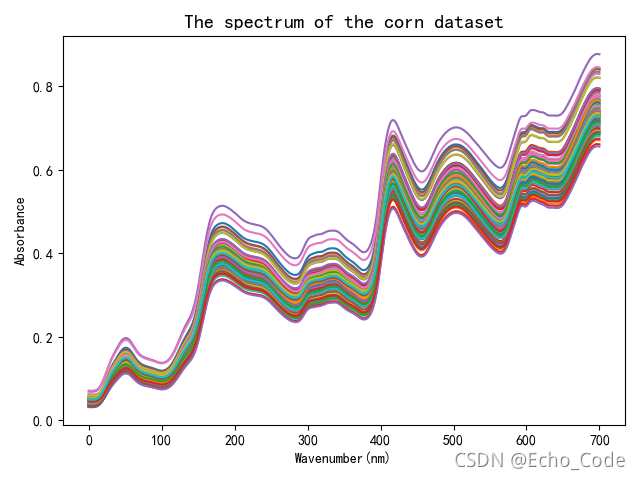
显示的光谱曲线

2.划分训练集和测试集

#随机划分数据集
x_data = np.array(data)
y_data = np.array(label[:,2])

test_ratio = 0.2
X_train,X_test,y_train,y_test = train_test_split(x_data,y_data,test_size=test_ratio,shuffle=True,random_state=2)

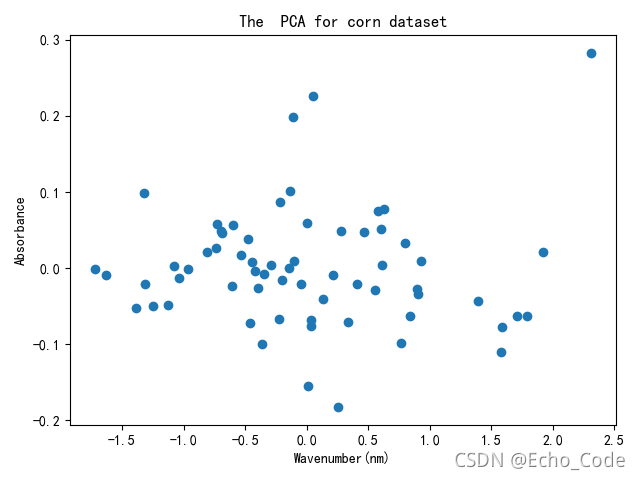
3.PCA降维并显示

#载入数据
#PCA降维到10个维度,测试该数据最好
pca=PCA(n_components=10)  #只保留2个特征
pca.fit(X_train)
X_train_reduction = pca.transform(X_train)
X_test_reduction = pca.transform(X_test)

# PCA降维后图片绘制
plt.figure(100)
plt.scatter(X_train_reduction[:, 0], X_train_reduction[:, 1],marker='o')
plt.xlabel("Wavenumber(nm)")
plt.ylabel("Absorbance")
plt.title("The  PCA for corn dataset",fontweight= "semibold",fontsize='large')
plt.savefig('.//Result//PCA.png')
plt.show()

PCA降维后的数据分布: PCA降维后的数据分布
4.建立校正模型(数据拟合)

#pls预测
pls2 = PLSRegression(n_components=3)
pls2.fit(X_train_reduction, y_train)

train_pred = pls2.predict(X_train_reduction)
pred = pls2.predict(X_test_reduction)

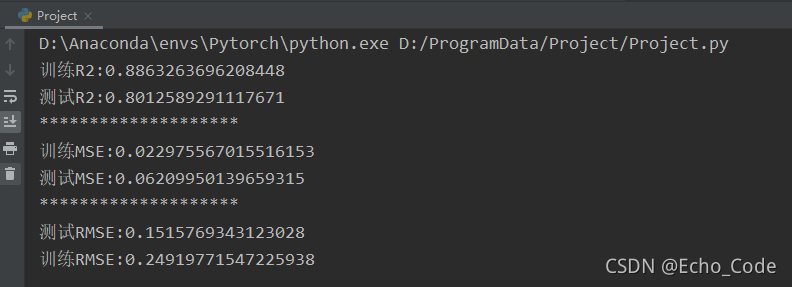
5.模型评估(使用R2、RMSE、MSE指标)

#计算R2
train_R2 = r2_score(train_pred,y_train)
R2 = r2_score(y_test,pred) #Y_true, Pred
print('训练R2:{}'.format(train_R2))
print('测试R2:{}'.format(R2))
#计算MSE
print('********************')
x_MSE = mean_squared_error(train_pred,y_train)
t_MSE = mean_squared_error(y_test,pred)
print('训练MSE:{}'.format(x_MSE))
print('测试MSE:{}'.format(t_MSE))

#计算RMSE
print('********************')
print('测试RMSE:{}'.format(sqrt(x_MSE)))
print('训练RMSE:{}'.format(sqrt(t_MSE)))

模型评估结果: 模型评估结果
6.绘制拟合差异曲线图

#绘制拟合图片
plt.figure(figsize=(6,4))
x_col = np.linspace(0,16,16)  #数组逆序
# y = [0,10,20,30,40,50,60,70,80]
# x_col = X_test
y_test = np.transpose(y_test)
ax = plt.gca()
ax.set_xlim(0,16)
ax.set_ylim(6,11)
# plt.yticks(y)
plt.scatter(x_col, y_test,label='Ture', color='blue')
plt.plot(x_col, pred,label='predict', marker='D',color='red')
plt.legend(loc='best')
plt.xlabel("测试集的样本")
plt.ylabel("样本的值")
plt.title("The Result of corn dataset",fontweight= "semibold",fontsize='large')
plt.savefig('.//Result//Reslut.png')
plt.show()

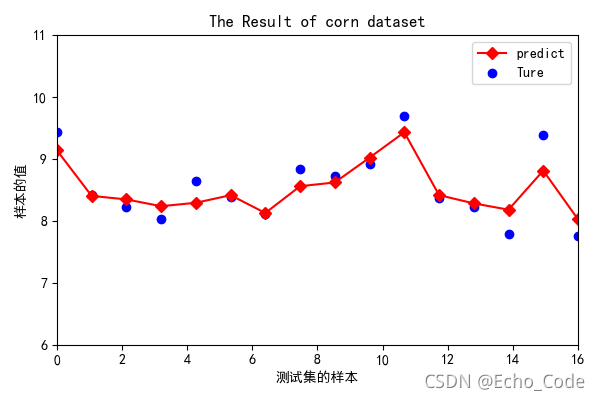
结果如图: 拟合差异曲线
Owner
Fu Pengyou
Computer graduate student, engaged in machine learning, data analysis
Fu Pengyou
SHRIMP: Sparser Random Feature Models via Iterative Magnitude Pruning

SHRIMP: Sparser Random Feature Models via Iterative Magnitude Pruning This repository is the official implementation of "SHRIMP: Sparser Random Featur

Bobby Shi 0 Dec 16, 2021
Apply a perspective transformation to a raster image inside Inkscape (no need to use an external software such as GIMP or Krita).

Raster Perspective Apply a perspective transformation to bitmap image using the selected path as envelope, without the need to use an external softwar

s.ouchene 19 Dec 22, 2022
Unofficial implementation of the paper: PonderNet: Learning to Ponder in TensorFlow

PonderNet-TensorFlow This is an Unofficial Implementation of the paper: PonderNet: Learning to Ponder in TensorFlow. Official PyTorch Implementation:

1 Oct 23, 2022
Towards Calibrated Model for Long-Tailed Visual Recognition from Prior Perspective

Towards Calibrated Model for Long-Tailed Visual Recognition from Prior Perspective Zhengzhuo Xu, Zenghao Chai, Chun Yuan This is the PyTorch implement

Sincere 16 Dec 15, 2022
Array Camera Ptychography

Array Camera Ptychography This repository provides the code for the following papers: Schulz, Timothy J., David J. Brady, and Chengyu Wang. "Photon-li

Brady lab in Optical Sciences 1 Nov 15, 2021
Leveraging Social Influence based on Users Activity Centers for Point-of-Interest Recommendation

SUCP Leveraging Social Influence based on Users Activity Centers for Point-of-Interest Recommendation () Direct Friends (i.e., users who follow each o

Kosar 8 Nov 26, 2022
Omniverse sample scripts - A guide for developing with Python scripts on NVIDIA Ominverse

Omniverse sample scripts ここでは、NVIDIA Omniverse ( https://www.nvidia.com/ja-jp/om

ft-lab (Yutaka Yoshisaka) 37 Nov 17, 2022
OREO: Object-Aware Regularization for Addressing Causal Confusion in Imitation Learning (NeurIPS 2021)

OREO: Object-Aware Regularization for Addressing Causal Confusion in Imitation Learning (NeurIPS 2021) Video demo We here provide a video demo from co

20 Nov 25, 2022
Seq2seq - Sequence to Sequence Learning with Keras

Seq2seq Sequence to Sequence Learning with Keras Hi! You have just found Seq2Seq. Seq2Seq is a sequence to sequence learning add-on for the python dee

Fariz Rahman 3.1k Dec 18, 2022
PyTorch implementation of Train Short, Test Long: Attention with Linear Biases Enables Input Length Extrapolation.

ALiBi PyTorch implementation of Train Short, Test Long: Attention with Linear Biases Enables Input Length Extrapolation. Quickstart Clone this reposit

Jake Tae 4 Jul 27, 2022
This is the official Pytorch implementation of "Lung Segmentation from Chest X-rays using Variational Data Imputation", Raghavendra Selvan et al. 2020

README This is the official Pytorch implementation of "Lung Segmentation from Chest X-rays using Variational Data Imputation", Raghavendra Selvan et a

Raghav 42 Dec 15, 2022
(Py)TOD: Tensor-based Outlier Detection, A General GPU-Accelerated Framework

(Py)TOD: Tensor-based Outlier Detection, A General GPU-Accelerated Framework Background: Outlier detection (OD) is a key data mining task for identify

Yue Zhao 127 Jan 05, 2023
PanopticBEV - Bird's-Eye-View Panoptic Segmentation Using Monocular Frontal View Images

Bird's-Eye-View Panoptic Segmentation Using Monocular Frontal View Images This r

63 Dec 16, 2022
BEGAN in PyTorch

BEGAN in PyTorch This project is still in progress. If you are looking for the working code, use BEGAN-tensorflow. Requirements Python 2.7 Pillow tqdm

Taehoon Kim 260 Dec 07, 2022
Easy genetic ancestry predictions in Python

ezancestry Easily visualize your direct-to-consumer genetics next to 2500+ samples from the 1000 genomes project. Evaluate the performance of a custom

Kevin Arvai 38 Jan 02, 2023
Datasets, Transforms and Models specific to Computer Vision

torchvision The torchvision package consists of popular datasets, model architectures, and common image transformations for computer vision. Installat

13.1k Jan 02, 2023
LVI-SAM: Tightly-coupled Lidar-Visual-Inertial Odometry via Smoothing and Mapping

LVI-SAM This repository contains code for a lidar-visual-inertial odometry and mapping system, which combines the advantages of LIO-SAM and Vins-Mono

Tixiao Shan 1.1k Dec 27, 2022
Code repository for the paper Computer Vision User Entity Behavior Analytics

Computer Vision User Entity Behavior Analytics Code repository for "Computer Vision User Entity Behavior Analytics" Code Description dataset.csv As di

Sameer Khanna 2 Aug 20, 2022
Object Detection and Multi-Object Tracking

Object Detection and Multi-Object Tracking

Bobby Chen 1.6k Jan 04, 2023
CCAFNet: Crossflow and Cross-scale Adaptive Fusion Network for Detecting Salient Objects in RGB-D Images

Code and result about CCAFNet(IEEE TMM) 'CCAFNet: Crossflow and Cross-scale Adaptive Fusion Network for Detecting Salient Objects in RGB-D Images' IEE

zyrant丶 14 Dec 29, 2021