Learning where to learn - Gradient sparsity in meta and continual learning

Overview

Learning where to learn - Gradient sparsity in meta and continual learning

In this paper, we investigate gradient sparsity found by MAML in various continual and few-shot learning scenarios.
Instead of only learning the initialization of neural network parameters, we additionally meta-learn parameters underneath a step function that stops gradient descent when smaller then 0.

We term this version Sparse-MAML - Link to the paper here.
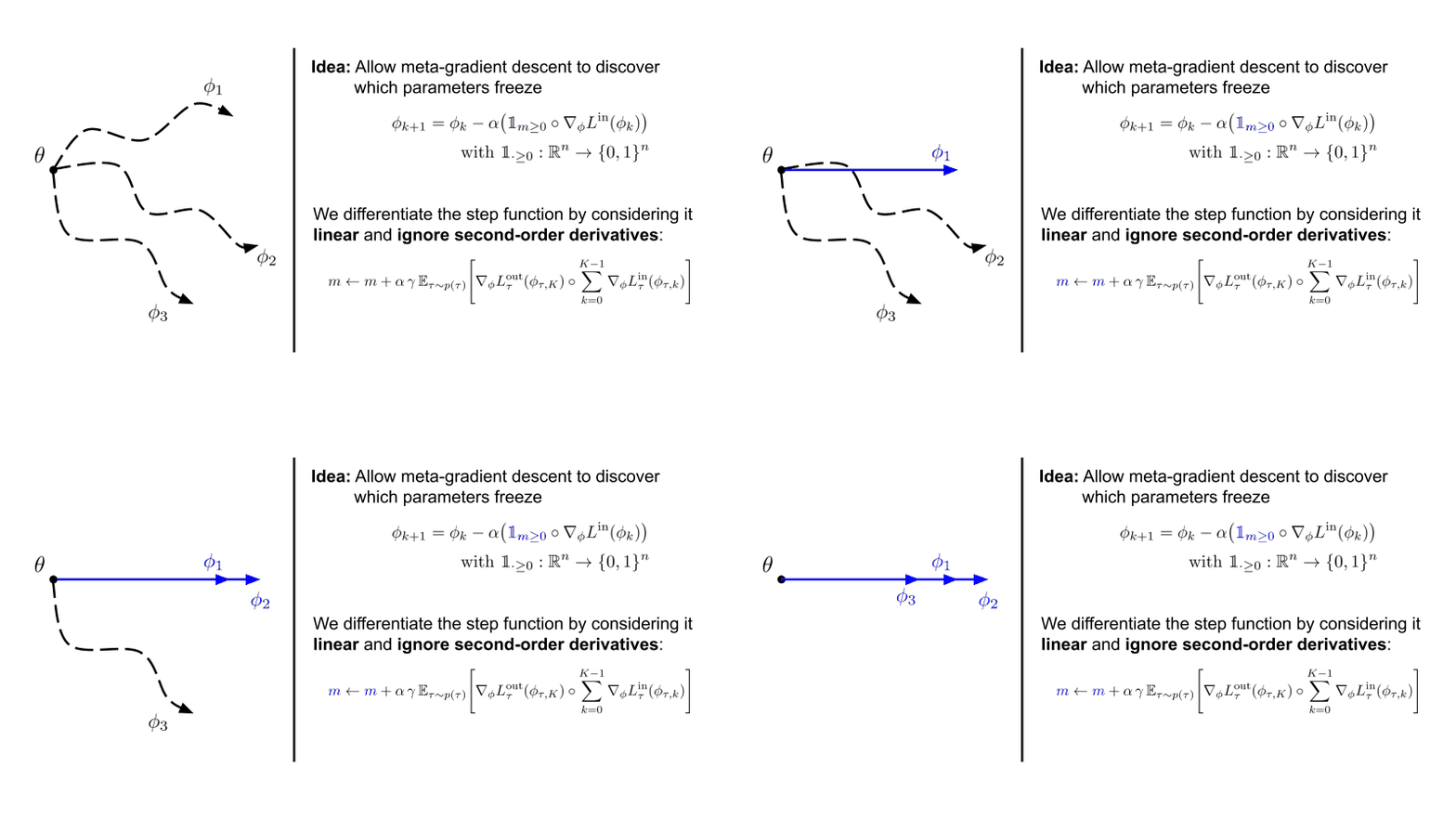
Interestingly, we see that structured sparsity emerges in both the classic 4-layer ConvNet as well as a ResNet-12 for few-shot learning. This is accompanied by improved robustness and generalisation across many hyperparameters.
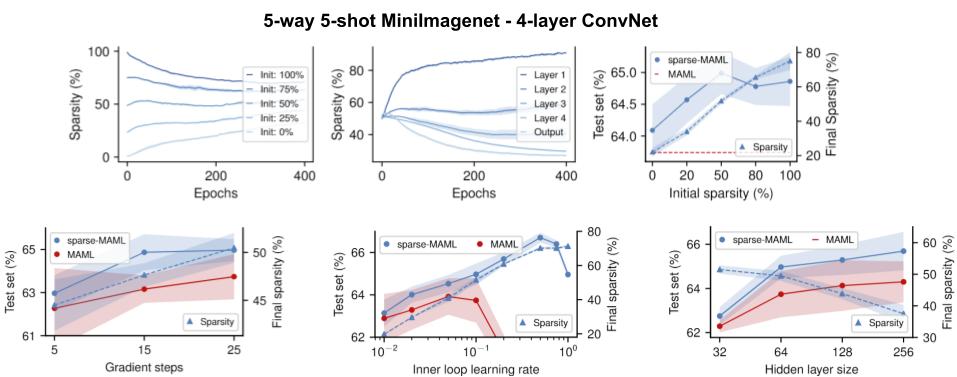
Note that Sparse-MAML is an extremely simple variant of MAML that possesses only the possibility to shut on/off training of specific parameters compared to proper gradient modulation.

This codebase implents the few-shot learning experiments that are presented in the paper. To reproduce the results in the paper, please follow these instructions:

Installation

#1. Install a conda env:

conda create -n sparse-MAML

#2. Activate the env:

source activate sparse-MAML

#3. Install anaconda:

conda install anaconda

#4. Install extra requiremetns (make sure you use the correct pip3):

pip3 install -r requirements.txt

#5. Run:

chmod u+x run_sparse_MAML.sh

#6. Execute:

./run_sparse_MAML.sh

Results

MiniImageNet Few-Shot MAML ANIL BOIL sparse-MAML sparse-ReLU-MAML
5-way 5-shot | ConvNet 63.15 61.50 66.45 67.03 64.84
5-way 1-shot | ConvNet 48.07 46.70 49.61 50.35 50.39
5-way 5-shot | ResNet12 69.36 70.03 70.50 70.02 73.01
5-way 1-shot | ResNet12 53.91 55.25 - 55.02 56.39

BOIL results are taken from the original paper.


This code based is heavily build on top of torchmeta.

Owner
Johannes Oswald
Johannes Oswald
A simple interface for editing natural photos with generative neural networks.

Neural Photo Editor A simple interface for editing natural photos with generative neural networks. This repository contains code for the paper "Neural

Andy Brock 2.1k Dec 29, 2022
Container : Context Aggregation Network

Container : Context Aggregation Network If you use this code for a paper please cite: @article{gao2021container, title={Container: Context Aggregati

AI2 47 Dec 16, 2022
Gesture-Volume-Control - This Python program can adjust the system's volume by using hand gestures

Gesture-Volume-Control This Python program can adjust the system's volume by usi

VatsalAryanBhatanagar 1 Dec 30, 2021
MAVE: : A Product Dataset for Multi-source Attribute Value Extraction

MAVE: : A Product Dataset for Multi-source Attribute Value Extraction The dataset contains 3 million attribute-value annotations across 1257 unique ca

Google Research Datasets 89 Jan 08, 2023
Web-interface + rest API for classification and regression (https://jeff1evesque.github.io/machine-learning.docs)

Machine Learning This project provides a web-interface, as well as a programmatic-api for various machine learning algorithms. Supported algorithms: S

Jeff Levesque 252 Dec 11, 2022
An implementation for Neural Architecture Search with Random Labels (CVPR 2021 poster) on Pytorch.

Neural Architecture Search with Random Labels(RLNAS) Introduction This project provides an implementation for Neural Architecture Search with Random L

18 Nov 08, 2022
This package implements the algorithms introduced in Smucler, Sapienza, and Rotnitzky (2020) to compute optimal adjustment sets in causal graphical models.

optimaladj: A library for computing optimal adjustment sets in causal graphical models This package implements the algorithms introduced in Smucler, S

Facundo Sapienza 6 Aug 04, 2022
Official code for the paper "Why Do Self-Supervised Models Transfer? Investigating the Impact of Invariance on Downstream Tasks".

Why Do Self-Supervised Models Transfer? Investigating the Impact of Invariance on Downstream Tasks This repository contains the official code for the

Linus Ericsson 11 Dec 16, 2022
[NeurIPS 2021] "Drawing Robust Scratch Tickets: Subnetworks with Inborn Robustness Are Found within Randomly Initialized Networks" by Yonggan Fu, Qixuan Yu, Yang Zhang, Shang Wu, Xu Ouyang, David Cox, Yingyan Lin

Drawing Robust Scratch Tickets: Subnetworks with Inborn Robustness Are Found within Randomly Initialized Networks Yonggan Fu, Qixuan Yu, Yang Zhang, S

12 Dec 11, 2022
Paddle-Skeleton-Based-Action-Recognition - DecoupleGCN-DropGraph, ASGCN, AGCN, STGCN

Paddle-Skeleton-Action-Recognition DecoupleGCN-DropGraph, ASGCN, AGCN, STGCN. Yo

Chenxu Peng 3 Nov 02, 2022
Empower Sequence Labeling with Task-Aware Language Model

LM-LSTM-CRF Check Our New NER Toolkit 🚀 🚀 🚀 Inference: LightNER: inference w. models pre-trained / trained w. any following tools, efficiently. Tra

Liyuan Liu 838 Jan 05, 2023
The Adapter-Bot: All-In-One Controllable Conversational Model

The Adapter-Bot: All-In-One Controllable Conversational Model This is the implementation of the paper: The Adapter-Bot: All-In-One Controllable Conver

CAiRE 37 Nov 04, 2022
Deep Occlusion-Aware Instance Segmentation with Overlapping BiLayers [CVPR 2021]

Deep Occlusion-Aware Instance Segmentation with Overlapping BiLayers [BCNet, CVPR 2021] This is the official pytorch implementation of BCNet built on

Lei Ke 434 Dec 01, 2022
Code for T-Few from "Few-Shot Parameter-Efficient Fine-Tuning is Better and Cheaper than In-Context Learning"

T-Few This repository contains the official code for the paper: "Few-Shot Parameter-Efficient Fine-Tuning is Better and Cheaper than In-Context Learni

220 Dec 31, 2022
Code of Puregaze: Purifying gaze feature for generalizable gaze estimation, AAAI 2022.

PureGaze: Purifying Gaze Feature for Generalizable Gaze Estimation Description Our work is accpeted by AAAI 2022. Picture: We propose a domain-general

39 Dec 05, 2022
An LSTM for time-series classification

Update 10-April-2017 And now it works with Python3 and Tensorflow 1.1.0 Update 02-Jan-2017 I updated this repo. Now it works with Tensorflow 0.12. In

Rob Romijnders 391 Dec 27, 2022
Code for paper "Document-Level Argument Extraction by Conditional Generation". NAACL 21'

Argument Extraction by Generation Code for paper "Document-Level Argument Extraction by Conditional Generation". NAACL 21' Dependencies pytorch=1.6 tr

Zoey Li 87 Dec 26, 2022
Retina blood vessel segmentation with a convolutional neural network

Retina blood vessel segmentation with a convolution neural network (U-net) This repository contains the implementation of a convolutional neural netwo

Orobix 1.2k Jan 06, 2023
Python code for the paper How to scale hyperparameters for quickshift image segmentation

How to scale hyperparameters for quickshift image segmentation Python code for the paper How to scale hyperparameters for quickshift image segmentatio

0 Jan 25, 2022
Pytorch implementation of "Training a 85.4% Top-1 Accuracy Vision Transformer with 56M Parameters on ImageNet"

Token Labeling: Training an 85.4% Top-1 Accuracy Vision Transformer with 56M Parameters on ImageNet (arxiv) This is a Pytorch implementation of our te

蒋子航 383 Dec 27, 2022