Demo code for ICCV 2021 paper "Sensor-Guided Optical Flow"

Overview

Sensor-Guided Optical Flow

Demo code for "Sensor-Guided Optical Flow", ICCV 2021

This code is provided to replicate results with flow hints obtained from LiDAR data.

At the moment, we do not plan to release training code.

[Project page] - [Paper] - [Supplementary]
Alt text

Reference

If you find this code useful, please cite our work:

@inproceedings{Poggi_ICCV_2021,
  title     = {Sensor-Guided Optical Flow},
  author    = {Poggi, Matteo and
               Aleotti, Filippo and
               Mattoccia, Stefano},
  booktitle = {IEEE/CVF International Conference on Computer Vision (ICCV)},
  year = {2021}
}

Contents

  1. Introduction
  2. Installation
  3. Data
  4. Weights
  5. Usage
  6. Contacts
  7. Acknowledgments

Introduction

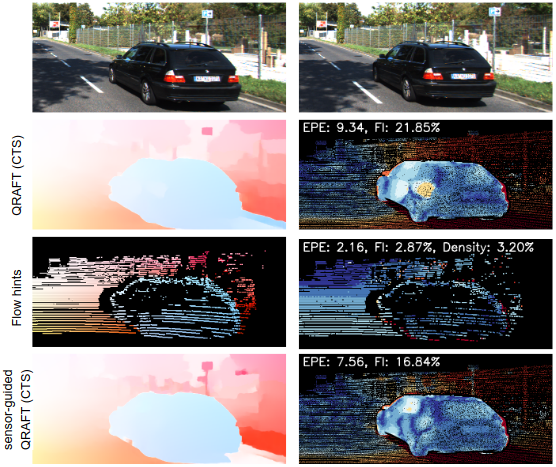
This paper proposes a framework to guide an optical flow network with external cues to achieve superior accuracy either on known or unseen domains. Given the availability of sparse yet accurate optical flow hints from an external source, these are injected to modulate the correlation scores computed by a state-of-the-art optical flow network and guide it towards more accurate predictions. Although no real sensor can provide sparse flow hints, we show how these can be obtained by combining depth measurements from active sensors with geometry and hand-crafted optical flow algorithms, leading to accurate enough hints for our purpose. Experimental results with a state-of-the-art flow network on standard benchmarks support the effectiveness of our framework, both in simulated and real conditions.

Installation

Install the project requirements in a new python 3 environment:

virtualenv -p python3 guided_flow_env
source guided_flow_env/bin/activate
pip install -r requirements.txt

Compile the guided_flow module, written in C (required for guided flow modulation):

cd external/guided_flow
bash compile.sh
cd ../..

Data

Download KITTI 2015 optical flow training set and precomputed flow hints. Place them under the data folder as follows:

data
├──training
    ├──image_2
        ├── 000000_10.png
        ├── 000000_11.png
        ├── 000001_10.png
        ├── 000001_11.png
        ...
    ├──flow_occ
        ├── 000000_10.png
        ├── 000000_11.png
        ├── 000001_10.png
        ├── 000001_11.png
        ...
    ├──hints
        ├── 000002_10.png
        ├── 000002_11.png
        ├── 000003_10.png
        ├── 000003_11.png
        ...

Weights

We provide QRAFT models tested in Tab. 4. Download the weights and unzip them under weights as follows:

weights
├──raw
    ├── C.pth
    ├── CT.pth
    ...
├──guided
    ├── C.pth
    ├── CT.pth
    ...    

Usage

You are now ready to run the demo_kitti142.py script:

python demo_kitti142.py --model CTK --guided --out_dir results_CTK_guided/

Use --model to specify the weights you want to load among C, CT, CTS and CTK. By default, raw models are loaded, specify --guided to load guided weights and enable sensor-guided optical flow.

Note: Occasionally, the demo may run out of memory on ~12GB GPUs. The script saves intermediate results are saved in --out_dir. You can run again the script and it will skip all images for which intermediate results have been already saved in --out_dir, loading them from the folder. Remember to select a brand new --out_dir when you start an experiment from scratch.

In the end, the aforementioned command should print:

Validation KITTI: 2.08, 5.97

Numbers in Tab. 4 are obtained by running this code on a Titan Xp GPU, with PyTorch 1.7.0. We observed slight fluctuations in the numbers when running on different hardware (e.g., 3090 GPUs), mostly on raw models.

Contacts

m [dot] poggi [at] unibo [dot] it

Acknowledgments

Thanks to Zachary Teed for sharing RAFT code, used as codebase in our project.

Predicting Event Memorability from Contextual Visual Semantics

Predicting Event Memorability from Contextual Visual Semantics

0 Oct 06, 2021
A computational block to solve entity alignment over textual attributes in a knowledge graph creation pipeline.

How to apply? Create your config.ini file following the example provided in config.ini Choose one of the options below to run: Run with Python3 pip in

Scientific Data Management Group 3 Jun 23, 2022
TabNet for fastai

TabNet for fastai This is an adaptation of TabNet (Attention-based network for tabular data) for fastai (=2.0) library. The original paper https://ar

Mikhail Grankin 116 Oct 21, 2022
CrossMLP - The repository offers the official implementation of our BMVC 2021 paper (oral) in PyTorch.

CrossMLP Cascaded Cross MLP-Mixer GANs for Cross-View Image Translation Bin Ren1, Hao Tang2, Nicu Sebe1. 1University of Trento, Italy, 2ETH, Switzerla

Bingoren 16 Jul 27, 2022
PyTorch Implementation of CvT: Introducing Convolutions to Vision Transformers

CvT: Introducing Convolutions to Vision Transformers Pytorch implementation of CvT: Introducing Convolutions to Vision Transformers Usage: img = torch

Rishikesh (ऋषिकेश) 193 Jan 03, 2023
PyTorch implementation of CVPR'18 - Perturbative Neural Networks

This is an attempt to reproduce results in Perturbative Neural Networks paper. See original repo for details.

Michael Klachko 57 May 14, 2021
v objective diffusion inference code for PyTorch.

v-diffusion-pytorch v objective diffusion inference code for PyTorch, by Katherine Crowson (@RiversHaveWings) and Chainbreakers AI (@jd_pressman). The

Katherine Crowson 635 Dec 30, 2022
CondNet: Conditional Classifier for Scene Segmentation

CondNet: Conditional Classifier for Scene Segmentation Introduction The fully convolutional network (FCN) has achieved tremendous success in dense vis

ycszen 31 Jul 22, 2022
Image marine sea litter prediction Shiny

MARLITE Shiny app for floating marine litter detection in aerial images. This directory contains the instructions and software needed to install the S

19 Dec 22, 2022
Cancer Drug Response Prediction via a Hybrid Graph Convolutional Network

DeepCDR Cancer Drug Response Prediction via a Hybrid Graph Convolutional Network This work has been accepted to ECCB2020 and was also published in the

Qiao Liu 50 Dec 18, 2022
This PyTorch package implements MoEBERT: from BERT to Mixture-of-Experts via Importance-Guided Adaptation (NAACL 2022).

MoEBERT This PyTorch package implements MoEBERT: from BERT to Mixture-of-Experts via Importance-Guided Adaptation (NAACL 2022). Installation Create an

Simiao Zuo 34 Dec 24, 2022
[ ICCV 2021 Oral ] Our method can estimate camera poses and neural radiance fields jointly when the cameras are initialized at random poses in complex scenarios (outside-in scenes, even with less texture or intense noise )

GNeRF This repository contains official code for the ICCV 2021 paper: GNeRF: GAN-based Neural Radiance Field without Posed Camera. This implementation

Quan Meng 191 Dec 26, 2022
Official repo for the work titled "SharinGAN: Combining Synthetic and Real Data for Unsupervised GeometryEstimation"

SharinGAN Official repo for the work titled "SharinGAN: Combining Synthetic and Real Data for Unsupervised GeometryEstimation" The official project we

Koutilya PNVR 23 Oct 19, 2022
Config files for my GitHub profile.

Canalyst Candas Data Science Library Name Canalyst Candas Description Built by a former PM / analyst to give anyone with a little bit of Python knowle

Canalyst Candas 13 Jun 24, 2022
This Deep Learning Model Predicts that from which disease you are suffering.

Deep-Learning-Project This Deep Learning Model Predicts that from which disease you are suffering. This Project Covers the Topics of Deep Learning Int

Jai Viral Doshi 0 Jan 20, 2022
A visualization tool to show a TensorFlow's graph like TensorBoard

tfgraphviz tfgraphviz is a module to visualize a TensorFlow's data flow graph like TensorBoard using Graphviz. tfgraphviz enables to provide a visuali

44 Nov 09, 2022
Python scripts form performing stereo depth estimation using the CoEx model in ONNX.

ONNX-CoEx-Stereo-Depth-estimation Python scripts form performing stereo depth estimation using the CoEx model in ONNX. Stereo depth estimation on the

Ibai Gorordo 8 Dec 29, 2022
The code from the paper Character Transformations for Non-Autoregressive GEC Tagging

Character Transformations for Non-Autoregressive GEC Tagging Milan Straka, Jakub Náplava, Jana Straková Charles University Faculty of Mathematics and

ÚFAL 5 Dec 10, 2022
The GitHub repository for the paper: “Time Series is a Special Sequence: Forecasting with Sample Convolution and Interaction“.

SCINet This is the original PyTorch implementation of the following work: Time Series is a Special Sequence: Forecasting with Sample Convolution and I

386 Jan 01, 2023