[ECCV 2020] Reimplementation of 3DDFAv2, including face mesh, head pose, landmarks, and more.

Overview

Stable Head Pose Estimation and Landmark Regression via 3D Dense Face Reconstruction

FaceReconstructionDemo

Language grade: Python License ECCV

Reimplementation of (ECCV 2020) Towards Fast, Accurate and Stable 3D Dense Face Alignment via Tensorflow Lite framework, face mesh, head pose, landmarks, and more.

  • CPU real-time face deteciton, alignment, and reconstruction pipeline.
  • Lightweight render library, 5x faster (3ms vs 15ms) than the Sim3DR tools.
  • Camera matrix and dense/sparse landmarks prediction via a single network.
  • Generate facial parameters for robust head pose and expression estimation.

Setup

Basic Requirements

  • Python 3.6+
  • pip3 install -r requirements.txt

Render for Dense Face

  • GCC 6.0+
  • bash build_render.sh
  • (Cautious) For Windows user, please refer to this tutorial for more details.

3D Facial Landmarks

In this project, we perform dense face reconstruction by 3DMM parameters regression. The regression target is simplified as camera matrix (C, shape of 3x4), appearance parameters (S, shape of 1x40), and expression variables (E, shape of 1x10), with 62 dimensions in total.

The sparse or dense facial landmarks can be estimated by applying these parameters to a predefined 3D model, such as BFM. More specifically, the following formula describes how to generate a face through parameters:

Generate Face

where U and W are from pre-defined face model. Combine them linearly with parameters to generate sparse or dense faces. Finally, we need to integrate the posture information into the result:

With matrix

where R (shape of 3x3) and T (shape of 3x1) denote rotation and translation matrices, respectively, which are fractured from the camera matrix C.

Sparse
sparse demo

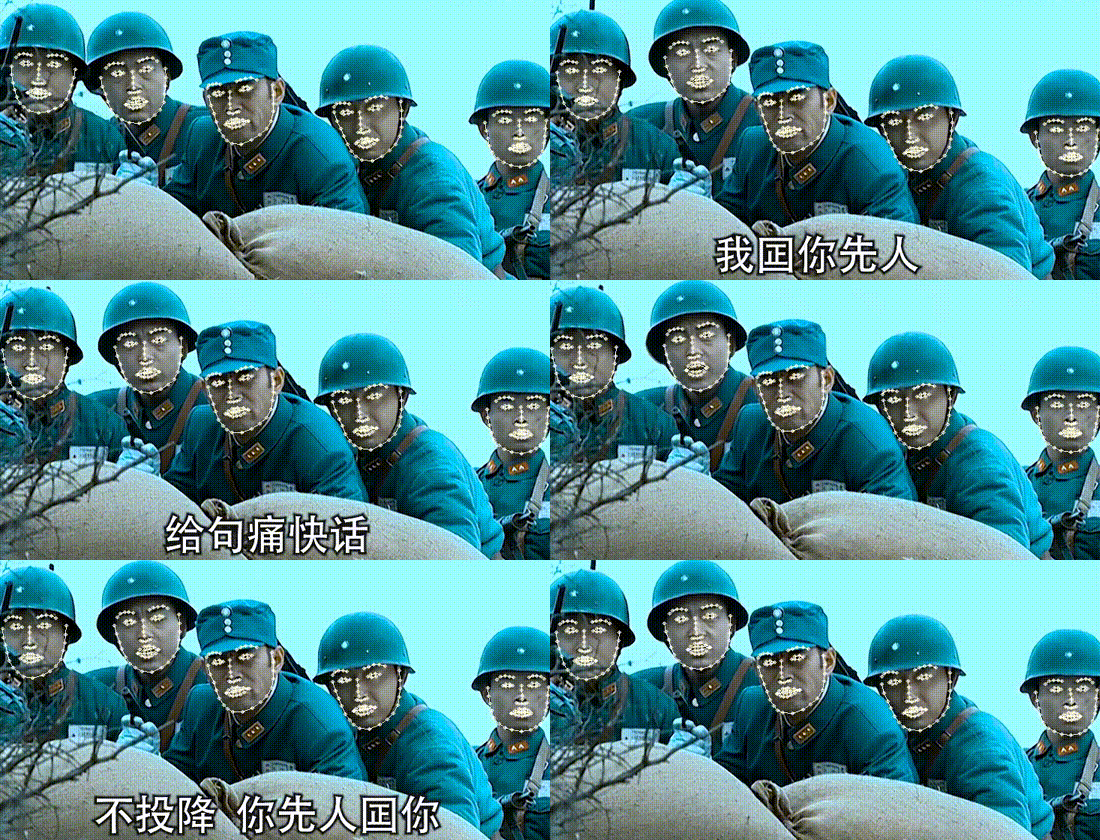
Since we have reconstructed the entire face, the 3D face alignment can be achieved by selecting the landmarks at the corresponding positions. See [TPAMI 2017] Face alignment in full pose range: A 3d total solution for more details.

Comparing with the method of first detecting 2D landmarks and then performing depth estimation, directly fitting 3DMM to solve 3D face alignment can not only obtain more accurate results in larger pose scenes, but also has obvious advantages in speed.

We provide a demonstration script that can generate 68 landmarks based on the reconstructed face. Run the following command to view the real-time 3D face alignment results:

python3 demo_video.py -m sparse -f <your-video-path>

Dense
dense demo

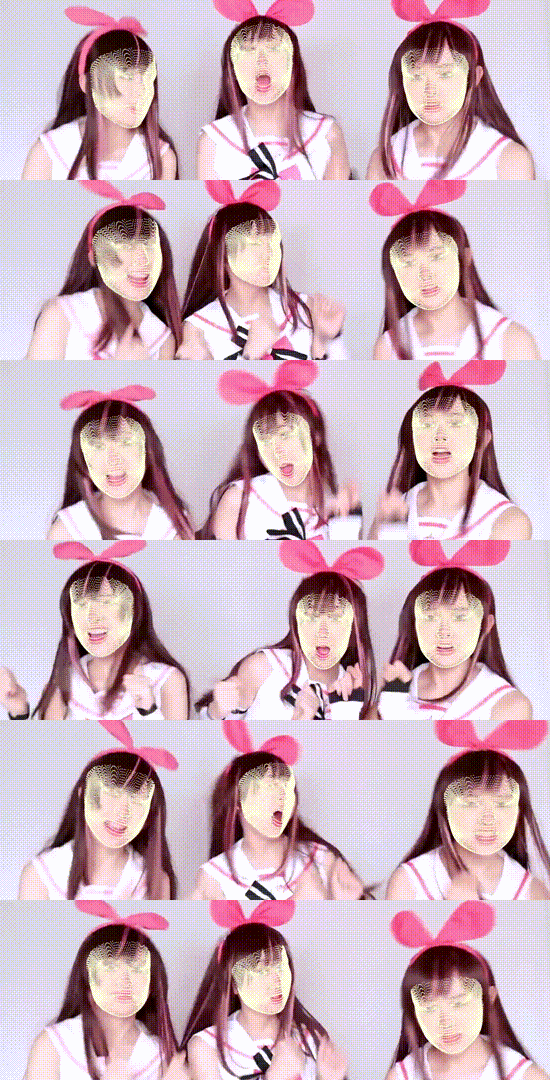
Currently, our method supports up to 38,365 landmarks. We draw landmarks every 6 indexes for a better illustration. Run the demonstrate script in dense mode for real-time dense facial landmark localization:

python3 demo_video.py -m dense -f <your-video-path>

Face Reconstruction

Our network is multi-task since it can directly regress 3DMM params from a single face image for reconstruction, as well as estimate the head pose via R and T prediction. During training, the predicted R can supervise the params regression branch to generate refined face mesh. Meanwhile, the landmarks calculated via the params are provided as the labeled data to the pose estimation branch for training, through the cv2.solvePnP tool.

Theoretically speaking, the head pose estimation task in our model is weakly supervised, since only a few labeled data is required to activate the training process. In detail, the loss function at the initial stage can be described as follows:

Init Pose Loss

After the initialization process, the ground truth can be replaced by the prediction results of other branches. Therefore, the loss function will be transformed to the following equation in the later stage of the training process:

Pose Loss

In general, fitting the 3D model during the training process dynamically can avoid the inaccurate head pose estimation results caused by the coarse predefined model.

Head Pose
pose demo

Traditional head pose estimation approaches, such as Appearance Template Models, Detector Arrays, and Mainfold Embedding have been extensively studied. However, methods based on deep learning improved the prediction accuracy to meet actual needs, until recent years.

Given a set of predefined 3D facial landmarks and the corresponding 2D image projections, the SolvePnP tool can be utilized to calculate the rotation matrix. However, the adopted mean 3D human face model usually introduces intrinsic error during the fitting process. Meanwhile, the additional landmarks extraction component is also kind of cumbersome.

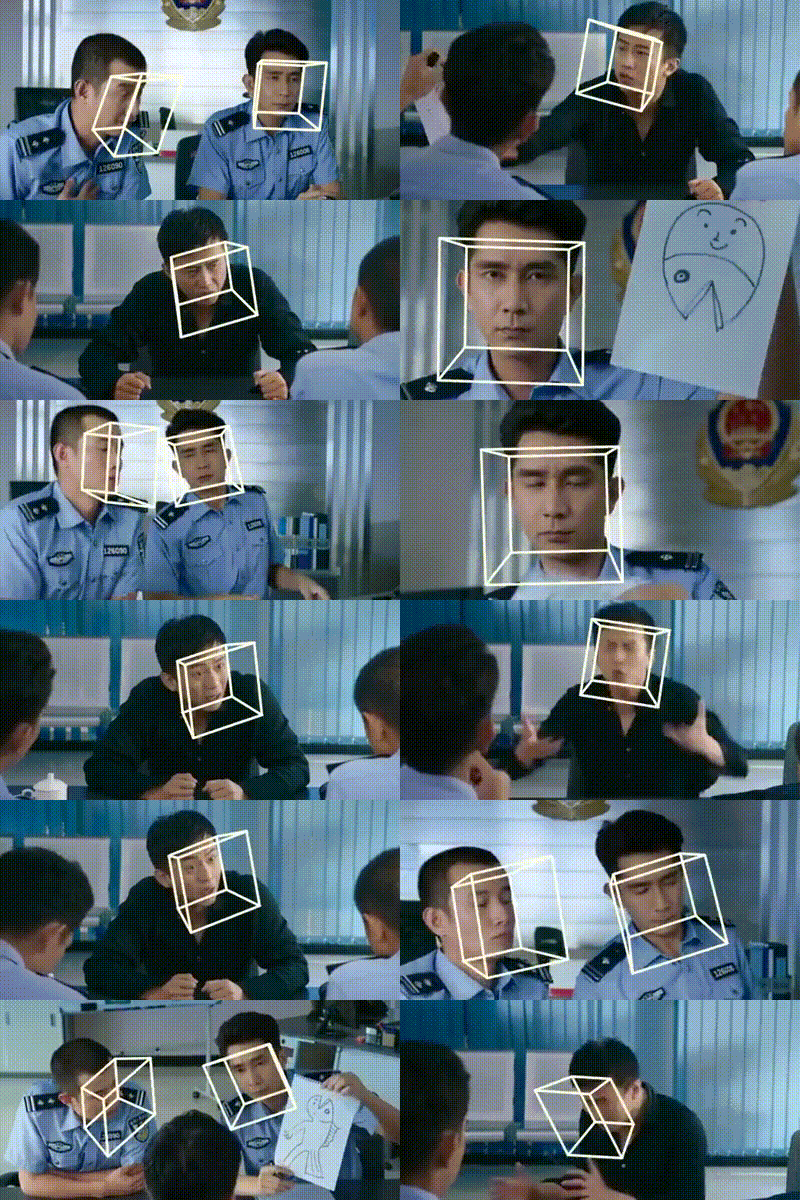
Therefore, we designed a network branch for directly regress 6DoF parameters from the face image. The predictions include the 3DoF rotation matrix R (Pitch, Yaw, Roll), and the 3DoF translation matrix T (x, y, z), Compared with the landmark-based method, directly regression the camera matrix is more robust and stable, as well as significantly reduce the network training cost. Run the demonstrate script in pose mode to view the real-time head pose estimation results:

python3 demo_video.py -m pose -f <your-video-path>

Expression
Expression

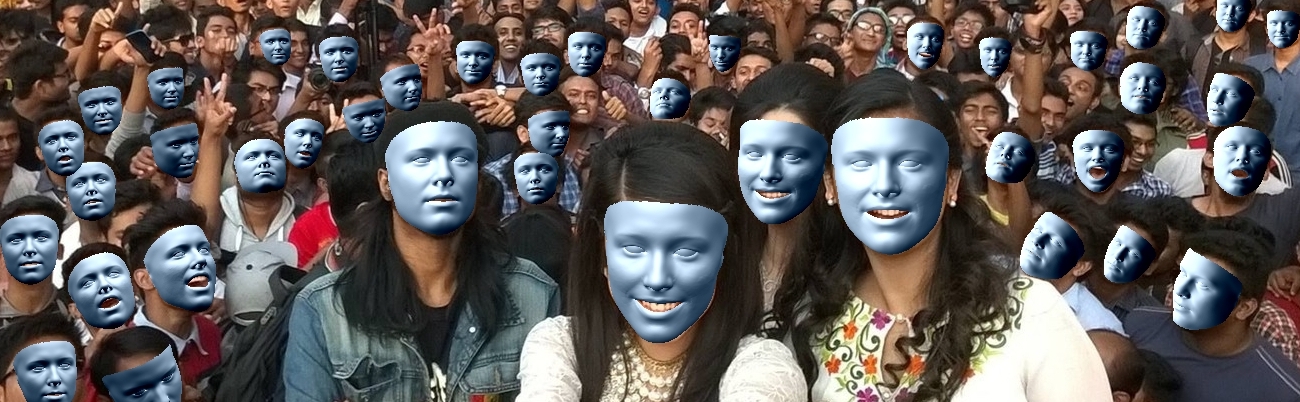
Coarse expression estimation can be achieved by combining the predefined expressions in BFM linearly. In our model, regression the E is one of the tasks of the params prediction branch. Obviously, the accuracy of the linear combination is positively related to the dimension.

Clipping parameters can accelerate the training process, however, it can also reduce reconstruction accuracy, especially details such as eye and mouth. More specifically, E has a greater impact on face details than S when emotion is involved. Therefore, we choose 10-dimension for a tradeoff between the speed and the accuracy, the training data can be found at here for refinement.

In addition, we provide a simple facial expression rendering script. Run the following command for illustration:

python3 demo_image.py <your-image-path>

Mesh
mesh demo

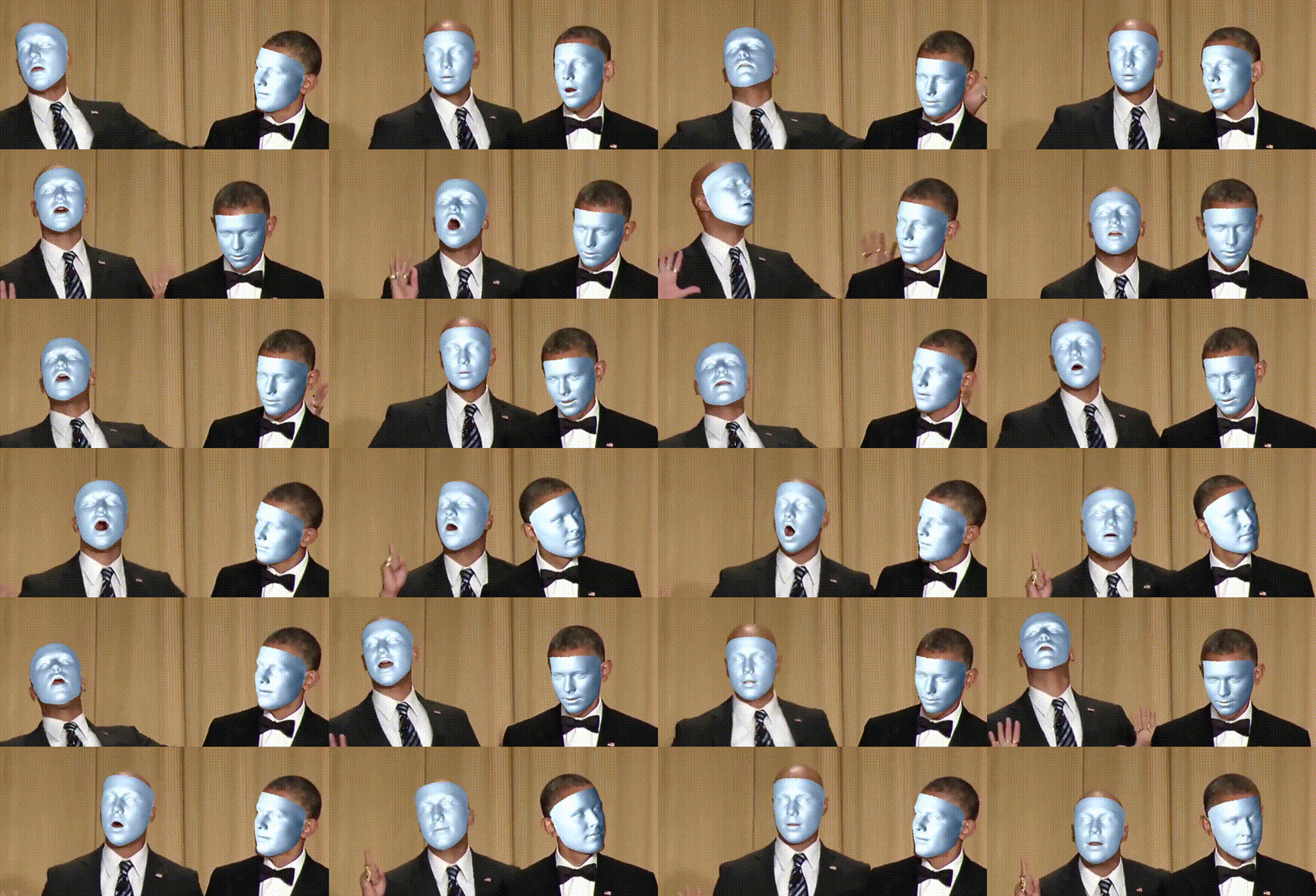
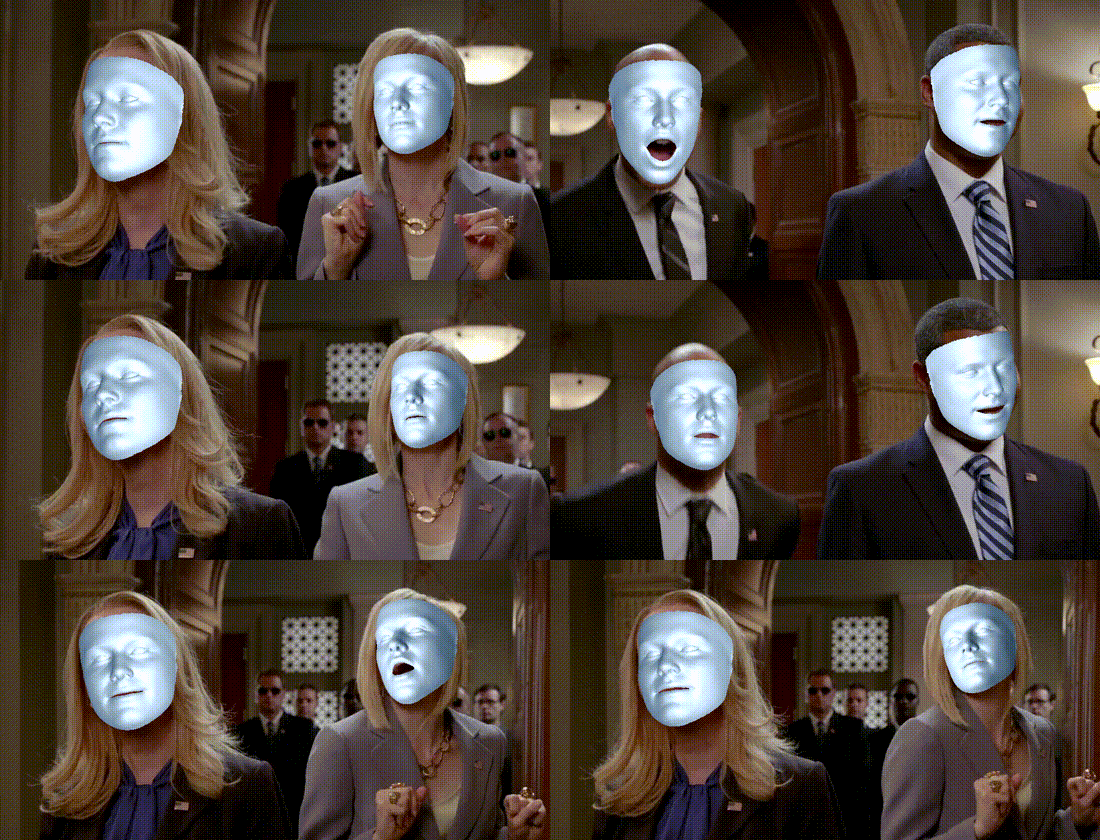
According to the predefined BFM and the predicted 3DMM parameters, the dense 3D facial landmarks can be easily calculated. On this basis, through the index mapping between the morphable triangle vertices and the dense landmarks defined in BFM, the renderer can plot these geometries with depth infomation for mesh preview. Run the demonstrate script in mesh mode for real-time face reconstruction:

python3 demo_video.py -m mesh -f <your-video-path>

Benchmark

Our network can directly output the camera matrix and sparse or dense landmarks. Compared with the model in the original paper with the same backbone, the additional parameters yield via the pose regression branch does not significantly affect the inference speed, which means it can still be CPU real-time.

Scheme THREAD=1 THREAD=2 THREAD=4
Inference 7.79ms 6.88ms 5.83ms

In addition, since most of the operations are wrapped in the model, the time consumption of pre-processing and post-processing are significantly reduced. Meanwhile, the optimized lightweight renderer is 5x faster (3ms vs 15ms) than the Sim3DR tools. These measures decline the latency of the entire pipeline.

Stage Preprocess Inference Postprocess Render
Each face cost 0.23ms 7.79ms 0.39ms 3.92ms

Run the following command for speed benchmark:

python3 video_speed_benchmark.py <your-video-path>

Citation

@inproceedings{guo2020towards,
    title={Towards Fast, Accurate and Stable 3D Dense Face Alignment},
    author={Guo, Jianzhu and Zhu, Xiangyu and Yang, Yang and Yang, Fan and Lei, Zhen and Li, Stan Z},
    booktitle={Proceedings of the European Conference on Computer Vision (ECCV)},
    year={2020}
}
Comments
  • __init__() got an unexpected keyword argument 'num_threads'

    __init__() got an unexpected keyword argument 'num_threads'

    While running "python3 demo_video.py -m mesh -f I receive the following ERROR: File "demo_video.py", line 53, in main(args) File "demo_video.py", line 16, in main fa = service.DenseFaceReconstruction("weights/dense_face.tflite") File "/home/happy/PycharmProjects/Dense-Head-Pose-Estimation/service/TFLiteFaceAlignment.py", line 11, in init num_threads=num_threads) TypeError: init() got an unexpected keyword argument 'num_threads'

    opened by berylyellow 2
  • asset/render.so not found

    asset/render.so not found

    While running "python3 demo_video.py -m mesh -f I receive the following ERROR OSError: asset/render.so: cannot open shared object file: No such file or directory I can successfully run the other three modes (sparse, dense, pose)

    opened by fisakhan 2
  • How can i get Depth

    How can i get Depth

    hi, I want to get information about the depth of the face, how do I calculate it? i don't need rendering but only need depth map. like https://github.kakaocorp.com/data-sci/3DDFA_V2_tf2/blob/master/utils/depth.py thank you in advance!

    opened by joongkyunKim 1
  • there is no asset/render.so

    there is no asset/render.so

    Ignore above cudart dlerror if you do not have a GPU set up on your machine. Traceback (most recent call last): File "demo_video.py", line 53, in main(args) File "demo_video.py", line 18, in main color = service.TrianglesMeshRender("asset/render.so", File "/home/xuhao/workspace/Dense-Head-Pose-Estimation-main/service/CtypesMeshRender.py", line 17, in init self._clibs = ctypes.CDLL(clibs)

    opened by hitxuhao 1
  • asset/render.so: cannot open shared object file: No such file or director

    asset/render.so: cannot open shared object file: No such file or director

    It worked well with: $ python3 demo_video.py -m pose -f ./re.mp4 $python3 demo_video.py -m sparse -f ./re.mp4 $ python3 demo_video.py -m dense -f ./re.mp4

    but with mesh not as you see here:

    $python3 demo_video.py -m mesh -f ./re.mp4 2022-12-05 17:03:03.713207: I tensorflow/stream_executor/platform/default/dso_loader.cc:48] Successfully opened dynamic library libcudart.so.10.1 Traceback (most recent call last): File "demo_video.py", line 55, in main(args) File "demo_video.py", line 21, in main color = service.TrianglesMeshRender("asset/render.so", "asset/triangles.npy") File "/home/redhwan/2/HPE/tensorflow/Dense-Head-Pose-Estimation-main/service/CtypesMeshRender.py", line 17, in init self._clibs = ctypes.CDLL(clibs) File "/usr/lib/python3.8/ctypes/init.py", line 373, in init self._handle = _dlopen(self._name, mode) OSError: asset/render.so: cannot open shared object file: No such file or directory

    opened by Algabri 0
  • Memory usage

    Memory usage

    hi @1996scarlet

    Is it expected that the model uses around 18GB of video RAM? Or does it maximises the RAM available to help with speed? (I got a 24GB ram GPU, and usage goes up to 22.2GB while inferencing) Thanks for this amazing MIT license repo btw.

    opened by Tetsujinfr 0
Releases(v1.0)
  • v1.0(Feb 1, 2021)

    Stable Head Pose Estimation and Landmark Regression via 3D Dense Face Reconstruction

    • CPU real-time face deteciton, alignment, and reconstruction pipeline.
    • Lightweight render library, 5x faster (3ms vs 15ms) than the Sim3DR tools.
    • Camera matrix and dense/sparse landmarks prediction via a single network.
    • Generate facial parameters for robust head pose and expression estimation.
    Source code(tar.gz)
    Source code(zip)
Owner
Remilia Scarlet
Remilia Scarlet
Building Ellee — A GPT-3 and Computer Vision Powered Talking Robotic Teddy Bear With Human Level Conversation Intelligence

Using an object detection and facial recognition system built on MobileNetSSDV2 and Dlib and running on an NVIDIA Jetson Nano, a GPT-3 model, Google Speech Recognition, Amazon Polly and servo motors,

24 Oct 26, 2022
An Intelligent Self-driving Truck System For Highway Transportation

Inceptio Intelligent Truck System An Intelligent Self-driving Truck System For Highway Transportation Note The code is still in development. OS requir

InceptioResearch 11 Jul 13, 2022
FindFunc is an IDA PRO plugin to find code functions that contain a certain assembly or byte pattern, reference a certain name or string, or conform to various other constraints.

FindFunc: Advanced Filtering/Finding of Functions in IDA Pro FindFunc is an IDA Pro plugin to find code functions that contain a certain assembly or b

213 Dec 17, 2022
Fine-Tune EleutherAI GPT-Neo to Generate Netflix Movie Descriptions in Only 47 Lines of Code Using Hugginface And DeepSpeed

GPT-Neo-2.7B Fine-Tuning Example Using HuggingFace & DeepSpeed Installation cd venv/bin ./pip install -r ../../requirements.txt ./pip install deepspe

Nikita 180 Jan 05, 2023
PyTorch implementation of image classification models for CIFAR-10/CIFAR-100/MNIST/FashionMNIST/Kuzushiji-MNIST/ImageNet

PyTorch Image Classification Following papers are implemented using PyTorch. ResNet (1512.03385) ResNet-preact (1603.05027) WRN (1605.07146) DenseNet

1.2k Jan 04, 2023
VD-BERT: A Unified Vision and Dialog Transformer with BERT

VD-BERT: A Unified Vision and Dialog Transformer with BERT PyTorch Code for the following paper at EMNLP2020: Title: VD-BERT: A Unified Vision and Dia

Salesforce 44 Nov 01, 2022
An interpreter for RASP as described in the ICML 2021 paper "Thinking Like Transformers"

RASP Setup Mac or Linux Run ./setup.sh . It will create a python3 virtual environment and install the dependencies for RASP. It will also try to insta

141 Jan 03, 2023
AdaNet is a lightweight TensorFlow-based framework for automatically learning high-quality models with minimal expert intervention

AdaNet is a lightweight TensorFlow-based framework for automatically learning high-quality models with minimal expert intervention. AdaNet buil

3.4k Jan 07, 2023
Implementation of Perceiver, General Perception with Iterative Attention in TensorFlow

Perceiver This Python package implements Perceiver: General Perception with Iterative Attention by Andrew Jaegle in TensorFlow. This model builds on t

Rishit Dagli 84 Oct 15, 2022
PyTorch implementation of paper: AdaAttN: Revisit Attention Mechanism in Arbitrary Neural Style Transfer, ICCV 2021.

AdaAttN: Revisit Attention Mechanism in Arbitrary Neural Style Transfer [Paper] [PyTorch Implementation] [Paddle Implementation] Overview This reposit

148 Dec 30, 2022
FinEAS: Financial Embedding Analysis of Sentiment 📈

FinEAS: Financial Embedding Analysis of Sentiment 📈 (SentenceBERT for Financial News Sentiment Regression) This repository contains the code for gene

LHF Labs 31 Dec 13, 2022
Pytorch implementation of the Variational Recurrent Neural Network (VRNN).

VariationalRecurrentNeuralNetwork Pytorch implementation of the Variational RNN (VRNN), from A Recurrent Latent Variable Model for Sequential Data. Th

emmanuel 251 Dec 17, 2022
A production-ready, scalable Indexer for the Jina neural search framework, based on HNSW and PSQL

🌟 HNSW + PostgreSQL Indexer HNSWPostgreSQLIndexer Jina is a production-ready, scalable Indexer for the Jina neural search framework. It combines the

Jina AI 25 Oct 14, 2022
Weakly-Supervised Semantic Segmentation Network with Deep Seeded Region Growing (CVPR 2018).

Weakly-Supervised Semantic Segmentation Network with Deep Seeded Region Growing (CVPR2018) By Zilong Huang, Xinggang Wang, Jiasi Wang, Wenyu Liu and J

Zilong Huang 245 Dec 13, 2022
DecoupledNet is semantic segmentation system which using heterogeneous annotations

DecoupledNet: Decoupled Deep Neural Network for Semi-supervised Semantic Segmentation Created by Seunghoon Hong, Hyeonwoo Noh and Bohyung Han at POSTE

Hyeonwoo Noh 74 Sep 22, 2021
Official code for: A Probabilistic Hard Attention Model For Sequentially Observed Scenes

"A Probabilistic Hard Attention Model For Sequentially Observed Scenes" Authors: Samrudhdhi Rangrej, James Clark Accepted to: BMVC'21 A recurrent atte

5 Nov 19, 2022
Airborne Optical Sectioning (AOS) is a wide synthetic-aperture imaging technique

AOS: Airborne Optical Sectioning Airborne Optical Sectioning (AOS) is a wide synthetic-aperture imaging technique that employs manned or unmanned airc

JKU Linz, Institute of Computer Graphics 39 Dec 09, 2022
OOD Generalization and Detection (ACL 2020)

Pretrained Transformers Improve Out-of-Distribution Robustness How does pretraining affect out-of-distribution robustness? We create an OOD benchmark

littleRound 57 Jan 09, 2023
Decision Transformer: A brand new Offline RL Pattern

DecisionTransformer_StepbyStep Intro Decision Transformer: A brand new Offline RL Pattern. 这是关于NeurIPS 2021 热门论文Decision Transformer的复现。 👍 原文地址: Deci

Irving 14 Nov 22, 2022
Commonality in Natural Images Rescues GANs: Pretraining GANs with Generic and Privacy-free Synthetic Data - Official PyTorch Implementation (CVPR 2022)

Commonality in Natural Images Rescues GANs: Pretraining GANs with Generic and Privacy-free Synthetic Data (CVPR 2022) Potentials of primitive shapes f

31 Sep 27, 2022