Neural Radiance Fields Using PyTorch

Overview

Neural Radiance Fields Using PyTorch

NeRF (Neural Radiance Fields) is a method for achieving outcomes for synthesizing novel views of complex scenes. Posted below are a few videos generated by this project.

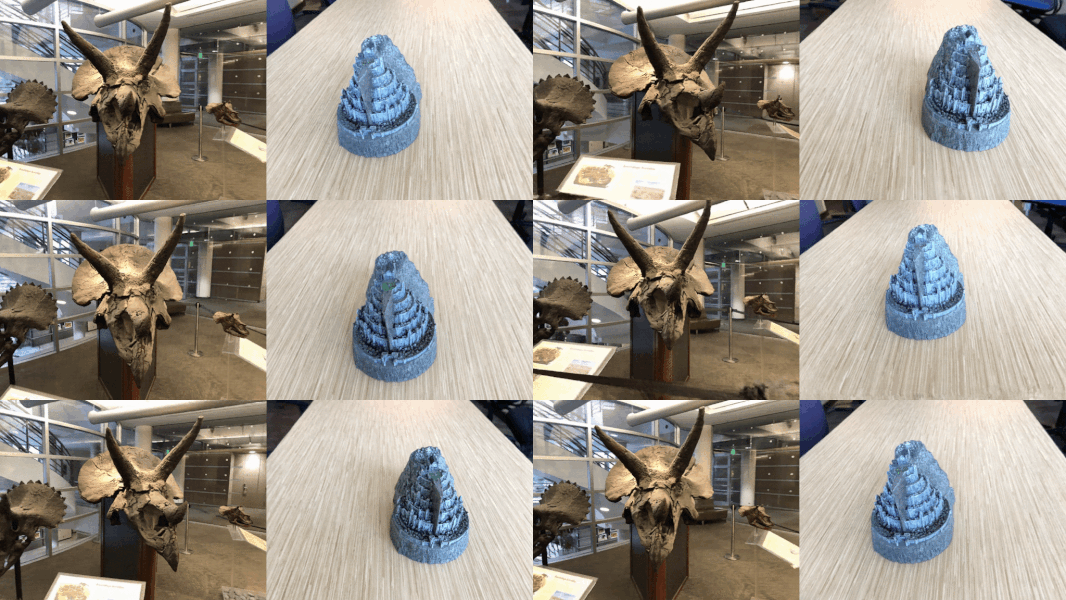
This project is a PyTorch implementation of NeRF that reproduces the results while running approximately 1.3x faster. The code is based on the TensorFlow implementation here of the author. PyTorch has been used for numerical testing and validation of the same.

Installation

git clone https://github.com/yenchenlin/nerf-pytorch.git
cd nerf-pytorch
pip install -r requirements.txt
cd torchsearchsorted
pip install .
cd ../
Dependencies (click to expand)

Dependencies

  • PyTorch 1.4
  • matplotlib
  • numpy
  • imageio
  • imageio-ffmpeg
  • configargparse

The LLFF data loader requires ImageMagick.

You will also need the LLFF code (and COLMAP) set up to compute poses if you want to run on your own real data.

How To Run?

Quick Start

Download data for two example datasets: lego and fern

bash download_example_data.sh

To train a low-res lego NeRF:

python run_nerf.py --config configs/config_lego.txt

After training for 100,000 iterations (~4 hours on a single 2080 Ti), you can find the following video at logs/lego_test/lego_test_spiral_100000_rgb.mp4.


To train a low-res fern NeRF:

python run_nerf.py --config configs/config_fern.txt

After training for 200k iterations (~8 hours on a single 2080 Ti), you can find the following video at logs/fern_test/fern_test_spiral_200000_rgb.mp4 and logs/fern_test/fern_test_spiral_200000_disp.mp4


More Datasets

To test out the other scenes presented in the paper, you can download the data here. Please place the downloaded dataset according to the following directory structure:

├── configs                                                                                                       
│   ├── ...                                                                                     
│                                                                                               
├── data                                                                                                                                                                                                       
│   ├── nerf_llff_data                                                                                                  
│   │   └── fern                                                                                                                             
│   │   └── flower  # downloaded llff dataset                                                                                  
│   │   └── horns   # downloaded llff dataset
|   |   └── ...
|   ├── nerf_synthetic
|   |   └── lego
|   |   └── ship    # downloaded synthetic dataset
|   |   └── ...

To train NeRF on different datasets:

python run_nerf.py --config configs/config_{DATASET}.txt

replace {DATASET} with trex | horns | flower | fortress | lego | etc.


To test NeRF trained on different datasets:

python run_nerf.py --config configs/config_{DATASET}.txt --render_only

replace {DATASET} with trex | horns | flower | fortress | lego | etc.

Pre-trained Models

You can download the pre-trained models here. Please place the downloaded directory in ./logs in order to test it later. Check the following directory structure for an example:

├── logs 
│   ├── fern_test
│   ├── flower_test  # downloaded logs
│   ├── trex_test    # downloaded logs

Reproducibility

The tests that ensure the results of all functions and training loop match the official implentation are contained in a different branch reproduce. One can check it out and run the tests:

git checkout reproduce
py.test

Method

NeRF: Representing Scenes as Neural Radiance Fields for View Synthesis
Ben Mildenhall*1, Pratul P. Srinivasan*1, Matthew Tancik*1, Jonathan T. Barron2, Ravi Ramamoorthi3, Ren Ng1
1UC Berkeley, 2Google Research, 3UC San Diego
*denotes equal contribution

A Neural Radiance Field is a simple fully connected network (weights are ~5MB) trained to reproduce input views of a single scene using a rendering loss. The network directly maps from spatial location and viewing direction (5D input) to color and opacity (4D output), acting as the "volume" so we can use volume rendering to differentiably render new views

Citation

A big thank-you to the authors (below) for their amazing work and results:

@misc{mildenhall2020nerf,
    title={NeRF: Representing Scenes as Neural Radiance Fields for View Synthesis},
    author={Ben Mildenhall and Pratul P. Srinivasan and Matthew Tancik and Jonathan T. Barron and Ravi Ramamoorthi and Ren Ng},
    year={2020},
    eprint={2003.08934},
    archivePrefix={arXiv},
    primaryClass={cs.CV}
}
Owner
Vedant Ghodke
Technical Undergraduate Intern At Cisco | Ex-AI Intern At Microsoft, India
Vedant Ghodke
OpenMMLab Model Deployment Toolset

Introduction English | 简体中文 MMDeploy is an open-source deep learning model deployment toolset. It is a part of the OpenMMLab project. Major features F

OpenMMLab 1.5k Dec 30, 2022
Machine learning framework for both deep learning and traditional algorithms

NeoML is an end-to-end machine learning framework that allows you to build, train, and deploy ML models. This framework is used by ABBYY engineers for

NeoML 704 Dec 27, 2022
Adaptation through prediction: multisensory active inference torque control

Adaptation through prediction: multisensory active inference torque control Submitted to IEEE Transactions on Cognitive and Developmental Systems Abst

Cristian Meo 1 Nov 07, 2022
[Link]deep_portfolo - Use Reforcemet earg ad Supervsed learg to Optmze portfolo allocato []

rl_portfolio This Repository uses Reinforcement Learning and Supervised learning to Optimize portfolio allocation. The goal is to make profitable agen

Deepender Singla 165 Dec 02, 2022
Iris prediction model is used to classify iris species created julia's DecisionTree, DataFrames, JLD2, PlotlyJS and Statistics packages.

Iris Species Predictor Iris prediction is used to classify iris species using their sepal length, sepal width, petal length and petal width created us

Siva Prakash 2 Jan 06, 2022
CAMoE + Dual SoftMax Loss (DSL): Improving Video-Text Retrieval by Multi-Stream Corpus Alignment and Dual Softmax Loss

CAMoE + Dual SoftMax Loss (DSL): Improving Video-Text Retrieval by Multi-Stream Corpus Alignment and Dual Softmax Loss This is official implement of "

程星 87 Dec 24, 2022
Prototype-based Incremental Few-Shot Semantic Segmentation

Prototype-based Incremental Few-Shot Semantic Segmentation Fabio Cermelli, Massimiliano Mancini, Yongqin Xian, Zeynep Akata, Barbara Caputo -- BMVC 20

Fabio Cermelli 21 Dec 29, 2022
[ACM MM 2021] Diverse Image Inpainting with Bidirectional and Autoregressive Transformers

Diverse Image Inpainting with Bidirectional and Autoregressive Transformers Installation pip install -r requirements.txt Dataset Preparation Given the

Yingchen Yu 25 Nov 09, 2022
A framework that allows people to write their own Rocket League bots.

YOU PROBABLY SHOULDN'T PULL THIS REPO Bot Makers Read This! If you just want to make a bot, you don't need to be here. Instead, start with one of thes

543 Dec 20, 2022
Official Code Release for "CLIP-Adapter: Better Vision-Language Models with Feature Adapters"

Official Code Release for "CLIP-Adapter: Better Vision-Language Models with Feature Adapters" Pipeline of CLIP-Adapter CLIP-Adapter is a drop-in modul

peng gao 157 Dec 26, 2022
A multi-mode modulator for multi-domain few-shot classification (ICCV)

A multi-mode modulator for multi-domain few-shot classification (ICCV)

Yanbin Liu 8 Apr 28, 2022
Official codebase used to develop Vision Transformer, MLP-Mixer, LiT and more.

Big Vision This codebase is designed for training large-scale vision models on Cloud TPU VMs. It is based on Jax/Flax libraries, and uses tf.data and

Google Research 701 Jan 03, 2023
A Gura parser implementation for Python

Gura Python parser This repository contains the implementation of a Gura (compliant with version 1.0.0) format parser in Python. Installation pip inst

Gura Config Lang 19 Jan 25, 2022
Next-Best-View Estimation based on Deep Reinforcement Learning for Active Object Classification

next_best_view_rl Setup Clone the repository: git clone --recurse-submodules ... In 'third_party/zed-ros-wrapper': git checkout devel Install mujoco `

Christian Korbach 1 Feb 15, 2022
A Python library for working with arbitrary-dimension hypercomplex numbers following the Cayley-Dickson construction of algebras.

Hypercomplex A Python library for working with quaternions, octonions, sedenions, and beyond following the Cayley-Dickson construction of hypercomplex

7 Nov 04, 2022
ISNAS-DIP: Image Specific Neural Architecture Search for Deep Image Prior [CVPR 2022]

ISNAS-DIP: Image-Specific Neural Architecture Search for Deep Image Prior (CVPR 2022) Metin Ersin Arican*, Ozgur Kara*, Gustav Bredell, Ender Konukogl

Özgür Kara 24 Dec 18, 2022
Implementation of UNet on the Joey ML framework

Independent Research Project - Code Joey can be cloned from here https://github.com/devitocodes/joey/. Devito and other dependencies such as PyTorch a

Navjot Kukreja 1 Oct 21, 2021
Semantically Contrastive Learning for Low-light Image Enhancement

Semantically Contrastive Learning for Low-light Image Enhancement Here, we propose an effective semantically contrastive learning paradigm for Low-lig

48 Dec 16, 2022
The reference baseline of final exam for XMU machine learning course

Mini-NICO Baseline The baseline is a reference method for the final exam of machine learning course. Requirements Installation we use /python3.7 /torc

JoaquinChou 3 Dec 29, 2021
This is the code for the paper "Jinkai Zheng, Xinchen Liu, Wu Liu, Lingxiao He, Chenggang Yan, Tao Mei: Gait Recognition in the Wild with Dense 3D Representations and A Benchmark. (CVPR 2022)"

Gait3D-Benchmark This is the code for the paper "Jinkai Zheng, Xinchen Liu, Wu Liu, Lingxiao He, Chenggang Yan, Tao Mei: Gait Recognition in the Wild

82 Jan 04, 2023