Implementation of "GNNAutoScale: Scalable and Expressive Graph Neural Networks via Historical Embeddings" in PyTorch

Overview

PyGAS: Auto-Scaling GNNs in PyG
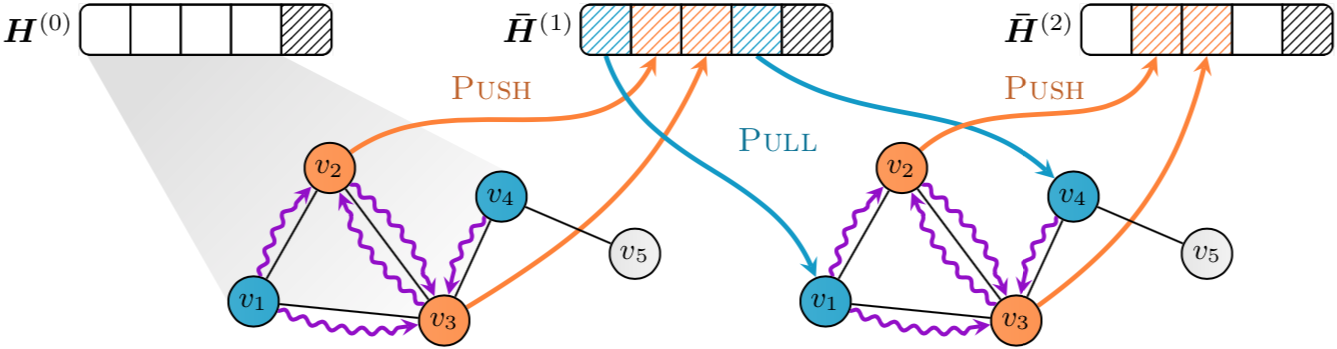

PyGAS is the practical realization of our GNNAutoScale (GAS) framework, which scales arbitrary message-passing GNNs to large graphs, as described in our paper:

Matthias Fey, Jan E. Lenssen, Frank Weichert, Jure Leskovec: GNNAutoScale: Scalable and Expressive Graph Neural Networks via Historical Embeddings (ICML 2021)

GAS prunes entire sub-trees of the computation graph by utilizing historical embeddings from prior training iterations, leading to constant GPU memory consumption in respect to input mini-batch size, and maximally expressivity.

PyGAS is implemented in PyTorch and utilizes the PyTorch Geometric (PyG) library. It provides an easy-to-use interface to convert a common or custom GNN from PyG into its scalable variant:

from torch_geometric.nn import SAGEConv
from torch_geometric_autoscale import ScalableGNN
from torch_geometric_autoscale import metis, permute, SubgraphLoader

class GNN(ScalableGNN):
    def __init__(self, num_nodes, in_channels, hidden_channels,
                 out_channels, num_layers):
        # * pool_size determines the number of pinned CPU buffers
        # * buffer_size determines the size of pinned CPU buffers,
        #   i.e. the maximum number of out-of-mini-batch nodes

        super().__init__(num_nodes, hidden_channels, num_layers,
                         pool_size=2, buffer_size=5000)

        self.convs = ModuleList()
        self.convs.append(SAGEConv(in_channels, hidden_channels))
        for _ in range(num_layers - 2):
            self.convs.append(SAGEConv(hidden_channels, hidden_channels))
        self.convs.append(SAGEConv(hidden_channels, out_channels))

    def forward(self, x, adj_t, *args):
        for conv, history in zip(self.convs[:-1], self.histories):
            x = conv(x, adj_t).relu_()
            x = self.push_and_pull(history, x, *args)
        return self.convs[-1](x, adj_t)

perm, ptr = metis(data.adj_t, num_parts=40, log=True)
data = permute(data, perm, log=True)
loader = SubgraphLoader(data, ptr, batch_size=10, shuffle=True)

model = GNN(...)
for batch, *args in loader:
    out = model(batch.x, batch.adj_t, *args)

A detailed description of ScalableGNN can be found in its implementation.

Requirements

pip install torch-scatter -f https://pytorch-geometric.com/whl/torch-${TORCH}+${CUDA}.html
pip install torch-sparse -f https://pytorch-geometric.com/whl/torch-${TORCH}+${CUDA}.html
pip install torch-geometric

where ${TORCH} should be replaced by either 1.7.0 or 1.8.0, and ${CUDA} should be replaced by either cpu, cu92, cu101, cu102, cu110 or cu111, depending on your PyTorch installation.

Installation

pip install git+https://github.com/rusty1s/pyg_autoscale.git

or

python setup.py install

Project Structure

  • torch_geometric_autoscale/ contains the source code of PyGAS
  • examples/ contains examples to demonstrate how to apply GAS in practice
  • small_benchmark/ includes experiments to evaluate GAS performance on small-scale graphs
  • large_benchmark/ includes experiments to evaluate GAS performance on large-scale graphs

We use Hydra to manage hyperparameter configurations.

Cite

Please cite our paper if you use this code in your own work:

@inproceedings{Fey/etal/2021,
  title={{GNNAutoScale}: Scalable and Expressive Graph Neural Networks via Historical Embeddings},
  author={Fey, M. and Lenssen, J. E. and Weichert, F. and Leskovec, J.},
  booktitle={International Conference on Machine Learning (ICML)},
  year={2021},
}
Owner
Matthias Fey
PhD student @ TU Dortmund University - Interested in Representation Learning on Graphs and Manifolds; PyTorch, CUDA, Vim and macOS Enthusiast
Matthias Fey
StyleGAN-NADA: CLIP-Guided Domain Adaptation of Image Generators

StyleGAN-NADA: CLIP-Guided Domain Adaptation of Image Generators [Project Website] [Replicate.ai Project] StyleGAN-NADA: CLIP-Guided Domain Adaptation

992 Dec 30, 2022
SC-GlowTTS: an Efficient Zero-Shot Multi-Speaker Text-To-Speech Model

SC-GlowTTS: an Efficient Zero-Shot Multi-Speaker Text-To-Speech Model Edresson Casanova, Christopher Shulby, Eren Gölge, Nicolas Michael Müller, Frede

Edresson Casanova 92 Dec 09, 2022
Implementation of "With a Little Help from my Temporal Context: Multimodal Egocentric Action Recognition, BMVC, 2021" in PyTorch

Multimodal Temporal Context Network (MTCN) This repository implements the model proposed in the paper: Evangelos Kazakos, Jaesung Huh, Arsha Nagrani,

Evangelos Kazakos 13 Nov 24, 2022
NNR conformation conditional and global probabilities estimation and analysis in peptides or proteins fragments

NNR and global probabilities estimation and analysis in peptides or protein fragments This module calculates global and NNR conformation dependent pro

0 Jul 15, 2021
Nested cross-validation is necessary to avoid biased model performance in embedded feature selection in high-dimensional data with tiny sample sizes

Pruner for nested cross-validation - Sphinx-Doc Nested cross-validation is necessary to avoid biased model performance in embedded feature selection i

1 Dec 15, 2021
DynamicViT: Efficient Vision Transformers with Dynamic Token Sparsification

DynamicViT: Efficient Vision Transformers with Dynamic Token Sparsification Created by Yongming Rao, Wenliang Zhao, Benlin Liu, Jiwen Lu, Jie Zhou, Ch

Yongming Rao 414 Jan 01, 2023
All course materials for the Zero to Mastery Machine Learning and Data Science course.

Zero to Mastery Machine Learning Welcome! This repository contains all of the code, notebooks, images and other materials related to the Zero to Maste

Daniel Bourke 1.6k Jan 08, 2023
Puzzle-CAM: Improved localization via matching partial and full features.

Puzzle-CAM The official implementation of "Puzzle-CAM: Improved localization via matching partial and full features".

Sanghyun Jo 150 Nov 14, 2022
Benchmarking Pipeline for Prediction of Protein-Protein Interactions

B4PPI Benchmarking Pipeline for the Prediction of Protein-Protein Interactions How this benchmarking pipeline has been built, and how to use it, is de

Loïc Lannelongue 4 Jun 27, 2022
NAS-Bench-x11 and the Power of Learning Curves

NAS-Bench-x11 NAS-Bench-x11 and the Power of Learning Curves Shen Yan, Colin White, Yash Savani, Frank Hutter. NeurIPS 2021. Surrogate NAS benchmarks

AutoML-Freiburg-Hannover 13 Nov 18, 2022
Statistical-Rethinking-with-Python-and-PyMC3 - Python/PyMC3 port of the examples in " Statistical Rethinking A Bayesian Course with Examples in R and Stan" by Richard McElreath

Statistical Rethinking with Python and PyMC3 This repository has been deprecated in favour of this one, please check that repository for updates, for

Osvaldo Martin 786 Dec 29, 2022
Open-source implementation of Google Vizier for hyper parameters tuning

Advisor Introduction Advisor is the hyper parameters tuning system for black box optimization. It is the open-source implementation of Google Vizier w

tobe 1.5k Jan 04, 2023
GeDML is an easy-to-use generalized deep metric learning library

GeDML is an easy-to-use generalized deep metric learning library

Borui Zhang 32 Dec 05, 2022
StarGAN - Official PyTorch Implementation (CVPR 2018)

StarGAN: Unified Generative Adversarial Networks for Multi-Domain Image-to-Image Translation

Yunjey Choi 5.1k Dec 30, 2022
Image Captioning on google cloud platform based on iot

Image-Captioning-on-google-cloud-platform-based-on-iot - Image Captioning on google cloud platform based on iot

Shweta_kumawat 1 Jan 20, 2022
Code for paper "Which Training Methods for GANs do actually Converge? (ICML 2018)"

GAN stability This repository contains the experiments in the supplementary material for the paper Which Training Methods for GANs do actually Converg

Lars Mescheder 885 Jan 01, 2023
Tensors and neural networks in Haskell

Hasktorch Hasktorch is a library for tensors and neural networks in Haskell. It is an independent open source community project which leverages the co

hasktorch 920 Jan 04, 2023
Pytorch implementation of our method for regularizing nerual radiance fields for few-shot neural volume rendering.

InfoNeRF: Ray Entropy Minimization for Few-Shot Neural Volume Rendering Pytorch implementation of our method for regularizing nerual radiance fields f

106 Jan 06, 2023
Agile SVG maker for python

Agile SVG Maker Need to draw hundreds of frames for a GIF? Need to change the style of all pictures in a PPT? Need to draw similar images with differe

SemiWaker 4 Sep 25, 2022
TensorFlow tutorials and best practices.

Effective TensorFlow 2 Table of Contents Part I: TensorFlow 2 Fundamentals TensorFlow 2 Basics Broadcasting the good and the ugly Take advantage of th

Vahid Kazemi 8.7k Dec 31, 2022