An implementation of Video Frame Interpolation via Adaptive Separable Convolution using PyTorch

Overview

This work has now been superseded by: https://github.com/sniklaus/revisiting-sepconv

sepconv-slomo

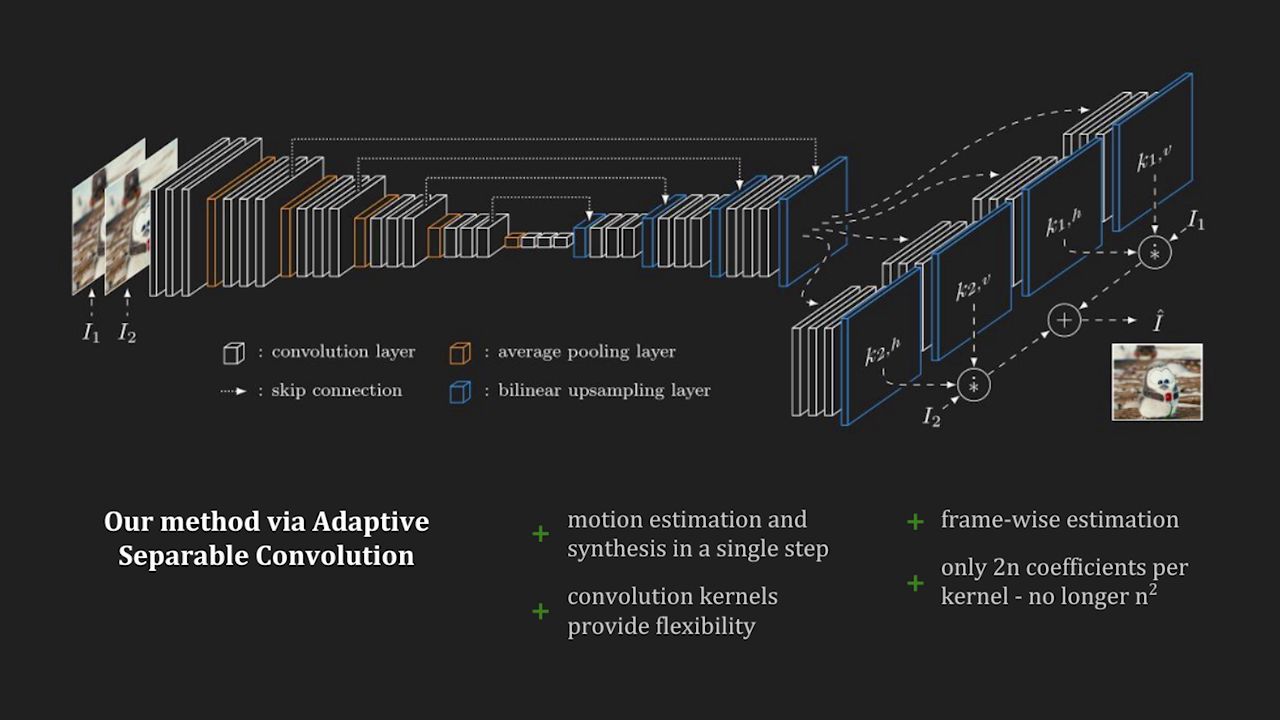
This is a reference implementation of Video Frame Interpolation via Adaptive Separable Convolution [1] using PyTorch. Given two frames, it will make use of adaptive convolution [2] in a separable manner to interpolate the intermediate frame. Should you be making use of our work, please cite our paper [1].

Paper

For a reimplemntation of our work, see: https://github.com/martkartasev/sepconv
And for another adaptation, consider: https://github.com/HyeongminLEE/pytorch-sepconv
For softmax splatting, please see: https://github.com/sniklaus/softmax-splatting

setup

The separable convolution layer is implemented in CUDA using CuPy, which is why CuPy is a required dependency. It can be installed using pip install cupy or alternatively using one of the provided binary packages as outlined in the CuPy repository.

If you plan to process videos, then please also make sure to have pip install moviepy installed.

usage

To run it on your own pair of frames, use the following command. You can either select the l1 or the lf model, please see our paper for more details. In short, the l1 model should be used for quantitative evaluations and the lf model for qualitative comparisons.

python run.py --model lf --one ./images/one.png --two ./images/two.png --out ./out.png

To run in on a video, use the following command.

python run.py --model lf --video ./videos/car-turn.mp4 --out ./out.mp4

For a quick benchmark using examples from the Middlebury benchmark for optical flow, run python benchmark.py. You can use it to easily verify that the provided implementation runs as expected.

video
Video

license

The provided implementation is strictly for academic purposes only. Should you be interested in using our technology for any commercial use, please feel free to contact us.

references

[1]  @inproceedings{Niklaus_ICCV_2017,
         author = {Simon Niklaus and Long Mai and Feng Liu},
         title = {Video Frame Interpolation via Adaptive Separable Convolution},
         booktitle = {IEEE International Conference on Computer Vision},
         year = {2017}
     }
[2]  @inproceedings{Niklaus_CVPR_2017,
         author = {Simon Niklaus and Long Mai and Feng Liu},
         title = {Video Frame Interpolation via Adaptive Convolution},
         booktitle = {IEEE Conference on Computer Vision and Pattern Recognition},
         year = {2017}
     }

acknowledgment

This work was supported by NSF IIS-1321119. The video above uses materials under a Creative Common license or with the owner's permission, as detailed at the end.

Owner
Simon Niklaus
Research Scientist at Adobe
Simon Niklaus
A PyTorch implementation of "Cluster-GCN: An Efficient Algorithm for Training Deep and Large Graph Convolutional Networks" (KDD 2019).

ClusterGCN ⠀⠀ A PyTorch implementation of "Cluster-GCN: An Efficient Algorithm for Training Deep and Large Graph Convolutional Networks" (KDD 2019). A

Benedek Rozemberczki 697 Dec 27, 2022
HyperSeg: Patch-wise Hypernetwork for Real-time Semantic Segmentation Official PyTorch Implementation

: We present a novel, real-time, semantic segmentation network in which the encoder both encodes and generates the parameters (weights) of the decoder. Furthermore, to allow maximal adaptivity, the w

Yuval Nirkin 182 Dec 14, 2022
Ros2-voiceroid2 - ROS2 wrapper package of VOICEROID2

ros2_voiceroid2 ROS2 wrapper package of VOICEROID2 Windows Only Installation Ins

Nkyoku 1 Jan 23, 2022
Pure python implementation reverse-mode automatic differentiation

MiniGrad A minimal implementation of reverse-mode automatic differentiation (a.k.a. autograd / backpropagation) in pure Python. Inspired by Andrej Kar

Kenny Song 76 Sep 12, 2022
Learning Continuous Signed Distance Functions for Shape Representation

DeepSDF This is an implementation of the CVPR '19 paper "DeepSDF: Learning Continuous Signed Distance Functions for Shape Representation" by Park et a

Meta Research 1.1k Jan 01, 2023
Improving Generalization Bounds for VC Classes Using the Hypergeometric Tail Inversion

Improving Generalization Bounds for VC Classes Using the Hypergeometric Tail Inversion Preface This directory provides an implementation of the algori

Jean-Samuel Leboeuf 0 Nov 03, 2021
DeepLab-ResNet rebuilt in TensorFlow

DeepLab-ResNet-TensorFlow This is an (re-)implementation of DeepLab-ResNet in TensorFlow for semantic image segmentation on the PASCAL VOC dataset. Fr

Vladimir 1.2k Nov 04, 2022
Dataset and Code for the paper "DepthTrack: Unveiling the Power of RGBD Tracking" (ICCV2021), and "Depth-only Object Tracking" (BMVC2021)

DeT and DOT Code and datasets for "DepthTrack: Unveiling the Power of RGBD Tracking" (ICCV2021) "Depth-only Object Tracking" (BMVC2021) @InProceedings

Yan Song 55 Dec 15, 2022
Code for ICDM2020 full paper: "Sub-graph Contrast for Scalable Self-Supervised Graph Representation Learning"

Subg-Con Sub-graph Contrast for Scalable Self-Supervised Graph Representation Learning (Jiao et al., ICDM 2020): https://arxiv.org/abs/2009.10273 Over

34 Jul 06, 2022
Revisiting Global Statistics Aggregation for Improving Image Restoration

Revisiting Global Statistics Aggregation for Improving Image Restoration Xiaojie Chu, Liangyu Chen, Chengpeng Chen, Xin Lu Paper: https://arxiv.org/pd

MEGVII Research 128 Dec 24, 2022
An atmospheric growth and evolution model based on the EVo degassing model and FastChem 2.0

EVolve Linking planetary mantles to atmospheric chemistry through volcanism using EVo and FastChem. Overview EVolve is a linked mantle degassing and a

Pip Liggins 2 Jan 17, 2022
Code for "Learning Graph Cellular Automata"

Learning Graph Cellular Automata This code implements the experiments from the NeurIPS 2021 paper: "Learning Graph Cellular Automata" Daniele Grattaro

Daniele Grattarola 37 Oct 26, 2022
[ICCV 2021] Official Pytorch implementation for Discriminative Region-based Multi-Label Zero-Shot Learning SOTA results on NUS-WIDE and OpenImages

Discriminative Region-based Multi-Label Zero-Shot Learning (ICCV 2021) [arXiv][Project page coming soon] Sanath Narayan*, Akshita Gupta*, Salman Kh

Akshita Gupta 54 Nov 21, 2022
Rendering Point Clouds with Compute Shaders

Compute Shader Based Point Cloud Rendering This repository contains the source code to our techreport: Rendering Point Clouds with Compute Shaders and

Markus Schütz 460 Jan 05, 2023
Exploring Image Deblurring via Blur Kernel Space (CVPR'21)

Exploring Image Deblurring via Encoded Blur Kernel Space About the project We introduce a method to encode the blur operators of an arbitrary dataset

VinAI Research 118 Dec 19, 2022
Code & Models for Temporal Segment Networks (TSN) in ECCV 2016

Temporal Segment Networks (TSN) We have released MMAction, a full-fledged action understanding toolbox based on PyTorch. It includes implementation fo

1.4k Jan 01, 2023
Bottom-up Human Pose Estimation

Introduction This is the official code of Rethinking the Heatmap Regression for Bottom-up Human Pose Estimation. This paper has been accepted to CVPR2

108 Dec 01, 2022
Online-compatible Unsupervised Non-resonant Anomaly Detection Repository

Online-compatible Unsupervised Non-resonant Anomaly Detection Repository Repository containing all scripts used in the studies of Online-compatible Un

0 Nov 09, 2021
Code for ICLR 2020 paper "VL-BERT: Pre-training of Generic Visual-Linguistic Representations".

VL-BERT By Weijie Su, Xizhou Zhu, Yue Cao, Bin Li, Lewei Lu, Furu Wei, Jifeng Dai. This repository is an official implementation of the paper VL-BERT:

Weijie Su 698 Dec 18, 2022
Graph WaveNet apdapted for brain connectivity analysis.

Graph WaveNet for brain network analysis This is the implementation of the Graph WaveNet model used in our manuscript: S. Wein , A. Schüller, A. M. To

4 Dec 17, 2022