ImageNet Adversarial Image Evaluation

Overview

ImageNet Adversarial Image Evaluation

This repository contains the code and some materials used in the experimental work presented in the following papers:

[1] Selection of Source Images Heavily Influences Effectiveness of Adversarial Attacks
British Machine Vision Conference (BMVC), 2021.

[2] Evaluating Adversarial Attacks on ImageNet: A Reality Check on Misclassification Classes
Conference on Neural Information Processing Systems (NeurIPS), Workshop on ImageNet: Past, Present, and Future, 2021.

Fragile Source images

Paper [1] TLDR: A number of source images easily become adversarial examples with relatively low perturbation levels and achieve high model-to-model transferability successes compared to other source images.

In src folder, we shared a number of cleaned source code that can be used to generate the figures used in the paper with the usage of adversarial examples generated with PGD, CW, and MI-FGSM. You can download the data here. Below are some of the visualizations used in the paper and their descriptions.

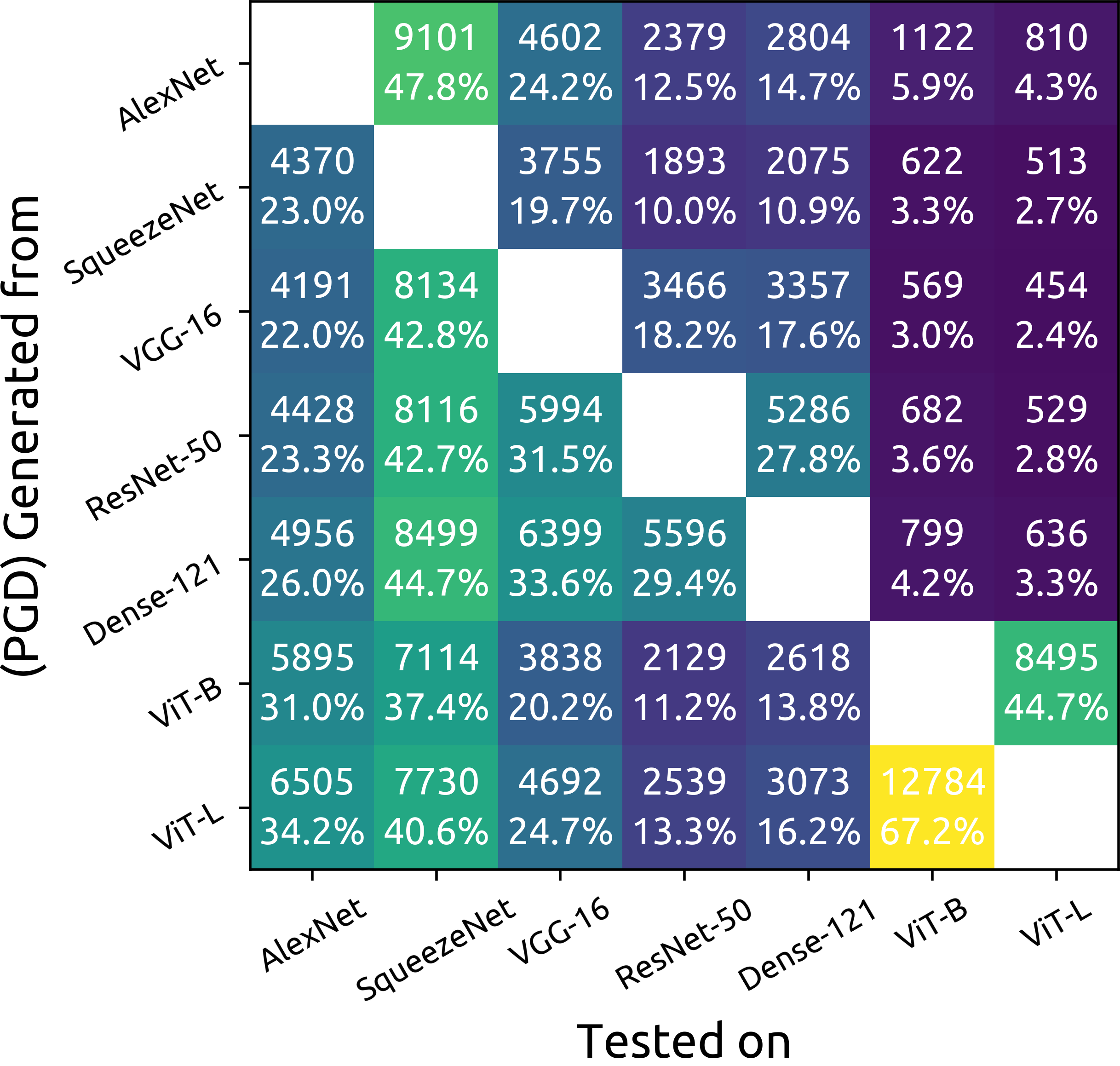
Model-to-model transferability matrix

Model-to-model transferability matrix can be generated with the usage of vis_m2m_transferability.py. This visualization has two modes, an overview one where only the transfer success percentage is shown and a detailed view where both the absolute amount and the percentage is shown. The visualization for this experiment is given below:
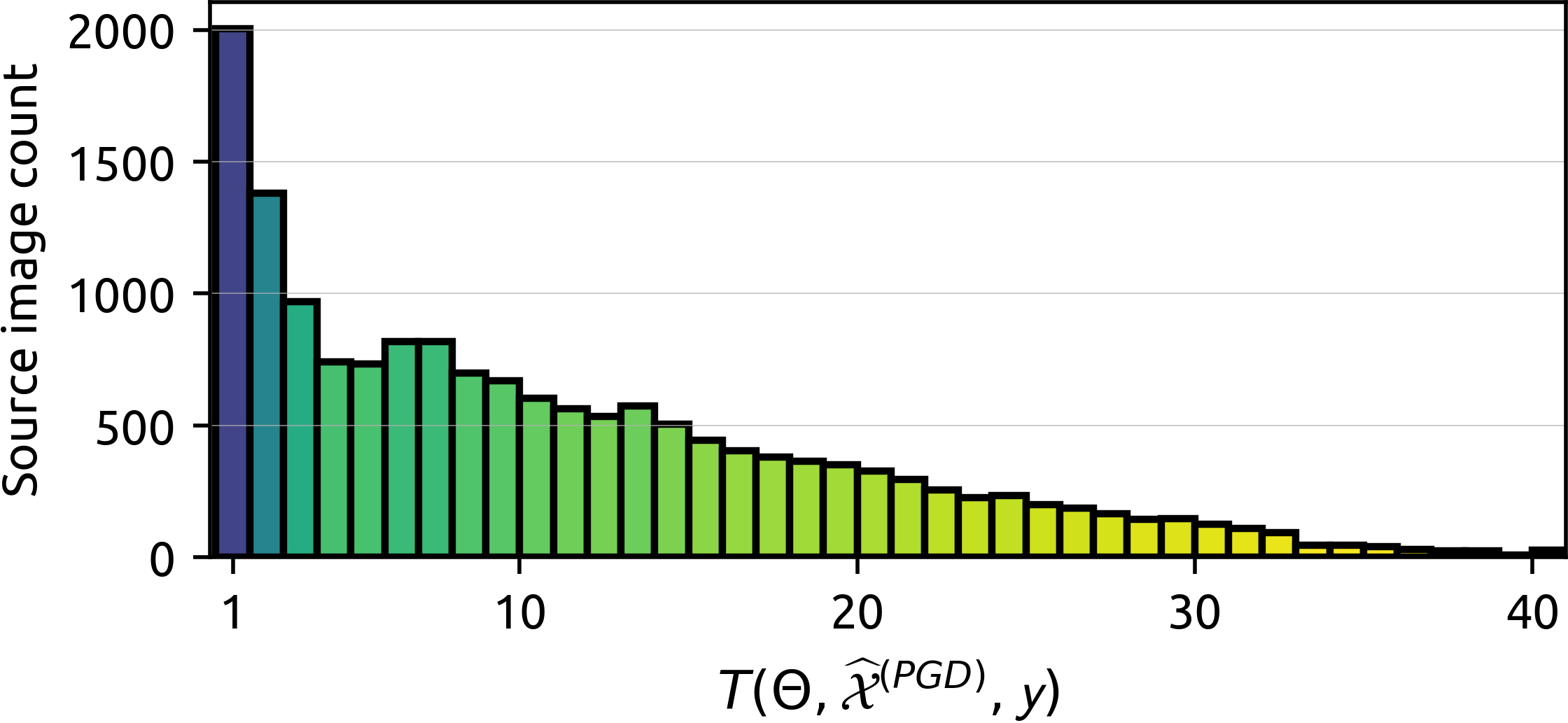
Source image transferability count

In the paper [1], we counted the model-to-model transferability of adversarial examples as they are generated from source images. This experiment can be reproduced with vis_transferability_cnt.py. The visualization for this experiment is given below:
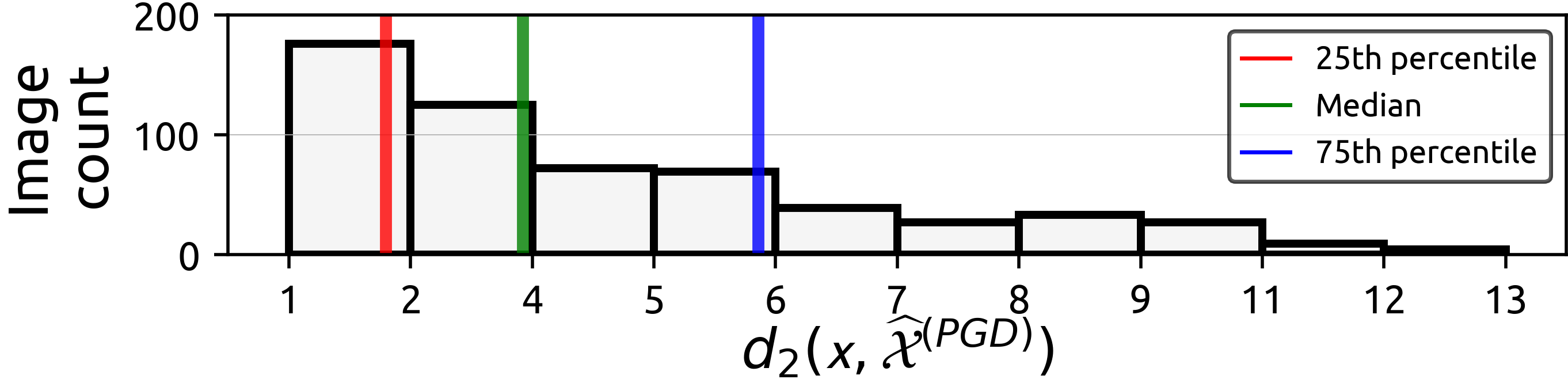
Perturbation distribution

In the paper [1], we counted the model-to-model transferability of adversarial examples as they are generated from source images. This experiment can be reproduced with vis_transferability_cnt.py. The visualization for this experiment is given below:
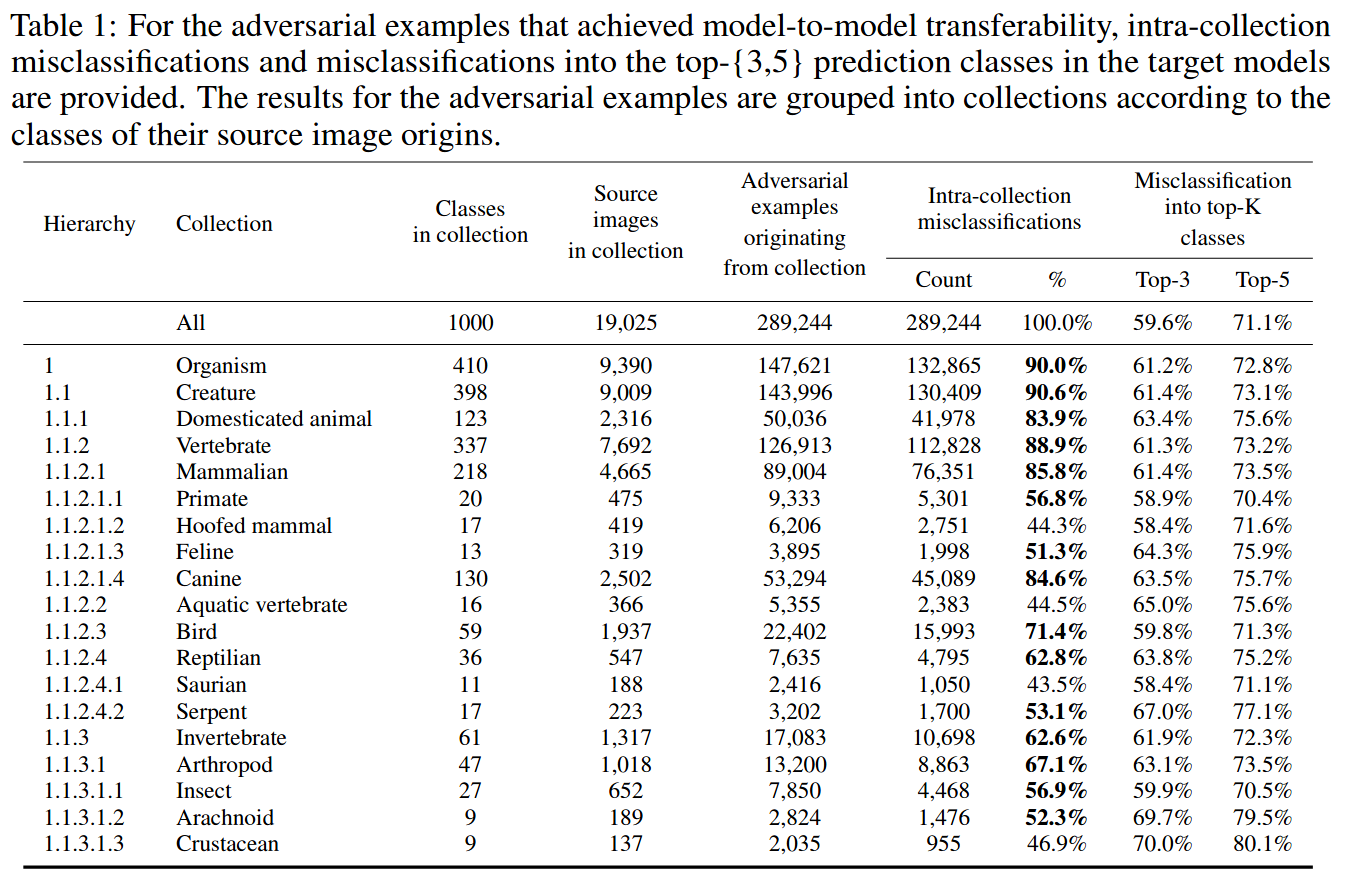
Untargeted misclassification for adversarial examples

Paper [2] TLDR: Adversarial examples that achieve untargeted model-to-model transferability are often misclassified into categories that are similar to the category of their origin.
We share the imagenet hierarchy used in the paper in the dictionary format in imagenet_hier.py.

Citation

If you find the code in this repository useful for your research, consider citing our paper. Also, feel free to use any visuals available here.

@inproceedings{ozbulak2021selection,
    title={Selection of Source Images Heavily Influences the Effectiveness of Adversarial Attacks},
    author={Ozbulak, Utku and Timothy Anzaku, Esla and De Neve, Wesley and Van Messem, Arnout},
    booktitle={British Machine vision Conference (BMVC)},
    year={2021}
}

@inproceedings{ozbulak2021evaluating,
  title={Evaluating Adversarial Attacks on ImageNet: A Reality Check on Misclassification Classes},
  author={Ozbulak, Utku and Pintor, Maura and Van Messem, Arnout and De Neve, Wesley},
  booktitle={NeurIPS 2021 Workshop on ImageNet: Past, Present, and Future},
  year={2021}
}

Requirements

python > 3.5
torch >= 0.4.0
torchvision >= 0.1.9
numpy >= 1.13.0
PIL >= 1.1.7
Owner
Utku Ozbulak
Fourth-year doctoral student at Ghent University. Located in Ghent University Global Campus, South Korea.
Utku Ozbulak
A very impractical 3D rendering engine that runs in the python terminal.

Terminal-3D-Render A very impractical 3D rendering engine that runs in the python terminal. do NOT try to run this program using the standard python I

23 Dec 31, 2022
3rd Place Solution for ICCV 2021 Workshop SSLAD Track 3A - Continual Learning Classification Challenge

Online Continual Learning via Multiple Deep Metric Learning and Uncertainty-guided Episodic Memory Replay 3rd Place Solution for ICCV 2021 Workshop SS

Rifki Kurniawan 6 Nov 10, 2022
Learning RAW-to-sRGB Mappings with Inaccurately Aligned Supervision (ICCV 2021)

Learning RAW-to-sRGB Mappings with Inaccurately Aligned Supervision (ICCV 2021) PyTorch implementation of Learning RAW-to-sRGB Mappings with Inaccurat

Zhilu Zhang 53 Dec 20, 2022
[CVPR 2020] Local Class-Specific and Global Image-Level Generative Adversarial Networks for Semantic-Guided Scene Generation

Contents Local and Global GAN Cross-View Image Translation Semantic Image Synthesis Acknowledgments Related Projects Citation Contributions Collaborat

Hao Tang 131 Dec 07, 2022
ScaleNet: A Shallow Architecture for Scale Estimation

ScaleNet: A Shallow Architecture for Scale Estimation Repository for the code of ScaleNet paper: "ScaleNet: A Shallow Architecture for Scale Estimatio

Axel Barroso 34 Nov 09, 2022
Official Repository of NeurIPS2021 paper: PTR

PTR: A Benchmark for Part-based Conceptual, Relational, and Physical Reasoning Figure 1. Dataset Overview. Introduction A critical aspect of human vis

Yining Hong 32 Jun 02, 2022
Lorien: A Unified Infrastructure for Efficient Deep Learning Workloads Delivery

Lorien: A Unified Infrastructure for Efficient Deep Learning Workloads Delivery Lorien is an infrastructure to massively explore/benchmark the best sc

Amazon Web Services - Labs 45 Dec 12, 2022
Experiments with differentiable stacks and queues in PyTorch

Please use stacknn-core instead! StackNN This project implements differentiable stacks and queues in PyTorch. The data structures are implemented in s

Will Merrill 141 Oct 06, 2022
Code for Environment Dynamics Decomposition (ED2).

ED2 Code for Environment Dynamics Decomposition (ED2). Installation Follow the installation in MBPO and Dreamer. Usage First follow the SD2 method for

0 Aug 10, 2021
Bilinear attention networks for visual question answering

Bilinear Attention Networks This repository is the implementation of Bilinear Attention Networks for the visual question answering and Flickr30k Entit

Jin-Hwa Kim 506 Nov 29, 2022
Sample Code for "Pessimism Meets Invariance: Provably Efficient Offline Mean-Field Multi-Agent RL"

Sample Code for "Pessimism Meets Invariance: Provably Efficient Offline Mean-Field Multi-Agent RL" This is the official codebase for Pessimism Meets I

3 Sep 19, 2022
PyTorch implementation for MINE: Continuous-Depth MPI with Neural Radiance Fields

MINE: Continuous-Depth MPI with Neural Radiance Fields Project Page | Video PyTorch implementation for our ICCV 2021 paper. MINE: Towards Continuous D

Zijian Feng 325 Dec 29, 2022
DataCLUE: 国内首个以数据为中心的AI测评(含模型分析报告)

DataCLUE: A Benchmark Suite for Data-centric NLP You can get the english version of README. 以数据为中心的AI测评(DataCLUE) 内容导引 章节 描述 简介 介绍以数据为中心的AI测评(DataCLUE

CLUE benchmark 135 Dec 22, 2022
An AutoML Library made with Optuna and PyTorch Lightning

An AutoML Library made with Optuna and PyTorch Lightning Installation Recommended pip install -U gradsflow From source pip install git+https://github.

GradsFlow 294 Dec 17, 2022
PyTorch Personal Trainer: My framework for deep learning experiments

Alex's PyTorch Personal Trainer (ptpt) (name subject to change) This repository contains my personal lightweight framework for deep learning projects

Alex McKinney 8 Jul 14, 2022
Demos of essentia classifiers hosted on replicate.ai

essentia-replicate-demos Demos of Essentia models hosted on replicate.ai's MTG site. The models Check our site for a complete list of the models avail

Music Technology Group - Universitat Pompeu Fabra 12 Nov 14, 2022
Multi-Object Tracking in Satellite Videos with Graph-Based Multi-Task Modeling

TGraM Multi-Object Tracking in Satellite Videos with Graph-Based Multi-Task Modeling, Qibin He, Xian Sun, Zhiyuan Yan, Beibei Li, Kun Fu Abstract Rece

Qibin He 6 Nov 25, 2022
A set of examples around hub for creating and processing datasets

Examples for Hub - Dataset Format for AI A repository showcasing examples of using Hub Uploading Dataset Places365 Colab Tutorials Notebook Link Getti

Activeloop 11 Dec 14, 2022
Generative Adversarial Networks for High Energy Physics extended to a multi-layer calorimeter simulation

CaloGAN Simulating 3D High Energy Particle Showers in Multi-Layer Electromagnetic Calorimeters with Generative Adversarial Networks. This repository c

Deep Learning for HEP 101 Nov 13, 2022