Pytorch code for our paper Beyond ImageNet Attack: Towards Crafting Adversarial Examples for Black-box Domains)

Overview

Beyond ImageNet Attack: Towards Crafting Adversarial Examples for Black-box Domains (ICLR'2022)

This is the Pytorch code for our paper Beyond ImageNet Attack: Towards Crafting Adversarial Examples for Black-box Domains). In this paper, with only the knowledge of the ImageNet domain, we propose a Beyond ImageNet Attack (BIA) to investigate the transferability towards black-box domains (unknown classification tasks).

Requirement

  • Python 3.7
  • Pytorch 1.8.0
  • torchvision 0.9.0
  • numpy 1.20.2
  • scipy 1.7.0
  • pandas 1.3.0
  • opencv-python 4.5.2.54
  • joblib 0.14.1
  • Pillow 6.1

Dataset

images

  • Download the ImageNet training dataset.

  • Download the testing dataset.

Note: After downloading CUB-200-2011, Standford Cars and FGVC Aircraft, you should set the "self.rawdata_root" (DCL_finegrained/config.py: lines 59-75) to your saved path.

Target model

The checkpoint of target model should be put into model folder.

  • CUB-200-2011, Stanford Cars and FGVC AirCraft can be downloaded from here.
  • CIFAR-10, CIFAR-100, STL-10 and SVHN can be automatically downloaded.
  • ImageNet pre-trained models are available at torchvision.

Pretrained-Generators

framework Adversarial generators are trained against following four ImageNet pre-trained models.

  • VGG19
  • VGG16
  • ResNet152
  • DenseNet169

After finishing training, the resulting generator will be put into saved_models folder. You can also download our pretrained-generator from here.

Train

Train the generator using vanilla BIA (RN: False, DA: False)

python train.py --model_type vgg16 --train_dir your_imagenet_path --RN False --DA False

your_imagenet_path is the path where you download the imagenet training set.

Evaluation

Evaluate the performance of vanilla BIA (RN: False, DA: False)

python eval.py --model_type vgg16 --RN False --DA False

Citing this work

If you find this work is useful in your research, please consider citing:

@inproceedings{Zhang2022BIA,
  author    = {Qilong Zhang and
               Xiaodan Li and
               Yuefeng Chen and
               Jingkuan Song and
               Lianli Gao and
               Yuan He and
               Hui Xue},
  title     = {Beyond ImageNet Attack: Towards Crafting Adversarial Examples for Black-box Domains},
  Booktitle = {International Conference on Learning Representations},
  year      = {2022}
}

Acknowledge

Thank @aaron-xichen and @Muzammal-Naseer for sharing their codes.

You might also like...
Explainer for black box models that predict molecule properties

Explaining why that molecule exmol is a package to explain black-box predictions of molecules. The package uses model agnostic explanations to help us

This is the repository for paper NEEDLE: Towards Non-invertible Backdoor Attack to Deep Learning Models.

This is the repository for paper NEEDLE: Towards Non-invertible Backdoor Attack to Deep Learning Models.

Iterative Normalization: Beyond Standardization towards Efficient Whitening

IterNorm Code for reproducing the results in the following paper: Iterative Normalization: Beyond Standardization towards Efficient Whitening Lei Huan

This is the official code for the paper
This is the official code for the paper "Ad2Attack: Adaptive Adversarial Attack for Real-Time UAV Tracking".

Ad^2Attack:Adaptive Adversarial Attack on Real-Time UAV Tracking Demo video 📹 Our video on bilibili demonstrates the test results of Ad^2Attack on se

Code for the CVPR2022 paper
Code for the CVPR2022 paper "Frequency-driven Imperceptible Adversarial Attack on Semantic Similarity"

Introduction This is an official release of the paper "Frequency-driven Imperceptible Adversarial Attack on Semantic Similarity" (arxiv link). Abstrac

[CVPR 2022 Oral] Crafting Better Contrastive Views for Siamese Representation Learning
[CVPR 2022 Oral] Crafting Better Contrastive Views for Siamese Representation Learning

Crafting Better Contrastive Views for Siamese Representation Learning (CVPR 2022 Oral) 2022-03-29: The paper was selected as a CVPR 2022 Oral paper! 2

Pre-trained model, code, and materials from the paper
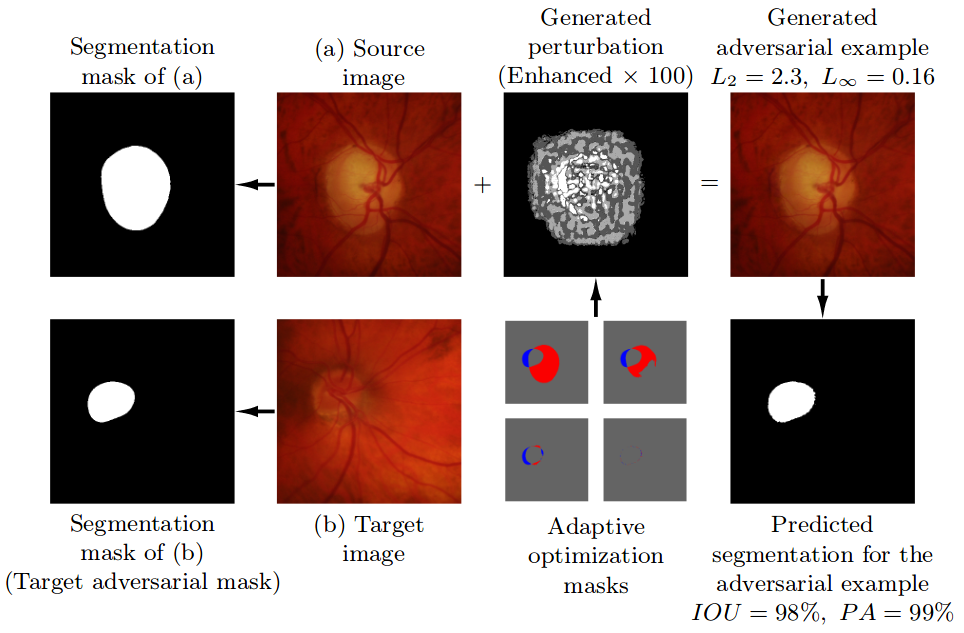
Pre-trained model, code, and materials from the paper "Impact of Adversarial Examples on Deep Learning Models for Biomedical Image Segmentation" (MICCAI 2019).

Adaptive Segmentation Mask Attack This repository contains the implementation of the Adaptive Segmentation Mask Attack (ASMA), a targeted adversarial

A PyTorch implementation of the paper Mixup: Beyond Empirical Risk Minimization in PyTorch

Mixup: Beyond Empirical Risk Minimization in PyTorch This is an unofficial PyTorch implementation of mixup: Beyond Empirical Risk Minimization. The co

Pythonic particle-based (super-droplet) warm-rain/aqueous-chemistry cloud microphysics package with box, parcel & 1D/2D prescribed-flow examples in Python, Julia and Matlab

PySDM PySDM is a package for simulating the dynamics of population of particles. It is intended to serve as a building block for simulation systems mo

Comments
  • About the comparative methods

    About the comparative methods

    Thank you for your insightful work! In Table3, I want to know that how to perform PGD or DIM on CUB with source models pretrained on ImageNet. Thank you~

    opened by lwmming 6
  • cursor already registered in Tk_GetCursor Aborted (core dumped)

    cursor already registered in Tk_GetCursor Aborted (core dumped)

    python train.py --model_type vgg16 --RN False --DA False

    I tried the above default training, but the error occurred at the end of the batch (epoch 1) training. Can you help debug this please?

    opened by hoonsyang 2
  • missing file

    missing file

    https://github.com/Alibaba-AAIG/Beyond-ImageNet-Attack/blob/7e8b1b8ec5728ebc01723f2c444bf2d5275ee7be/DCL_finegrained/LoadModel.py#L6 NameError: name 'pretrainedmodels' is not defined`

    opened by nkv1995 2
  • when computing cosine similarity

    when computing cosine similarity

    Hi! this is more of a question for the elegant work you have here but less of an issue.

    So when you take cosine similarity (which is to be decreased during training) between two feature maps, you take,

    loss = torch.cosine_similarity((adv_out_slice*attention).reshape(adv_out_slice.shape[0], -1), 
                                (img_out_slice*attention).reshape(img_out_slice.shape[0], -1)).mean()
    

    and that's to compare two flatten vectors, each of which is the flattened feature maps of size (N feature channels, width, height).

    I wonder why not comparing the flattened feature maps with respect to each channel, and then take the average across channels? To me, you're comparing two vectors that are (Nwidthheight)-dimensional, which is not so straightforward to me. Thanks in advance for any intuition behind!

    opened by juliuswang0728 1
Releases(pretrained_models)
Owner
Alibaba-AAIG
Alibaba Artificial Intelligence Governance Laboratory
Alibaba-AAIG
SurfEmb (CVPR 2022) - SurfEmb: Dense and Continuous Correspondence Distributions

SurfEmb SurfEmb: Dense and Continuous Correspondence Distributions for Object Pose Estimation with Learnt Surface Embeddings Rasmus Laurvig Haugard, A

Rasmus Haugaard 56 Nov 19, 2022
The Generic Manipulation Driver Package - Implements a ROS Interface over the robotics toolbox for Python

Armer Driver Armer aims to provide an interface layer between the hardware drivers of a robotic arm giving the user control in several ways: Joint vel

QUT Centre for Robotics (QCR) 13 Nov 26, 2022
Exploit Camera Raw Data for Video Super-Resolution via Hidden Markov Model Inference

RawVSR This repo contains the official codes for our paper: Exploit Camera Raw Data for Video Super-Resolution via Hidden Markov Model Inference Xiaoh

Xiaohong Liu 23 Oct 08, 2022
A hybrid SOTA solution of LiDAR panoptic segmentation with C++ implementations of point cloud clustering algorithms. ICCV21, Workshop on Traditional Computer Vision in the Age of Deep Learning

ICCVW21-TradiCV-Survey-of-LiDAR-Cluster Motivation In contrast to popular end-to-end deep learning LiDAR panoptic segmentation solutions, we propose a

YimingZhao 103 Nov 22, 2022
chen2020iros: Learning an Overlap-based Observation Model for 3D LiDAR Localization.

Overlap-based 3D LiDAR Monte Carlo Localization This repo contains the code for our IROS2020 paper: Learning an Overlap-based Observation Model for 3D

Photogrammetry & Robotics Bonn 219 Dec 15, 2022
PyTorch implementation of Neural Dual Contouring.

NDC PyTorch implementation of Neural Dual Contouring. Citation We are still writing the paper while adding more improvements and applications. If you

Zhiqin Chen 140 Dec 26, 2022
Cross-Image Region Mining with Region Prototypical Network for Weakly Supervised Segmentation

Cross-Image Region Mining with Region Prototypical Network for Weakly Supervised Segmentation The code of: Cross-Image Region Mining with Region Proto

LiuWeide 16 Nov 26, 2022
Flexible Networks for Learning Physical Dynamics of Deformable Objects (2021)

Flexible Networks for Learning Physical Dynamics of Deformable Objects (2021) By Jinhyung Park, Dohae Lee, In-Kwon Lee from Yonsei University (Seoul,

Jinhyung Park 0 Jan 09, 2022
A PaddlePaddle implementation of Time Interval Aware Self-Attentive Sequential Recommendation.

TiSASRec.paddle A PaddlePaddle implementation of Time Interval Aware Self-Attentive Sequential Recommendation. Introduction 论文:Time Interval Aware Sel

Paddorch 2 Nov 28, 2021
Align and Prompt: Video-and-Language Pre-training with Entity Prompts

ALPRO Align and Prompt: Video-and-Language Pre-training with Entity Prompts [Paper] Dongxu Li, Junnan Li, Hongdong Li, Juan Carlos Niebles, Steven C.H

Salesforce 127 Dec 21, 2022
PyTorch implementation of Rethinking Positional Encoding in Language Pre-training

TUPE PyTorch implementation of Rethinking Positional Encoding in Language Pre-training. Quickstart Clone this repository. git clone https://github.com

Jake Tae 5 Jan 27, 2022
This is an official implementation of CvT: Introducing Convolutions to Vision Transformers.

Introduction This is an official implementation of CvT: Introducing Convolutions to Vision Transformers. We present a new architecture, named Convolut

Microsoft 408 Dec 30, 2022
Character-Input - Create a program that asks the user to enter their name and their age

Character-Input Create a program that asks the user to enter their name and thei

PyLaboratory 0 Feb 06, 2022
Distributed DataLoader For Pytorch Based On Ray

Dpex——用户无感知分布式数据预处理组件 一、前言 随着GPU与CPU的算力差距越来越大以及模型训练时的预处理Pipeline变得越来越复杂,CPU部分的数据预处理已经逐渐成为了模型训练的瓶颈所在,这导致单机的GPU配置的提升并不能带来期望的线性加速。预处理性能瓶颈的本质在于每个GPU能够使用的C

Dalong 23 Nov 02, 2022
Over9000 optimizer

Optimizers and tests Every result is avg of 20 runs. Dataset LR Schedule Imagenette size 128, 5 epoch Imagewoof size 128, 5 epoch Adam - baseline OneC

Mikhail Grankin 405 Nov 27, 2022
Ray tracing of a Schwarzschild black hole written entirely in TensorFlow.

TensorGeodesic Ray tracing of a Schwarzschild black hole written entirely in TensorFlow. Dependencies: Python 3 TensorFlow 2.x numpy matplotlib About

5 Jan 15, 2022
A Python Package For System Identification Using NARMAX Models

SysIdentPy is a Python module for System Identification using NARMAX models built on top of numpy and is distributed under the 3-Clause BSD license. N

Wilson Rocha 175 Dec 25, 2022
这是一个yolox-keras的源码,可以用于训练自己的模型。

YOLOX:You Only Look Once目标检测模型在Keras当中的实现 目录 性能情况 Performance 实现的内容 Achievement 所需环境 Environment 小技巧的设置 TricksSet 文件下载 Download 训练步骤 How2train 预测步骤 Ho

Bubbliiiing 64 Nov 10, 2022
Simple-Image-Classification - Simple Image Classification Code (PyTorch)

Simple-Image-Classification Simple Image Classification Code (PyTorch) Yechan Kim This repository contains: Python3 / Pytorch code for multi-class ima

Yechan Kim 8 Oct 29, 2022
Unofficial PyTorch implementation of Neural Additive Models (NAM) by Agarwal, et al.

nam-pytorch Unofficial PyTorch implementation of Neural Additive Models (NAM) by Agarwal, et al. [abs, pdf] Installation You can access nam-pytorch vi

Rishabh Anand 11 Mar 14, 2022